







The best free employee survey tools in 2026 are FeedbackPulse (best overall for small teams, anonymous by default), Google Forms (best DIY option, unlimited responses), Typeform (best for completion rates), Jotform (best for response volume), and SurveyMonkey (best for polished HR templates). Each works without a credit card. The tradeoffs are in setup effort, response limits, and how much of the analysis you have to do yourself.
Running a small or medium business means constantly juggling priorities, and employee engagement is one of those things everyone knows matters but rarely gets the attention it deserves. You don't need a massive budget or enterprise software to start collecting honest feedback. You need the right approach and the right tool.
This guide breaks down the best free employee survey platforms in 2026: ones built for small teams, ones that support anonymous feedback, and ones that won't cost you a week of setup time. Free tools are only one slice of the market. For the full category, including paid platforms that add 360 feedback and performance reviews, see our guide to the best employee feedback tools.
Key Takeaways
- Best overall (small teams): FeedbackPulse, purpose-built, anonymous by default, with a free tier for teams up to 10 people.
- Best DIY (unlimited responses): Google Forms, free and flexible if you're willing to build templates and analysis yourself.
- Best for completion rates: Typeform, conversational one-question format, 10 free responses a month.
- Best for volume and design: Jotform, 100 free responses a month with strong integrations.
- The biggest quality lever isn't the tool. It's whether responses are truly anonymous.
Why Honest Feedback Changes Everything
Engaged employees show up differently. They do better work, stay longer, and contribute to a culture that feels good to be part of. Getting there requires something most companies struggle to build: genuine honesty from their teams.
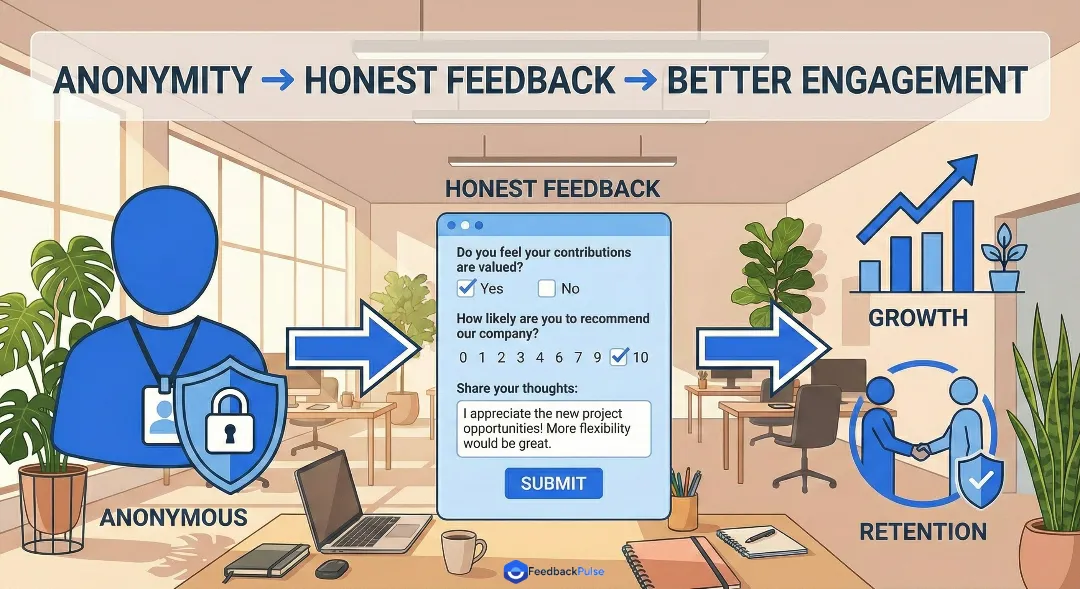
Anonymous surveys remove the biggest barrier to truthful feedback. When people know their responses can't be traced back to them, they're far more likely to say what's actually happening. Employees who think their identity might be revealed tend to give the answer they believe leadership wants to hear, softening honest criticism of their direct manager out of fear of reprisal.
Few people will tell a manager directly that their leadership style needs work. Anonymity removes that fear, so more people say what's actually true.
Done right, employee surveys help you:
- Catch problems early, before they become expensive turnover statistics
- Learn what's actually working, not just what leadership assumes is working
- Show your team you're listening, not just collecting data
Gallup's engagement data shows only 31% of U.S. employees are actively engaged at work, while 17% are actively disengaged, the highest disengagement level in nearly a decade. That gap shows up in productivity, retention, and the bottom line, not just morale scores.
The 2026 Landscape: What's Changed
Employee survey tools keep evolving fast. The clearest trend: platforms are leaning harder on AI and integrations that cut down repetitive analysis work. Instead of spending hours combing through spreadsheets, modern tools flag trends, summarize open-ended comments, and surface who might be at flight risk.
More platforms now support targeted questions by team and flexible 360 feedback options, so you can zero in on a specific pain point instead of drowning in generic results.
For small businesses, that means enterprise-level insight without enterprise-level cost or complexity.
Top Free Employee Survey Tools
Here's a look at the platforms worth considering. We focused on tools with a genuine free plan (not just a trial), support for anonymous responses, and setup simple enough that you won't need IT support.
1. FeedbackPulse: Purpose-Built for Employee Engagement
Unlike generic form builders, FeedbackPulse was designed specifically for HR teams and people leaders. That focus shows up everywhere, from the interface to the pre-built templates to how results are displayed.
What makes it work:
- Anonymous responses by default, no configuration required
- Ready-made survey templates for weekly pulse checks, onboarding feedback, leadership effectiveness, and eNPS
- Real-time dashboards that surface what matters instead of raw data dumps
- Built for teams of 2 to 200, with a genuinely free tier for small teams (not a bait-and-switch trial)
FeedbackPulse removes the guesswork. Instead of spending hours figuring out what questions to ask or how to interpret results, you get templates grounded in organizational psychology research. The platform guides you from distribution to action planning in one flow.
If you're tired of stitching together survey tools that weren't built for HR, this is the cleanest option.
2. Google Forms: Unlimited Responses, But DIY Everything
Google Forms is free forever and handles unlimited responses. If you're already living in Google Workspace, it's right there waiting.
The tradeoff: you're building everything from scratch. No employee-specific templates, no analytics beyond basic charts, and anonymous only if you remember to disable email collection. You'll write your own questions, interpret results manually, and decide what action to take with no guidance built in.
Works well for: Teams comfortable with a DIY approach who don't mind the extra setup work.
3. SurveyMonkey: Professional Templates, Tight Limits
SurveyMonkey's free plan gives you HR-specific templates and a polished interface, with pre-built questions for engagement, eNPS, and satisfaction surveys.
The catch: only 25 responses per survey on the free plan, with a maximum of 10 questions per survey. Detailed analytics and data exports sit behind paid plans.
Works well for: Small teams (under 25 people) who want professional templates without paying.
4. Jotform: More Volume, Good Flexibility
Jotform's free plan offers 100 responses per month and more design control than Google Forms, with customizable templates, a drag-and-drop builder, and decent integrations.
The templates aren't built specifically for employee engagement, so you'll adapt general survey formats to HR use cases yourself. But if you need volume and visual customization, Jotform delivers.
Works well for: Small teams wanting more responses than SurveyMonkey allows, with some design flexibility.
5. Typeform: Conversational Surveys People Actually Finish
Typeform takes a different approach. Instead of a wall of questions, it asks one question at a time. That conversational flow improves completion rates, especially on sensitive topics where you want people to feel comfortable answering honestly.
Typeform's free plan includes 10 responses per month and employee satisfaction templates. The interface is pleasant to use, which matters more than it sounds. When a survey feels less intimidating, people give more thoughtful answers.
Platforms built around a conversational, one-question format tend to see higher completion rates and richer open-ended responses than a traditional long-form survey.
Works well for: Teams struggling with completion rates who want something that feels less corporate.
What Actually Matters in a Survey Tool
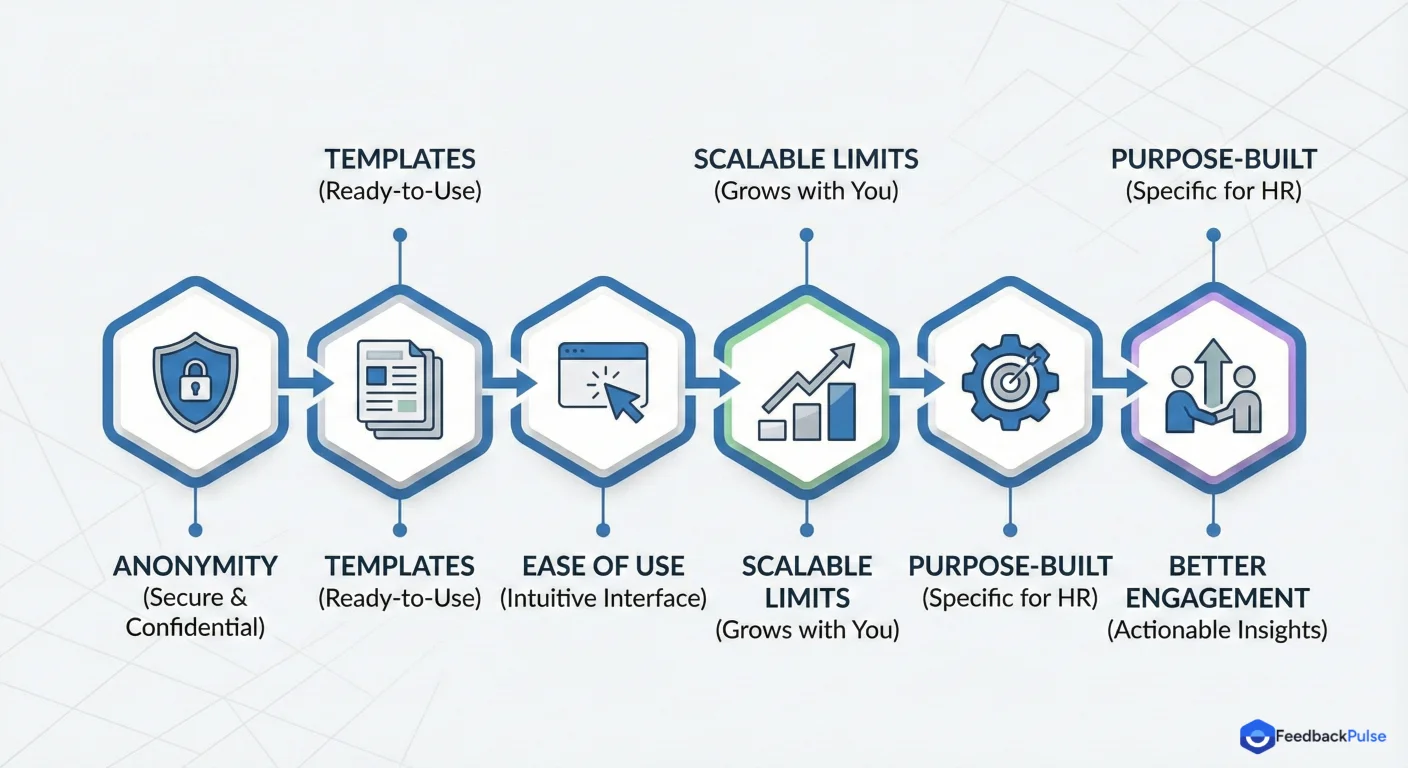
Before committing to any platform, weigh what will actually make or break your feedback program:
Anonymity: Non-negotiable for honest responses. Look for anonymous survey mode built in, not bolted on. The easier the tool makes it, the better your data quality.
Templates: Starting from proven questions saves setup time and helps you ask the right things the first time.
Ease of use: If setting up a survey takes more than 15 minutes, adoption will suffer.
Volume limits: Confirm the free plan actually supports your team size, or you'll hit the wall on your first send.
Purpose-built features: Generic form builders work. HR-focused tools understand engagement drivers, retention signals, and action planning in ways a generic builder never will.
Quick Comparison
| Tool | Anonymous Setup | Employee Templates | Response Limit | Best For |
|---|---|---|---|---|
| FeedbackPulse | Automatic | Yes (purpose-built) | Unlimited for small teams | Teams wanting a trustworthy employee engagement tool |
| Google Forms | Manual config | No | Unlimited | DIY teams comfortable building from scratch |
| SurveyMonkey | Manual config | Yes | 25 per survey | Small teams needing polished templates |
| Jotform | Manual config | Limited | 100/month | Teams wanting design flexibility with decent volume |
| Typeform | Manual config | Yes | 10/month | Teams focused on high completion rates |
Why FeedbackPulse Makes Sense
Generic form builders force you to become a survey designer, data analyst, and HR consultant all at once. SurveyMonkey looks professional, but those response limits will stop you cold the moment your team grows.
FeedbackPulse hits the sweet spot: purpose-built for employee feedback, free for small teams up to 10 people (not a time-boxed trial), with anonymous responses by design rather than an afterthought. The templates come from real HR research, not a generic questionnaire someone assembled overnight.
Whether you need weekly pulse checks, onboarding feedback, or eNPS measurement, the platform gives you what you need without piling on complexity you'll never use.
Getting Started
You don't need to piece together a feedback system from five different tools. Create your free account and launch your first survey in minutes.
Free for small teams. No credit card required. Built for employee feedback, not adapted from a generic form builder.
Your team already has insights that could change how your company operates. Give them a safe way to share them, then show them you're listening by acting on what you hear.
Companies that retain talent share one habit: leadership knows what's happening on the ground before it turns into a resignation letter. Budget for employee listening the same way you budget for retention, because that's what it protects.
Start small. Run one pulse check. See what your team tells you when they know their feedback is genuinely anonymous. What you learn might change your next planning cycle.