





You know the drill. Someone on the leadership team says "we should do an engagement survey" and suddenly you're comparing 47 platforms, sitting through demos that all blur together, and trying to figure out which one won't eat your entire HR budget.
We've been there. So we did the homework for you.
This is our honest breakdown of the best employee survey software in 2026 - what actually works, what's overpriced, and which tool fits your team. No affiliate rankings. No "top 50" listicles where every tool gets five stars. Just real talk.
TL;DR - Quick Picks by Category
| Category | Our Pick |
|---|---|
| Best overall for mid-market | Culture Amp |
| Best for SMBs & growing teams | FeedbackPulse |
| Best for performance + surveys combo | Lattice |
| Best for manager development | 15Five |
| Best for enterprise & deep analytics | Qualtrics XM |
| Best if you're already on Microsoft | Microsoft Viva Glint |
| Best for continuous listening at scale | Workday Peakon |
| Best all-in-one people platform | Leapsome |
| Best budget-friendly option | Workleap (Officevibe) |
| Best for survey power users | SurveyMonkey Enterprise |
###Pricing chart as of April 2026 for quick comparison
Keep reading for the full breakdown. 👇
Why Employee Surveys Still Matter in 2026
Let's get this out of the way quickly because you probably already know this: employee surveys aren't dead. They've evolved.
The "annual engagement survey" that takes 45 minutes and collects dust for six months? Yeah, that's dead. Good riddance.
What's replaced it is better: shorter pulse surveys, real-time sentiment tracking, AI-powered analysis that actually surfaces why people are disengaged - not just that they are.
Here's what the data says in 2026:
- Organizations with continuous listening programs see 24% lower turnover than those running annual-only surveys (Gallup, 2025)
- Only 33% of employees feel engaged at work - meaning two-thirds of your team might be quietly checking out
- Companies that act on survey results within 30 days see 2x the engagement lift compared to those that take longer
The point isn't the survey itself. It's the feedback loop: ask → listen → act → repeat. The right software makes that loop painless.
What to Look For in Employee Survey Software
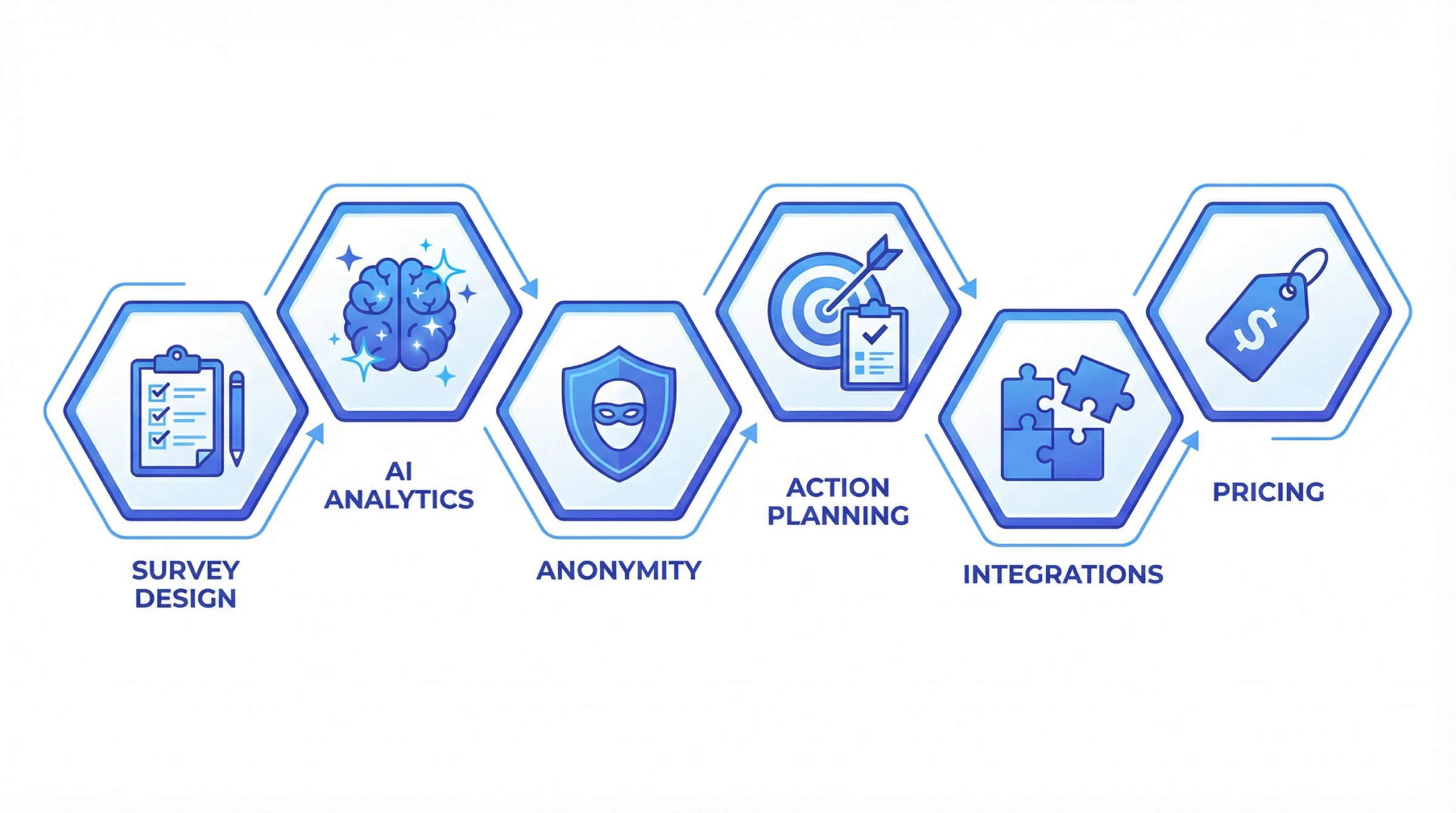
Before we get into specific tools, here's what actually matters when you're evaluating platforms:
Survey Design & Templates
Can you launch a pulse survey in 5 minutes? Or do you need a PhD in survey methodology? Look for pre-built, science-backed templates - engagement, eNPS, onboarding, exit interviews - plus the flexibility to customize.
AI & Analytics
This is the big shift in 2026. The best platforms now use AI to analyze open-ended responses, surface themes automatically, predict attrition risk, and suggest action plans. If your tool still makes you read 500 comment responses manually, it's time to upgrade.
Anonymity & Trust
If employees don't trust the survey is anonymous, you'll get polished non-answers. Look for strong anonymity guarantees, clear thresholds (e.g., minimum 5 responses before showing results), and transparent communication features.
Action Planning
The survey is 10% of the work. Acting on results is the other 90%. The best tools give managers nudges, suggested actions, and tracking - not just dashboards they'll never open.
Integrations
Your survey tool needs to play nice with your HRIS, Slack/Teams, and whatever else your HR stack includes. Bonus points for seamless SSO and automatic employee syncing.
Pricing That Makes Sense
Some platforms charge $11+/user/month and require annual contracts with $4,000 minimums. Others give you most features for $4-5/user. Know what you're paying for.
The 10 Best Employee Survey Software Platforms in 2026
1. Culture Amp - Best Overall for Mid-Market Teams
What it does well: Culture Amp is the gold standard for a reason. Their engagement surveys are built on genuine people science - developed with researchers from Berkeley, and it shows. The analytics are deep but accessible, the benchmarking data is extensive (drawing from 6,000+ companies), and their action planning tools actually help managers do something with the results.
In 2025-2026, they've leaned heavily into AI-powered comment analysis and predictive analytics, which surfaces attrition risk before it hits your desk.
Honest tradeoffs: It's not cheap. Pricing starts around $9-14/employee/month for the engagement module alone, and enterprise plans can run $8,000-15,000/year for a 50-100 person team. The platform can also feel overwhelming at first - there's a lot going on, and smaller teams may not need all of it. Setup and onboarding takes real effort.
Pricing: Custom, based on company size and modules. Expect ~$9-14/user/month for engagement surveys. Annual billing. We've put together a full breakdown of Culture Amp pricing including what teams actually pay at different sizes.
Works well for: Mid-market and enterprise teams (100-5,000 employees) who want research-backed surveys, deep analytics, and are willing to invest in a premium platform.
2. FeedbackPulse - Best for SMBs & Growing Teams
What it does well: FeedbackPulse is purpose-built for employee engagement - and nothing else. That focus is its strength. Where bigger platforms bolt surveys onto a massive HR suite, FeedbackPulse gives you clean, simple survey tools that your team will actually use.
You get pre-built templates for the surveys that matter (Weekly Pulse Check, eNPS, Onboarding Feedback, Leadership Effectiveness, Exit Interviews), anonymous responses by default, and real-time dashboards. Setup takes about 2 minutes, which isn't marketing speak - it's genuinely fast.
The free plan covers up to 10 employees with full survey functionality, and the Pro plan at $4-5/employee/month includes performance reviews, advanced analytics, and recognition features. No enterprise sales calls required.
Honest tradeoffs: FeedbackPulse is focused on surveys, recognition, and feedback - it's not a full HRIS or performance management suite like Lattice or Culture Amp. If you need compensation management, OKR tracking, and surveys all in one platform, you'll need to pair it with other tools.
Pricing: Free for up to 10 employees. Pro starts at $4/employee/month (billed yearly) or $5/month (billed monthly).
Works well for: Small to mid-sized teams (10-500 employees) who want a focused, affordable survey tool that's dead simple to set up. Especially good for teams that don't want to pay for features they'll never use.
3. Lattice - Best for Performance + Surveys Combined
What it does well: Lattice started as a performance management tool and has grown into a proper people platform. The engagement surveys integrate tightly with performance reviews, goals, and 1:1s - so you can actually connect survey sentiment to performance data. That's powerful if you're trying to understand how engagement drives results.
Their pulse survey builder is flexible, the eNPS tracking is solid, and the manager dashboards make it easy to act on team-level results. They've also added AI-powered insights that summarize themes from open-ended responses.
Honest tradeoffs: Pricing adds up fast. The base platform starts at $11/user/month, but surveys are an add-on module. If you want engagement + performance + compensation, you're looking at $15-20+/user/month. The minimum annual contract is $4,000. Smaller teams may find they're paying for a lot of features they're not ready to use.
Pricing: Starts at $11/user/month for the base platform. Engagement surveys are an add-on. Annual billing, $4,000 minimum.
Works well for: Mid-market companies (200-2,000 employees) that want surveys and performance management in a single platform and have the budget for it.
4. 15Five - Best for Manager Enablement
What it does well: 15Five has carved out a unique niche: they're not just an engagement tool, they're a manager effectiveness platform. Their engagement surveys (Engage module) are solid, but the real magic is how they connect survey insights to manager action - through weekly check-ins, 1:1 agendas, and micro-learning for managers.
Their HR Outcomes Dashboard ties engagement data to business outcomes, which makes the ROI conversation with leadership much easier.
Honest tradeoffs: Pricing is opaque - they've moved to a "book a demo" model with no public pricing, which usually means it's not cheap. Some users report the survey customization is more limited than dedicated survey tools. And if you just want surveys without the full performance management suite, you're paying for more than you need.
Pricing: Custom pricing only. Based on user reports, expect $6-14/user/month depending on modules. Annual billing.
Works well for: Companies (100-1,000 employees) that see manager effectiveness as a core engagement strategy and want surveys connected to coaching and development workflows.
5. Qualtrics Employee Experience - Best Enterprise Analytics
What it does well: Qualtrics is the heavyweight. Their Employee Experience (EX) platform is arguably the most powerful survey and analytics engine available. We're talking advanced statistical analysis, predictive modeling, text analytics powered by their XM AI, and benchmarking across industries.
In 2025-2026, they've doubled down on their AI capabilities - auto-generated action plans, real-time sentiment analysis, and conversational survey formats. If you need to survey 50,000 employees across 30 countries in 15 languages, Qualtrics handles it without breaking a sweat.
Honest tradeoffs: This is enterprise software with enterprise complexity and enterprise pricing. It's overwhelming for smaller teams - the interface has a steep learning curve, and you'll likely need a dedicated admin (or implementation partner) to get full value. Pricing isn't published and typically starts at five figures annually. Overkill for most SMBs.
Pricing: Custom enterprise pricing. Not published, but industry sources suggest $20-30+/user/year for the EX suite. Usually bundled with other Qualtrics products.
Works well for: Large enterprises (1,000+ employees) with dedicated people analytics teams who need advanced research-grade survey capabilities.
6. Microsoft Viva Glint - Best for Microsoft-Heavy Organizations
What it does well: If your company already lives in Microsoft 365, Viva Glint is the path of least resistance. Surveys live right inside Teams, results integrate with the broader Viva suite (Viva Insights, Viva Learning), and admin setup piggybacks on your existing Microsoft infrastructure.
Glint's people-science heritage (from before the Microsoft acquisition) means the survey methodology is solid. The AI-powered narrative intelligence summarizes open-ended responses effectively, and manager dashboards are clean and actionable.
Honest tradeoffs: It's tightly coupled to the Microsoft ecosystem - if you're a Google Workspace shop, look elsewhere. The platform has gone through significant changes during the Viva integration, and some long-time Glint users report feature gaps compared to the standalone product. Pricing can be confusing, as it's sometimes bundled with Viva suite licenses.
Pricing: Typically bundled with Microsoft Viva Suite ($12/user/month) or available as a standalone add-on. Contact Microsoft for specifics.
Works well for: Organizations (500+ employees) already invested in Microsoft 365/Teams that want employee surveys natively integrated into their existing workflow.
7. Workday Peakon Employee Voice - Best for Continuous Listening at Scale
What it does well: Peakon (now Workday Peakon Employee Voice) pioneered the "continuous listening" approach - short, frequent pulse surveys that build a real-time picture of engagement over time instead of relying on annual snapshots. The machine learning engine is sophisticated, automatically identifying engagement drivers and predicting attrition.
For Workday customers, the integration is seamless - survey data flows directly into Workday HCM, which is a huge plus for large organizations running Workday as their system of record.
Honest tradeoffs: If you're not a Workday customer, the value proposition weakens. Pricing is enterprise-only and not published - expect it to be significant. The platform is designed for scale, which means smaller organizations may find it overly complex. Some users report the survey question bank is less customizable than competitors.
Pricing: Custom enterprise pricing only. Contact Workday for quotes.
Works well for: Large enterprises (1,000+ employees), especially existing Workday customers who want continuous pulse data feeding directly into their HCM.
8. Leapsome - Best All-in-One People Platform
What it does well: Leapsome is a European-born platform that bundles surveys, performance reviews, OKRs, learning, and compensation into one cohesive system. Their engagement surveys include pulse checks, eNPS, and custom surveys with solid analytics.
The standout in 2025-2026 is their AI-powered Manager Assistant and Unified Inbox, which brings all feedback - from surveys, reviews, and 1:1s - into one view. The platform feels modern and well-designed, and they've built strong GDPR compliance from the ground up (which matters for European teams).
Honest tradeoffs: As an all-in-one platform, the survey module alone may not be as deep as dedicated survey tools like Qualtrics or Culture Amp. Pricing is modular, so costs can climb as you add features. Integration with non-standard HR tools can require extra technical work.
Pricing: Starts around $8/user/month for individual modules. Bundled pricing for multiple modules. Annual billing.
Works well for: European and global mid-market companies (50-2,000 employees) that want performance management, surveys, and learning on one platform.
9. Workleap (Officevibe) - Best Budget-Friendly Option
What it does well: Workleap (formerly Officevibe) has been a crowd favorite for years - and the free tier is part of why. Even on the paid plans, it's one of the most affordable dedicated engagement tools. Weekly automated pulse surveys run in the background, eNPS tracking is built in, and the anonymous feedback loop lets employees flag issues anytime.
The interface is clean and approachable. Managers actually use it (which is half the battle).
Honest tradeoffs: The analytics are solid but not as deep as Culture Amp or Qualtrics. Custom survey flexibility is more limited - you're mostly working with their pulse framework. Workleap has been expanding into other HR areas (onboarding, performance), which means the survey product sometimes takes a backseat to new priorities.
Pricing: Free plan available (limited features). Paid plans start at $5/user/month (billed annually) or $6.25/user/month (billed monthly). 10-user minimum.
Works well for: Small to mid-sized teams (25-500 employees) that want continuous pulse surveys on a budget and don't need enterprise-grade customization.
10. SurveyMonkey Enterprise - Best for Survey Power Users
What it does well: SurveyMonkey is the name everyone knows, and their Enterprise/team plans offer genuinely powerful survey building for HR teams. The question bank is massive, branching logic is sophisticated, and the analysis tools - including AI-powered sentiment analysis on paid plans - are mature.
For HR teams that want maximum control over survey design and question types, SurveyMonkey gives you more flexibility than most engagement-specific platforms. They also offer pre-built employee engagement templates validated by their research team.
Honest tradeoffs: SurveyMonkey wasn't built specifically for employee engagement - it's a general survey platform. That means you miss out on features like built-in action planning, manager nudges, and the engagement-specific analytics that dedicated tools provide. You're essentially building your own engagement program on top of a survey engine. The pricing gap between free and paid is also steep.
Pricing: Team Advantage starts at $25/user/month. Enterprise pricing is custom. Individual plans available but limited for organizational use.
Works well for: HR teams (any size) that want maximum survey customization and already have their own engagement framework - they just need a powerful survey engine.
Quick Comparison
| Tool | Starting Price | Best For | AI Features | Free Plan | Ease of Setup |
|---|---|---|---|---|---|
| Culture Amp | ~$9/user/mo | Mid-market, research-backed surveys | ✅ Advanced | ❌ | ⭐⭐⭐ |
| FeedbackPulse | $4/user/mo | SMBs, simple & focused | ✅ Basic | ✅ (10 users) | ⭐⭐⭐⭐⭐ |
| Lattice | $11/user/mo | Performance + engagement | ✅ Advanced | ❌ | ⭐⭐⭐ |
| 15Five | ~$6/user/mo | Manager effectiveness | ✅ Moderate | ❌ | ⭐⭐⭐⭐ |
| Qualtrics XM | Custom ($$$) | Enterprise analytics | ✅ Advanced | ❌ | ⭐⭐ |
| Viva Glint | ~$12/user/mo (Viva Suite) | Microsoft shops | ✅ Advanced | ❌ | ⭐⭐⭐ |
| Workday Peakon | Custom ($$$) | Continuous listening at scale | ✅ Advanced | ❌ | ⭐⭐ |
| Leapsome | ~$8/user/mo | All-in-one people platform | ✅ Advanced | ❌ | ⭐⭐⭐⭐ |
| Workleap | $5/user/mo | Budget-friendly pulse surveys | ✅ Basic | ✅ | ⭐⭐⭐⭐⭐ |
| SurveyMonkey | $25/user/mo | Survey customization pros | ✅ Moderate | ✅ (limited) | ⭐⭐⭐⭐ |
How to Choose the Right Employee Survey Tool
Still not sure? Here's a quick decision framework:
Start with your team size and budget
- Under 50 employees, tight budget? → FeedbackPulse or Workleap. Both offer free/affordable plans that don't compromise on core survey features.
- 50-500 employees, want surveys + performance? → Lattice, 15Five, or Leapsome. You'll pay more, but you get a unified platform.
- 500+ employees, need enterprise analytics? → Culture Amp, Qualtrics, or Workday Peakon. Invest in the analytics and benchmarking that justify the cost at scale.
Consider your existing tech stack
- Microsoft 365 shop? → Viva Glint is the obvious pairing.
- Workday customer? → Peakon integrates natively.
- Slack-first team? → Most tools integrate with Slack, but FeedbackPulse and Workleap make it particularly seamless.
Ask yourself: will managers actually use it?
The best survey software in the world is useless if managers don't look at the results. Prioritize tools with simple manager dashboards, action prompts, and mobile access. Pretty analytics reports that sit in an HR silo help nobody.
Don't overbuy
This is the most common mistake. You don't need a $15/user/month platform if you're a 40-person team running quarterly pulse surveys. Start simple, get the feedback loop working, and upgrade when you genuinely outgrow your tool.
Final Thoughts
The employee survey market in 2026 is mature, competitive, and honestly a bit overwhelming. Every vendor promises AI-powered insights and "actionable analytics." The difference is in the details: how quickly can you actually launch a survey? Will your managers engage with the results? Does the pricing make sense for a team your size?
Our advice: start with the problem, not the platform. If your team has never run an engagement survey, you don't need Qualtrics. If you're a 2,000-person company with complex analytics needs, a $4/user tool probably won't cut it.
Pick the tool that fits where you are today, with room to grow into where you'll be tomorrow.