










Employee Net Promoter Score (eNPS) is the simplest measure of how your employees really feel about working for you. One question. One number. One clear signal about the health of your workplace culture.
This guide covers everything you need to know about eNPS: from what it is and how to calculate it, to how to interpret your score and take action. Jump to the free eNPS calculator, or read the calculation and interpretation guidance first.
What Is eNPS?
eNPS is the employee-focused version of Net Promoter Score (NPS), a customer loyalty metric developed by Fred Reichheld and Bain & Company in the early 2000s. eNPS adapts that recommendation question to the workplace. Its score is a sentiment signal; the shared formula does not establish equally strong predictive power for employee retention. It is one of the core metrics in any employee engagement survey programme.
The eNPS question is:
"On a scale of 0 to 10, how likely are you to recommend [Company] as a place to work?"
Responses fall into three groups:
| Group | Score | What it signals |
|---|---|---|
| Promoters | 9 to 10 | Enthusiastic advocates. They love working here and say so. |
| Passives | 7 to 8 | Satisfied but not passionate. Vulnerable to poaching. |
| Detractors | 0 to 6 | Unhappy employees. At risk of leaving and potentially disparaging the company. |
The eNPS formula then calculates the net difference between your strongest advocates and your most disengaged employees.
eNPS vs Customer NPS
eNPS and NPS share the same question format and calculation method, but they measure fundamentally different things:
| eNPS | Customer NPS | |
|---|---|---|
| Who answers | Employees | Customers |
| What it measures | Workforce loyalty and engagement | Customer satisfaction and brand advocacy |
| Benchmark context | Use matched employee benchmark records | Use customer/sector benchmarks; not interchangeable |
| Survey frequency | Quarterly or monthly | After transactions or annually |
| Action owner | HR and leadership | Customer success and product |
High scores on both tend to correlate, and engaged employees deliver better customer experiences. But they are separate programmes with separate benchmarks; never compare your eNPS directly against a customer NPS figure.
Why Not Just Ask "Are You Happy?"
Happiness is fleeting and easy to fake in surveys. Willingness to recommend is a higher-stakes question: it reflects genuine belief. Promoter and detractor bands describe answers to the recommendation question. They do not establish what an individual employee will do next. eNPS forces employees to think about advocacy, not just momentary satisfaction.
How to Calculate eNPS
The eNPS formula is:
eNPS = % Promoters - % Detractors
Passives count in the total respondent denominator, but not in the promoter-minus-detractor numerator. Keep them in the total when calculating both percentages.
Worked Example
This calculation is illustrative, not customer data. Imagine 200 employees complete your eNPS survey:
- 100 score 9 or 10 → Promoters = 50%
- 60 score 7 or 8 → Passives = 30%
- 40 score 0 to 6 → Detractors = 20%
eNPS = 50% - 20% = 30
The illustrative score is +30; whether that is strong depends on your context and reference point. The 30% of Passives didn't affect the score directly, but they represent a significant improvement opportunity.
Have a previous cycle to compare? Use the free eNPS interpretation workbook (XLSX) to calculate both scores and participation rates from aggregate counts, see how one answer can move the score, and record a next step. The eNPS workbook guide explains how to use it.
What Is a Good eNPS Score?
An eNPS above zero means promoters outnumber detractors. Labels such as good, excellent or world class are editorial guidance, not universal statistical cutoffs. Read the score alongside participation, comments, the closest benchmark and your own trend.
The January 2026 eNPS Tools compilation contains 554 published benchmark records. Its published global aggregate reports a median of +17 with n=5,000 organizations. This is one source-reported aggregate; it is not a pooled calculation across the 554 records or a count of FeedbackPulse survey responses. Country and industry records have different source cohorts and may overlap.
For the full picture, see our 2026 eNPS benchmarks by industry and region, or the versioned benchmark set at enpstools.com.
eNPS Limitations to Know
eNPS is powerful precisely because it is simple, but that simplicity comes with trade-offs worth understanding before you act on a score.
One number can hide segment problems. A company-wide eNPS of +35 can mask a department sitting at -15 and another at +60. Use team, tenure or role cuts only when disclosure controls and sample size allow them. The aggregate score is informative; segment-level data is where you can actually act.
Participation affects interpretation. A low response rate can hide views of nonrespondents, but the direction of that bias is not known from the rate alone. Report invitations, responses and participation, then investigate missing groups before interpreting movement.
Culture influences scoring differently across groups. In some organisations, cultural norms or hierarchical dynamics lead employees to avoid low scores regardless of actual sentiment. In high-mobility markets, even satisfied employees may score lower because they consider leaving normal. Context matters, so track your own trend over time rather than fixating on any single data point.
eNPS captures loyalty, not causes. A drop in score tells you something is wrong; it does not tell you what. Pair eNPS with at least one open-text follow-up question per respondent group, and complement it with a more diagnostic employee engagement survey annually.
Trust drives honesty. If employees suspect their responses can be traced back to them, even on platforms claiming anonymity, they will inflate scores. Select anonymous mode and verify access and small-group controls in your survey tool. Comments and context may identify someone even after names are removed.
Turn the score into a recorded action
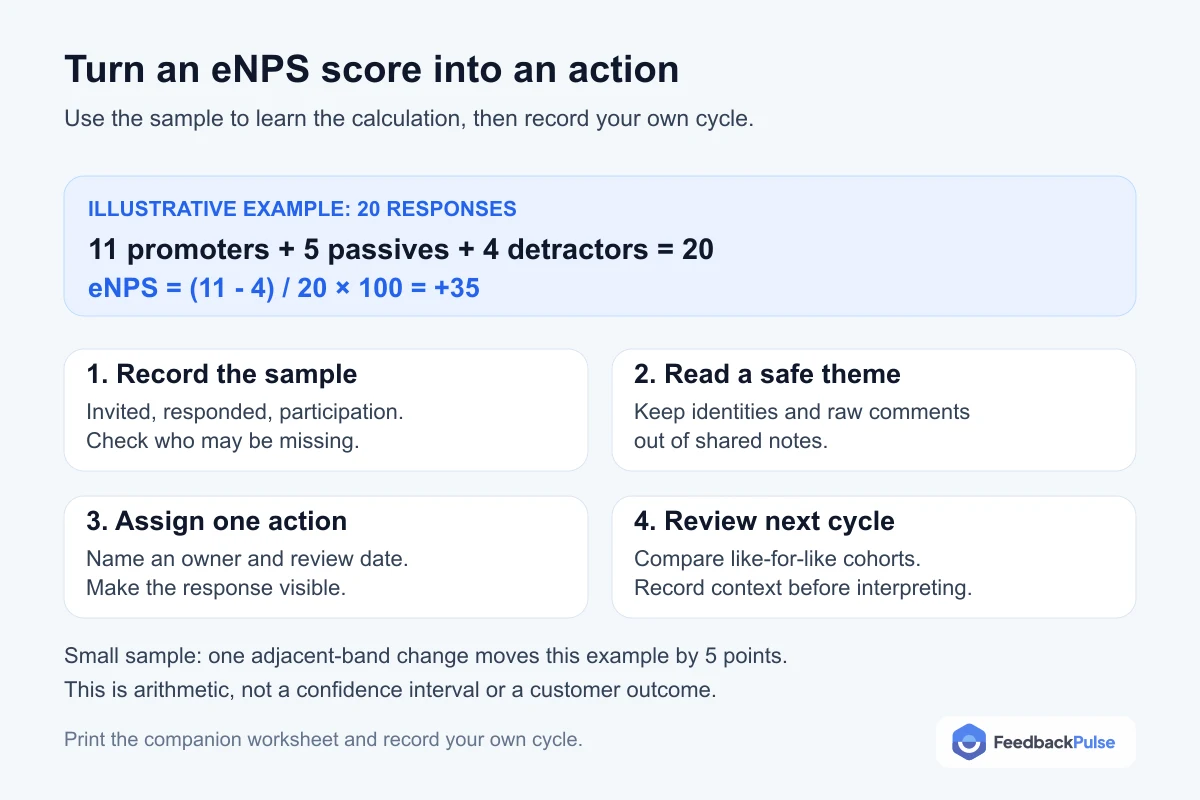
In this illustrative sample, 11 promoters, 5 passives and 4 detractors make 20 responses. The score is (11 - 4) / 20 × 100 = +35. Moving one response between adjacent bands changes this small-cohort score by 5 points; from detractor to promoter changes it by 10. That is arithmetic, not a confidence interval or a customer outcome.
Open the printable eNPS-to-action worksheet. Record invitations, responses, participation, a safe theme summary, one action owner and a review date. Keep comments and identifying details out of the shared worksheet.
Free Interactive eNPS Calculator
Use the calculator below to enter your survey results and instantly get your eNPS score with a colour-coded interpretation and improvement tips.