




TinyPulse isn't dead. But the simple, "tiny" pulse-survey tool you remember is now a product inside a large corporate well-being suite, and that changes the decision for most SMB buyers. If you're searching for TinyPulse alternatives in 2026, you're probably reacting to one of two things: ownership churn after two acquisitions, or pricing that no longer fits a growing team.
Here's the short version. TinyPulse was acquired by Limeade in 2021, rebranded Limeade Listening, then absorbed by WebMD Health Services in 2023 and renamed again. The engagement tool still works. It just answers to a much bigger owner now.
This guide is for people leaders at growing companies (roughly 20 to 200 employees) who want lightweight continuous feedback without enterprise overhead. Some teams still search for Limeade Listening alternatives, not realizing it's the same product under a third name. We'll cover what actually happened to TinyPulse, why teams are switching, and the six best alternatives to TinyPulse ranked by fit, not by who pays the most for a directory listing.
Guided product shortlist
Find your best-fit shortlist
Answer four quick questions to narrow the products covered in this article.
FeedbackPulse publishes this comparison. This shortlist considers a selection of the products covered in this article.
Your shortlist
Best-supported fits for your answers
These products have verified support for your selected survey goal and requirements.
The leading products have equal documented fit for these answers; they are ordered by name.
Consider:
Free for up to 10 employees. No credit card required.
No confirmed match
We could not confirm a product that meets your survey goal and every selected requirement.
Some capabilities may be unsupported or unverified. Investigate the linked guides without treating them as recommendations.
- :
TinyPulse alternatives at a glance
Use this table to shortlist fast. The current pricing rows below were checked against each vendor's public page on September 9, 2026. Verify the complete quote, contract term, and included modules before you buy.
| Tool | Best for | Pricing model | Standout strength |
|---|---|---|---|
| FeedbackPulse | SMBs wanting simple continuous feedback | Free plan, transparent per-user Pro | Pulse, eNPS, and reviews in one light tool |
| 15Five | Manager enablement plus performance | $4 to $16 per user/month, billed annually | Weekly check-ins and 1:1 workflows |
| Culture Amp | People-science depth at scale | Request a quote | Benchmarks and people analytics |
| Lattice | Performance plus engagement for mid-market | Foundations from $13/seat/month; Enterprise custom | Unified performance and goals |
| Leapsome | Development-focused all-in-one | Customized quote | Learning plus performance plus engagement |
| Workleap Officevibe | Broader engagement and talent platform | Annual plans from $4,999 | Surveys, feedback, recognition, and optional performance |
Running a lean team? See why FeedbackPulse is built for small teams, then run your first pulse this week.
What happened to TinyPulse?
TinyPulse started as a lightweight, anonymous pulse-survey tool. Frequent check-ins, one simple score, easy for a small team to run. That focus was the whole brand. Then the ownership changed twice in three years.
- 2021: Limeade acquired TinyPulse and folded it into its platform, rebranding the product Limeade Listening.
- August 2023: WebMD Health Services completed its acquisition of Limeade for about $75 million.
- July 2024: The Limeade Listening brand was retired, and the product was renamed TINYpulse by WebMD Health Services.
So the brand you knew came back in name. The context did not. The tool now sits inside a large health and well-being company, alongside wellness programs and benefits products, rather than standing on its own as a focused feedback startup.
That's not automatically bad. Big owners bring stability and resources. But for a 60-person team that wanted a simple monthly pulse, "now part of WebMD's well-being portfolio" is a different buying decision than "the tiny tool built for teams like mine."
Why teams look for a TinyPulse alternative
Switching tools is a hassle, so people don't do it casually. When teams evaluate TinyPulse competitors in 2026, the same reasons come up.
Ownership churn and category drift
Two acquisitions in three years create real questions. Where does the roadmap go now? Who owns support? Does a focused feedback product still get priority inside a broad well-being suite? You can't answer those from the outside, and uncertainty alone pushes careful buyers to look around.
Pricing that is easy to compare
Historical TinyPulse price lists and directory estimates are not a current quote. Before you switch, ask each finalist for its annual minimum, seat basis, modules, implementation fees, renewal terms, and the exact plan that includes anonymous feedback. That gives you a comparison you can defend internally.
"Is it still simple, and still anonymous?"
People still search "is TinyPulse really anonymous" and "how much does TinyPulse cost." Those questions tell you what buyers care about: trust and clarity. Anonymity was central to TinyPulse's original pitch. If you depend on confidential feedback to get honest answers, you want that promise to be unmistakable, not buried in a larger platform's settings. Any tool you pick should make anonymous employee surveys obvious and default-friendly.
The 6 best TinyPulse alternatives in 2026
We ranked these by fit for growing teams, then by breadth and value. Each entry includes who it's best for and an honest tradeoff, because no single tool wins for everyone.
1. FeedbackPulse, best for SMBs that want simple continuous feedback
FeedbackPulse is the closest match to what TinyPulse originally promised: lightweight, frequent feedback that a lean team can actually run. You get employee engagement surveys, eNPS, and lightweight performance reviews in one place, without enterprise setup or a sales call to see pricing.
The design goal is action, not dashboards. Run a monthly pulse, spot sentiment shifts by team, and assign one clear follow-up per manager. That's the rhythm that keeps participation high, because employees see something change after they speak up.
- Best fit for: Teams of 20 to 200 that want continuous feedback plus eNPS without enterprise overhead. Strong choice if you're leaving TinyPulse and want the original simplicity back.
- Pricing: Free forever for up to 10 employees, then transparent per-user Pro pricing. You can see plans and start without talking to sales.
- Honest tradeoff: FeedbackPulse doesn't have the enterprise procurement infrastructure, dedicated security-review cycles and custom SLAs that a people-science platform like Culture Amp provides. If your organization needs a multi-week vendor security audit before any pilot can start, weigh that.
Ready to test the difference? Start a free trial and see your first sentiment baseline in days, not weeks.
2. 15Five, best for manager enablement plus performance
15Five built its name on the weekly check-in, where employees answer a few questions in 15 minutes and managers read them in five. It pairs that with 1:1 tools, goal tracking, and reviews, so it leans more toward manager workflows than pure pulse measurement.
- Best fit for: Teams that want to build a strong manager habit around weekly check-ins and continuous performance, not just engagement scores.
- Pricing: 15Five's public pricing currently lists Engage at $4, Perform at $11, and Total Platform at $16 per user/month, billed annually.
- Honest tradeoff: The check-in model needs manager buy-in to work. If your managers won't read responses every week, you'll pay for features you don't use.
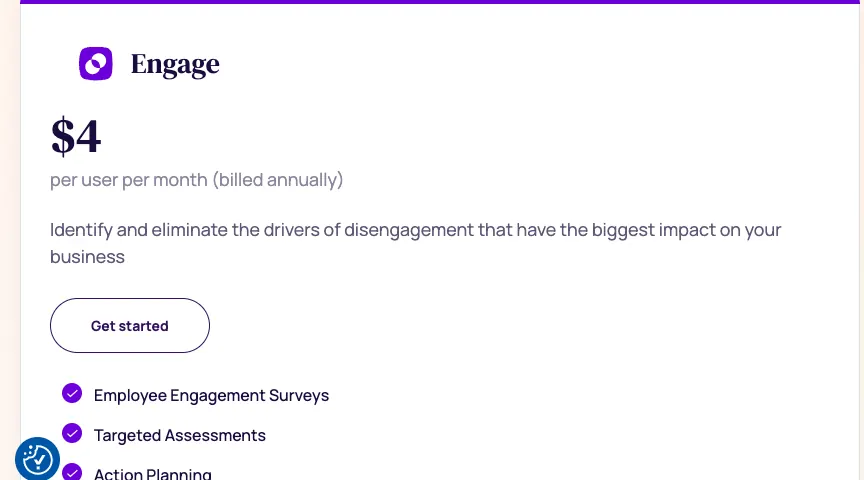
15Five's public pricing page captured September 9, 2026. Pricing can change.
3. Culture Amp, best for people-science depth at scale
Culture Amp is the heavyweight for engagement analytics and benchmarking. It's built for mid-market and enterprise people teams that want research-grade survey design and the ability to compare results against a large dataset of other companies.
- Best fit for: Larger or fast-scaling organizations with a dedicated people-ops function and budget for depth.
- Pricing: Culture Amp's public pricing page asks buyers to request a quote for Engage and Perform.
- Honest tradeoff: For most teams under 200 people, Culture Amp is more platform than they need. If you want the full picture on cost and fit, see our Culture Amp pricing guide and Culture Amp alternatives.
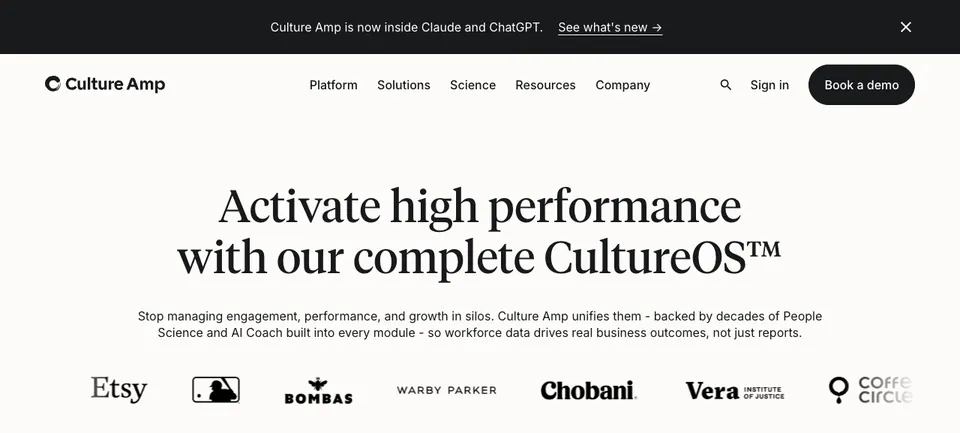
Culture Amp's public pricing page captured September 9, 2026. Pricing can change.
4. Lattice, best for performance plus engagement in mid-market
Lattice combines performance reviews, goals, and engagement surveys in one platform. It's a solid pick for growing companies that are formalizing performance management and want engagement data alongside it.
- Best fit for: Mid-market teams building a structured performance program who also want engagement signals.
- Pricing: Lattice's public pricing page shows Foundations from $13 per seat/month, with Enterprise sold as a custom package.
- Honest tradeoff: Lattice can be more than a small team needs, and costs climb as you add modules. Compare options in our Lattice alternatives breakdown.
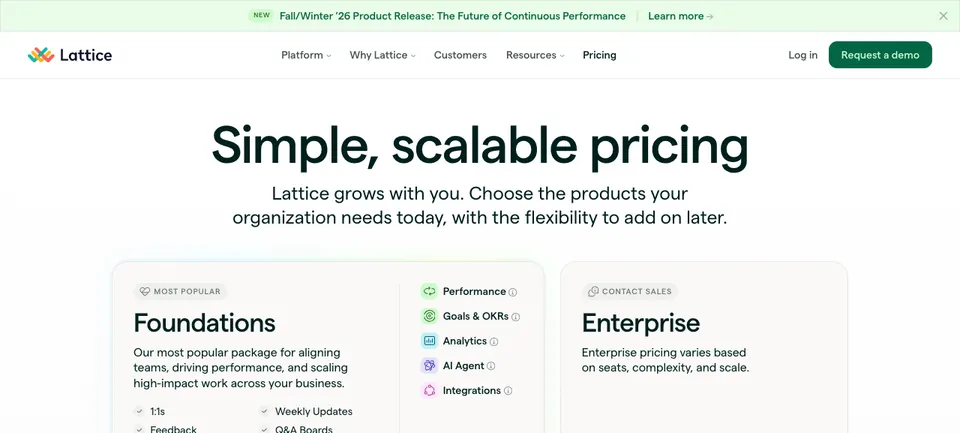
Lattice's public pricing page captured September 9, 2026. Pricing can change.
5. Leapsome, best for development-focused all-in-one
Leapsome bundles performance, engagement, learning, and goals. The learning module sets it apart, so it suits teams that treat development as a core part of their feedback program.
- Best fit for: Teams that want learning and development woven into engagement and reviews.
- Pricing: Leapsome's public pricing page presents modular products and directs buyers to request a customized quote.
- Honest tradeoff: The breadth adds setup and configuration. If you only need a pulse, it's overkill. See Leapsome alternatives for lighter options.
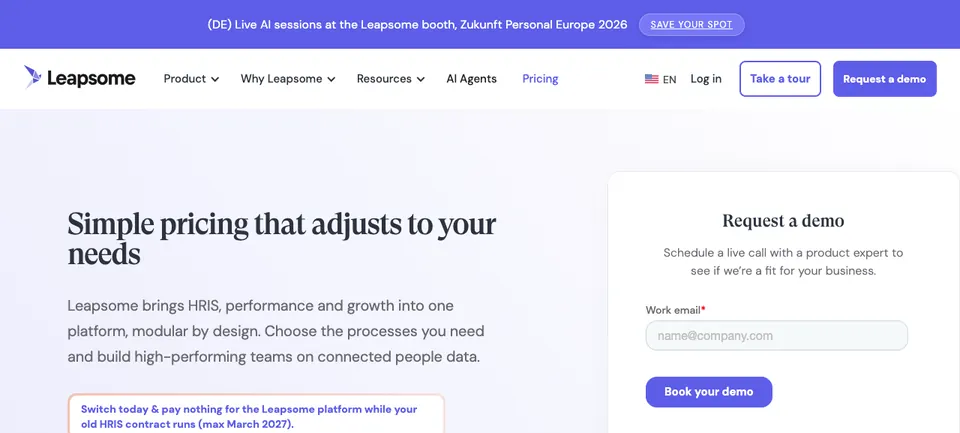
Leapsome's public pricing page captured September 9, 2026. Pricing can change.
6. Workleap Officevibe, best for a familiar feedback workflow
Officevibe now sits inside Workleap's broader talent platform. Its engagement page highlights custom surveys, anonymous feedback, recognition, and an optional performance-management layer. That makes it a credible option for teams that want to keep a familiar feedback workflow while considering more than pulse surveys.
- Best fit for: Teams that want engagement, recognition, and optional performance management from the same vendor.
- Pricing: Workleap's public pricing currently starts annual Standard plans at $4,999 and Pro at $11,999; Enterprise is custom.
- Honest tradeoff: The current packaging is broader than Officevibe's older pulse-only identity, which may add cost and buying complexity for a team that only needs a lightweight monthly survey. Our Officevibe and Workleap alternatives guide covers the migration details.
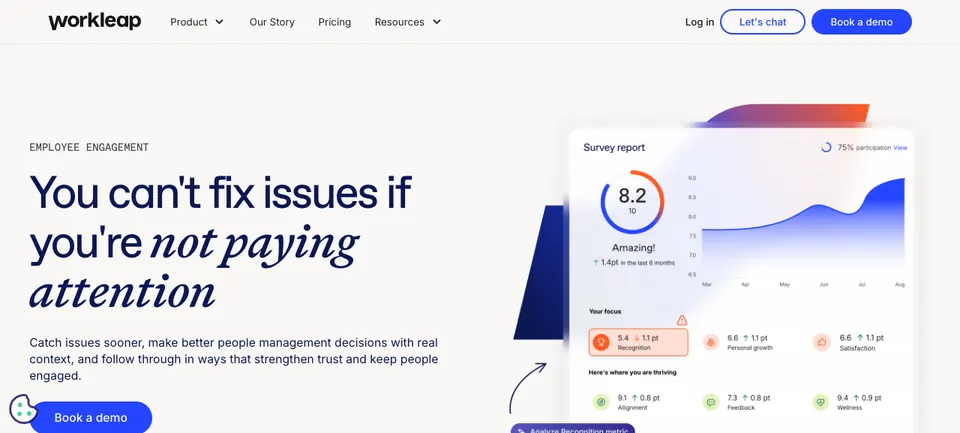
Workleap's public employee-engagement page captured September 9, 2026. Product packaging can change.
How to choose the right TinyPulse alternative
Don't start with features. Start with fit. The best TinyPulse alternatives for your team depend on your size, your appetite for process, and how much you value transparent pricing.
- Match the tool to your size. Under 200 people with a lean HR function? Prefer a tool whose price, setup work, and reporting depth match the program you can actually run. Larger teams with a dedicated people function may value the depth in Culture Amp or Lattice.
- Decide how much process you want. If you only need a pulse and eNPS, don't buy a full performance suite. If you're formalizing reviews, pick a tool that does both well so you avoid tool sprawl.
- Compare the complete cost. Published entry prices are useful, but annual minimums, modules, implementation, and renewal terms decide the real budget.
- Protect anonymity and follow-through. Confirm that anonymous mode is clear, and that the tool helps managers act, not just collect responses. Feedback only matters if it changes something.
How to switch off TinyPulse
Migrating is less painful than it looks if you sequence it. Here's a simple plan.
- Export your historical data. Pull past survey results, eNPS scores, and comments from TinyPulse before your contract lapses, so you keep your trendline.
- Define your core program. Write down your cadence (for example, monthly pulse plus quarterly eNPS), your must-have questions, and who owns follow-up.
- Run a parallel pulse. Launch one survey in your new tool while TinyPulse is still active. Compare participation and ease of setup with a real cycle, not a demo.
- Move managers first. Get team leads into the new dashboard early so insights turn into action from day one.
- Close the loop publicly. Tell employees what's changing and why. Then show one visible action from the first new survey. That single step rebuilds trust faster than any feature.
If you're weighing the broader market while you switch, our guides to the best employee engagement software and best free employee survey tools give you a wider shortlist.
Frequently asked questions
What happened to TinyPulse?
TinyPulse was acquired by Limeade in 2021 and rebranded Limeade Listening. WebMD Health Services then acquired Limeade in 2023, and in July 2024 the product was renamed TINYpulse by WebMD Health Services. It's still active, but now sits inside a large well-being company rather than operating as an independent startup.
Is TinyPulse still anonymous?
TinyPulse historically offered anonymous feedback, and that capability still exists in the platform. If anonymity is essential to your program, confirm the current settings directly, and pick any alternative that makes anonymous mode clear and easy to enable.
How much does TinyPulse cost?
Historical directory prices are not a reliable current quote. If TinyPulse is still on your shortlist, ask for a written price that states the annual minimum, seat basis, included modules, implementation costs, and renewal terms.
What is the best TinyPulse alternative for small teams?
For most teams under 200 people, FeedbackPulse is the closest fit to TinyPulse's original simplicity, with a free plan, transparent pricing, and pulse, eNPS, and lightweight reviews in one tool. Workleap Officevibe is another option if its broader packaging fits your program and budget.
Is there a free TinyPulse alternative?
Yes. FeedbackPulse is free forever for up to 10 employees. Workleap's current public pricing begins with annual platform plans rather than an Officevibe free tier, so verify the plan that fits before you shortlist it.
The bottom line
TinyPulse hasn't disappeared, but it has changed owners twice and now lives inside WebMD's well-being suite. For a growing team, that means a different buying decision than the focused pulse tool many people remember. None of that is a crisis. It is a reason to check whether the product, price, and support model still fit.
If you want the original promise back, lightweight continuous feedback, eNPS, and clear manager action without enterprise cost, FeedbackPulse is the closest match. If you need deep benchmarking or a full performance suite, Culture Amp, Lattice, or Leapsome may fit better. Score your real needs on one page, trial two tools in parallel, and pick the one that makes the next action obvious.
Start where it's easiest. Create your free account, run a pulse this week, and see your first sentiment baseline before your next team meeting.
Frequently asked questions
What happened to TinyPulse?
TinyPulse was acquired by Limeade in 2021 and rebranded Limeade Listening. WebMD Health Services then acquired Limeade in 2023, and in July 2024 the product was renamed TINYpulse by WebMD Health Services. It is still active, but now sits inside a large well-being company.
Is TinyPulse still anonymous?
TinyPulse historically offered anonymous feedback, and that capability still exists in the platform. If anonymity is essential, confirm the current settings directly and pick an alternative that makes anonymous mode clear and easy to enable.
How much does TinyPulse cost?
Third-party listings cite roughly 5 to 8 dollars per user per month, with enterprise pricing quote-based. As of mid-2026 the pricing page is largely sales-led, so you may need to contact sales. Treat published figures as estimates and verify before budgeting.
What is the best TinyPulse alternative for small teams?
For most teams under 200 people, FeedbackPulse is the closest fit to TinyPulse's original simplicity, with a free plan, transparent pricing, and pulse, eNPS, and lightweight reviews in one tool. Officevibe is another familiar lightweight option.
Is there a free TinyPulse alternative?
Yes. FeedbackPulse is free forever for up to 10 employees. Workleap's current public pricing begins with annual platform plans rather than an Officevibe free tier, so verify the plan that fits before you shortlist it.