










Most negative feedback fails, not because the message is wrong, but because the delivery makes people defensive instead of motivated. A Zenger and Folkman study found that 92% of employees say well-delivered negative feedback improves performance. The problem is that "well-delivered" part.
A Harvard Business Review study found that 72% of employees believe their performance would improve if their managers provided more corrective feedback. The demand is there. The supply is broken.
This guide takes a different approach. Instead of listing phrases in isolation, every constructive negative feedback example below shows the destructive version next to the constructive version, so you can see exactly what to avoid and what to say instead. Each pair targets a specific, common workplace scenario, including remote and async teams.
Quick reference
The core rule: describe behavior, not character
- 1.Describe the action, not the person ("The report was late" vs. "You're lazy")
- 2.Use specifics, not absolutes ("In the last two sprints" vs. "You always")
- 3.State impact, not motive ("This created a bottleneck" vs. "You don't care")
- 4.End with a question, not blame ("How can we prevent it?" vs. "This is your fault")
Jump to: Deadlines · Communication · Quality · Teamwork · Attitude · Reviews · Remote · Upward · Peers
The core principle: behavior, not character
Every constructive negative feedback example in this guide follows one rule: describe the behavior and its impact, not the person's character. The moment feedback sounds like a judgment of who someone is rather than what they did, the conversation is lost.
| Destructive Pattern | Constructive Pattern |
|---|---|
| Labels the person ("You're lazy") | Describes the action ("The report was submitted three days late") |
| Uses absolutes ("You always / never") | Uses specifics ("In the last two sprints...") |
| Assigns motive ("You don't care") | States impact ("This created a bottleneck for the team") |
| Ends with blame | Ends with a question or collaborative next step |
This isn't just a communication preference, it's how the brain works. Research on feedback receptivity shows that identity-level criticism ("you're irresponsible") triggers a threat response in the amygdala. Behavior-level feedback ("the report was late") keeps the prefrontal cortex engaged, which is where problem-solving happens.
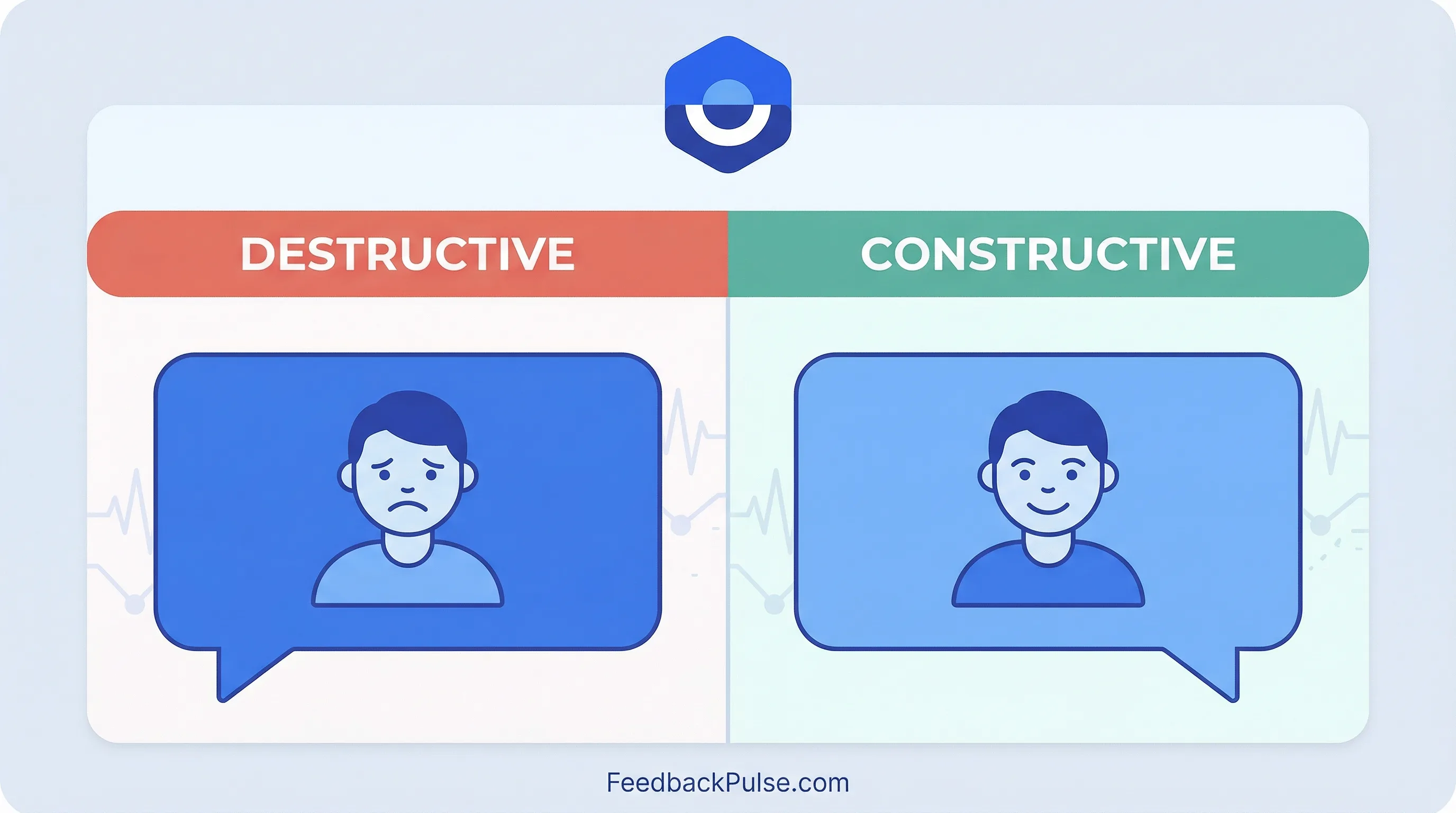
35 before-and-after feedback phrases
The following constructive negative feedback examples are organized by scenario. Each "Don't Say" phrase represents a common pattern that triggers defensiveness. Each "Say Instead" phrase models specific, behavior-focused feedback that opens a productive conversation.
Missed deadlines and time management
| Don't Say | Say Instead |
|---|---|
| "You're always late with your work." | "The client report was due Thursday and came in Monday. That pushed the review back a full week. What happened, and how can we prevent it?" |
| "You can't manage your time." | "The last three sprint tasks were completed after the deadline. I'd like to understand what's causing the delays so we can adjust the workload or timeline." |
| "You clearly don't prioritize this project." | "The status update was due by noon and arrived at end of day. When it's late, the rest of the team can't plan their afternoon. Can we set a reminder or move the deadline to something more realistic?" |
| "You're a procrastinator." | "The intake form wasn't submitted until the morning of the client call, even though it was due 48 hours prior. That made preparation harder for everyone. Can we set an earlier internal deadline going forward?" |
Poor communication
| Don't Say | Say Instead |
|---|---|
| "Nobody knows what you're talking about in meetings." | "In yesterday's standup, the project update didn't match what was in the tracker. Can we sync those before the meeting?" |
| "You're terrible at emails." | "The email to the client had inaccuracies about our timeline. Let's add a quick review step before external communications go out." |
| "You never respond to messages." | "I sent a question about the deadline change last Tuesday and didn't hear back until Friday. For time-sensitive items, is there a better channel to reach you?" |
Work quality and attention to detail
| Don't Say | Say Instead |
|---|---|
| "This work is sloppy." | "The last two reports had calculation errors in the revenue section. I'd like to set up a peer review step before these go to clients." |
| "You don't pay attention to detail." | "The design mockups didn't include the accessibility requirements we discussed. Can we add those to the deliverable checklist?" |
| "You keep making the same mistakes." | "The code review feedback from the last sprint wasn't incorporated into this release. What blocked that, and how can I help clear it?" |
| "This isn't what I asked for." | "The deliverable covers points 1 and 3 from the brief but missed the competitive analysis in point 2. Can we agree on a timeline to complete that section?" |
Teamwork and collaboration
| Don't Say | Say Instead |
|---|---|
| "You're not a team player." | "Several tasks that required your input sat in the queue for over a week, creating a bottleneck. How can we make handoffs smoother?" |
| "You always take over meetings." | "I've noticed decisions are getting made before the rest of the group weighs in. Pausing for input before committing would strengthen our outcomes." |
| "Nobody wants to work with you." | "Two team members mentioned they weren't included in key decisions on the project. Even when moving fast, looping in stakeholders early prevents rework." |
| "You're a bottleneck on this team." | "The handoff from your stage to the design team has been delayed in three of the last four sprints. Let's look at what's creating friction in that transition." |
| "You're holding the team back." | "The shared documentation hasn't been updated in three weeks, and two people had to redo work because of it. Can we make updates part of your close-out checklist?" |
Attitude and professionalism
| Don't Say | Say Instead |
|---|---|
| "You have a bad attitude." | "The comments about the marketing team's timeline in the last meeting came across as dismissive. Even when the frustration is valid, the tone affects collaboration." |
| "You're too negative." | "I've noticed a pattern of pushing back on new ideas in planning sessions. I want to understand what's behind that, is something about the process not working for you?" |
| "You're unprofessional." | "Responding to Slack messages with one-word answers when people are asking detailed questions creates friction. A bit more context in responses would go a long way." |
Negative feedback examples for performance reviews
Performance reviews carry higher stakes than day-to-day feedback. The examples above work in reviews, but the review context demands additional patterns, particularly around goal-setting, growth trajectory, and documented expectations. If you're also looking for the employee side of reviews, see our 100 self-appraisal comments by industry.
| Don't Say | Say Instead |
|---|---|
| "Your performance this quarter was disappointing." | "You hit 3 of your 5 quarterly targets. Let's look at what worked on the ones you hit, and what got in the way of the other two." |
| "You haven't grown this year." | "Comparing your goals from January to where we are now, the technical skills have progressed well but the stakeholder communication piece hasn't moved as much as we planned. What support would help there?" |
| "You're not meeting expectations." | "The expectation for this role is handling 4 client accounts independently. You're currently managing 2 with support. Let's build a plan to close that gap over the next quarter." |
| "Your attitude needs to change." | "There have been three instances this quarter where team members raised concerns about how feedback was received in group settings. I want to work with you on this because it's affecting how the team collaborates." |
| "You need to be more of a leader." | "In the last project, the junior team members came to me with questions that ideally would have gone to you first. I'd like to see you take more ownership of mentoring in the next cycle, let's define what that looks like." |
| "You're not promotable at this rate." | "The skills you'd need for the next level are stakeholder management and cross-functional coordination. Those haven't shown up much this cycle. Let's define what growth looks like in those areas before our next review." |
How to write negative feedback in a performance review document
When feedback is written, not just spoken, the stakes are even higher. Written feedback becomes part of a permanent record. Three rules:
Be specific enough to be actionable. "Needs improvement in communication" is useless in writing. "Missed 3 deadlines for client-facing deliverables in Q3, each requiring escalation" gives the employee something concrete to address.
Separate observation from interpretation. State what happened. Then state the impact. Let the employee provide their own context before you assign cause.
Include a forward-looking plan. Every written criticism should pair with a development action. "Going forward, we'll set up weekly check-ins on active deliverables to catch timeline risks early" turns a criticism into a commitment.
For teams running structured performance review cycles, building this SBI language into review templates makes consistent, behavior-level feedback easier for all managers, not just the experienced ones.
Constructive negative feedback for remote and async teams
Distributed teams face extra friction: fewer informal check-ins, heavier reliance on written messages, and no visual cues to soften tone. Constructive negative feedback in async contexts requires more precision, because ambiguity in text reads as harshness.
Three adjustments for remote feedback:
- Name the channel, date, and message. "Your message in #projects on Thursday" is clearer than "the thing you said online."
- Avoid sensitive feedback in text. For recurring issues or performance concerns, use video or voice. Written feedback becomes permanent, is easily misread, and closes off the conversation.
- Separate observation from tone. Remote employees cannot see your facial expression or body language. State facts, then explicitly signal your intent: "I'm raising this because I want to help you succeed in this role, not because I'm frustrated."
| Don't Say | Say Instead |
|---|---|
| "Your Slack responses are unprofessional." | "The message to the client in #projects last Thursday used informal language that didn't match our external communication standard. Going forward, external-facing channels should match our email tone." |
| "You're disconnected from the team." | "In the last four weeks, you've been absent from the weekly sync and haven't contributed to the shared doc. I want to understand what's getting in the way, is the meeting cadence not working for your timezone?" |
| "You're slow to update the board." | "The project tracker reflects work from two weeks ago, which means the team is making planning decisions on outdated information. Can we agree on a twice-weekly update rhythm?" |
| "You ignored my message." | "I sent a question on Monday about the timeline and didn't hear back until Thursday. For decisions that are blocking others, a same-day acknowledgment, even just 'I'll check and get back to you', would help." |
Constructive negative feedback examples for employees giving feedback to their manager
Giving your boss negative feedback takes courage. The most effective approach: frame it around the impact on your work, not what the manager is doing wrong. You're describing a problem you need help solving, not issuing a critique.
| Don't Say | Say Instead |
|---|---|
| "You keep changing priorities and it's chaotic." | "When priorities shift mid-week without a heads-up, it's hard to manage my workload effectively. Could we flag changes earlier?" |
| "You don't explain things well enough." | "On the new project, I would have benefited from more context on the goal before jumping into execution. A short briefing at kickoff would help." |
| "You never give feedback on time." | "When feedback on my work comes weeks after submission, it's hard to course-correct. Is there a way to get directional input earlier in the process?" |
| "You play favorites." | "I've noticed the high-visibility projects tend to go to the same two people. I'd like the chance to take one on, what would I need to demonstrate to be considered?" |
| "You micromanage everything." | "I appreciate the thoroughness, but the daily check-ins on the current project feel more frequent than I need. Would a twice-weekly sync work, with async updates in between?" |
Constructive negative feedback examples for peers and colleagues
Peer feedback requires a different touch than manager-to-report feedback. You don't have positional authority, you're operating from shared goals and mutual respect. Lead with the shared objective, not with what the other person did wrong. For more on structuring peer feedback, see our 30+ peer review examples and templates.
| Don't Say | Say Instead |
|---|---|
| "You're holding up the project." | "I've been waiting on your section for a week past the agreed date, and it's blocking my deliverables. Can we talk about a realistic timeline?" |
| "You publicly called out my work." | "Your feedback on my draft was helpful, but sharing it in the group channel felt too public for that kind of critique. Would you be open to DM'ing that kind of thing?" |
| "You never pull your weight in group projects." | "On the last project, the workload ended up unevenly split, I took on sections X and Y while Z was pending. Can we divide things more explicitly upfront next time?" |
| "You always interrupt me in meetings." | "In the planning meeting yesterday, I got cut off twice while presenting the timeline. I want to make sure we're both heard, can we agree on a no-interruption rule during presentations?" |
The SBI framework: a quick reference for any feedback conversation
The Situation-Behavior-Impact model gives structure to any negative feedback conversation. It works for managers, peers, and upward feedback equally. For a one-page worksheet you can print or fill in before a conversation, grab the free SBI feedback template (PDF) from our full SBI guide.
| Step | What It Means | Example |
|---|---|---|
| Situation | Set the context, when and where | "In Monday's client call..." |
| Behavior | State the observable action, what specifically happened | "... you interrupted the client twice while they were explaining their concerns..." |
| Impact | Explain the effect, what was the result | "... which made them visibly frustrated and shortened the discussion." |
After stating SBI, ask a question: "What's your perspective?" or "How can we approach this differently next time?"
This turns a monologue into a conversation, and a conversation is where behavior actually changes.
When SBI isn't enough
SBI works for most situations, but it has limits. For recurring patterns, where you've given the same feedback more than twice, you need to escalate the structure:
- State the pattern: "This is the third time in two months that..."
- Reference prior conversations: "We discussed this on [date] and agreed to [action]..."
- Name the gap: "The agreed change hasn't happened yet. Help me understand what's getting in the way."
- Define consequences or escalation: "If this continues, we'll need to [specific next step]."
This isn't punitive, it's honest. Avoiding escalation when a pattern persists is a disservice to everyone involved.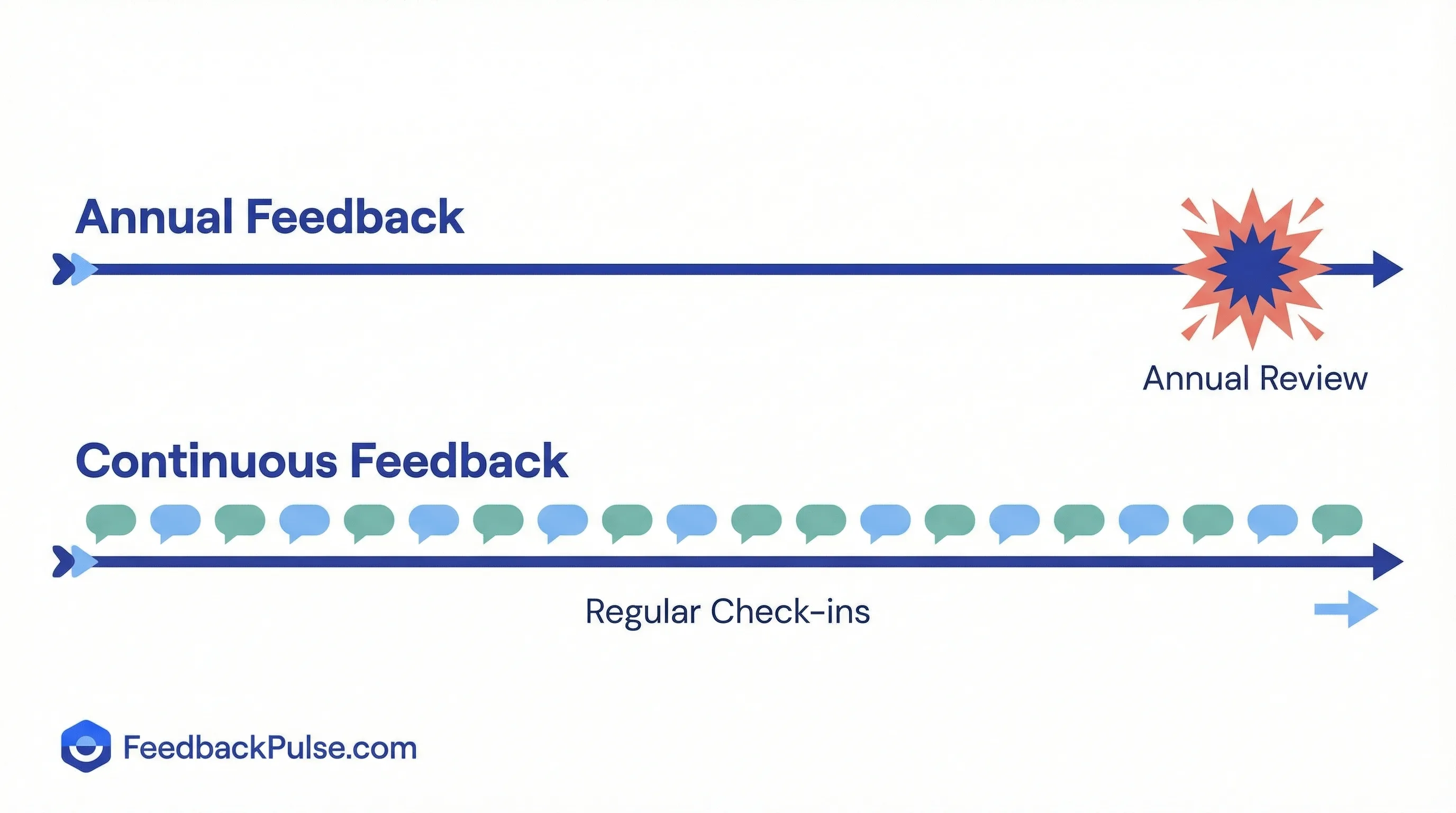
Why negative feedback fails when it only happens in reviews
Here's the pattern most teams fall into: feedback happens once or twice a year during formal reviews. By then, issues have been building for months. The conversation carries enormous weight. The employee feels ambushed. The manager feels anxious. Neither side gets what they need.
Gallup data shows organizations with strong feedback cultures see 14.9% lower turnover and 21% higher profitability. But "strong feedback culture" doesn't mean more annual reviews, it means more frequent, lighter-weight conversations throughout the year.
The fix is frequency. When feedback, positive and negative, flows regularly through 1-on-1s, pulse surveys, and structured peer reviews, no single conversation carries disproportionate weight. Small corrections happen early. Trust builds because people know where they stand.
Building that cadence doesn't require an enterprise HR system. Teams using continuous feedback tools report that difficult conversations become normalized when feedback stops being a once-a-year event. FeedbackPulse is built for exactly this: run regular pulse check-ins and structured review cycles that make honest feedback part of how your team works, not something that only surfaces when a problem becomes urgent.
When honest conversations are the norm, negative feedback stops being a crisis and becomes a growth tool.
Frequently asked questions
How do you give negative feedback without being rude?
Focus on the behavior and its impact, not the person's character. Use specific examples like 'The report was three days late' instead of generalizations like 'You're always late.' Ask a follow-up question to make it a two-way conversation. Timing matters too, deliver feedback privately and within 48 hours of the event.
What is an example of constructive negative feedback?
A constructive negative feedback example: 'The last two client proposals had pricing errors that the client caught before we did. I'd like to set up a peer review step so we catch those internally. What do you think would work?' This works because it names the specific issue, explains the impact, and invites collaboration on the solution.
How do you write negative feedback in a performance review?
Be specific enough to be actionable. Instead of 'needs improvement in communication,' write 'missed 3 deadlines for client-facing deliverables in Q3, each requiring escalation to the project lead.' Pair every criticism with a forward-looking development action so the review document serves as a roadmap, not just a report card.
How do you give negative feedback to your boss?
Frame it around the impact on your work rather than what the manager is doing wrong. For example: 'When priorities shift mid-week without a heads-up, it's hard to manage my workload effectively. Could we flag changes earlier?' You're describing a problem you need help solving, not issuing a critique.
What is the best framework for giving negative feedback?
The Situation-Behavior-Impact (SBI) model is the most widely used framework. Describe the situation (when and where), the specific behavior (what happened), and the impact (what resulted). Then ask a question to make it a dialogue. For recurring issues, add pattern recognition and reference prior conversations.
How do you give constructive negative feedback to a remote employee?
In remote and async settings, precision matters more because tone is harder to read. State the specific behavior, channel, and date ('Your message in #projects on Thursday'), explain the impact, and end with a question. Avoid text-based feedback for sensitive situations, use video or voice instead.