







Here's a number that should give any growing company pause: 62% of organizations are already using AI somewhere in their business, yet only 39% have implemented it in their HR functions, according to new SHRM research. Most of the guidance being published about AI in HR is written for companies with dedicated people science teams, HR analytics departments, and headcounts in the thousands.
If you're a COO, CEO, or Chief of Staff running people operations for a team of 30 to 200, most of that guidance does not apply to you. The tools are different, the data volumes are different, and the tradeoffs are completely different.
This guide is the one written for your situation. It covers what AI in HR actually does, where it genuinely helps smaller teams, and where it creates problems that enterprise vendors don't talk about. By the end, you'll know exactly what to prioritize, what to skip, and how to get started without overbuilding.
What is AI in HR?
AI in HR refers to the use of machine learning, natural language processing, and predictive analytics to automate HR tasks, analyze employee data, and surface insights that support people decisions.
In practical terms, that means tools that can read 200 open-ended survey responses and identify the five most common themes in seconds. Or tools that flag that one team's engagement score has been declining for three consecutive cycles before a single manager notices. Or systems that draft a plain-language briefing for a team lead instead of leaving them to interpret a dashboard alone.
AI in HR doesn't replace the decision-making. It changes how fast leaders get to the information they need to make good ones. FeedbackPulse's AI Analysis & Agents feature is built around exactly this: shortening the time from survey close to manager action, not adding another layer of dashboards to manage.
Why AI is showing up in HR right now
For most of the last decade, "AI in HR" meant expensive predictive hiring tools that required months of data preparation and carried documented bias risks. Those tools still exist. But the arrival of large language models in 2023 and 2024 made it possible to do something that was not practical before: process qualitative employee feedback reliably, flag sentiment shifts in plain language, and give managers specific explanations of what their teams are experiencing.
That shift is why Gartner found that the share of HR leaders planning to use or already using generative AI jumped from 19% in June 2023 to 61% by early 2025. The tools changed. The interest followed.
For growing teams, that timing matters. The practical AI applications that produce the most value for a 75-person company are now accessible without enterprise contracts or implementation consultants.
Where AI in HR actually makes a difference
Not every AI application is worth equal attention. For growing teams, a few specific areas produce disproportionate return.
Analyzing employee feedback at scale
The most immediately useful AI application for small and mid-sized teams is automated analysis of open-ended survey responses.
Before AI in HR, reviewing qualitative feedback from a 60-person pulse survey meant someone reading through responses manually, grouping themes by hand, and writing a summary that reflected their own interpretation as much as the data. That process took hours. It introduced real bias.
It often meant that qualitative responses got skimmed or ignored entirely in favor of the simpler score.
AI changes that workflow. A language model processes the same 60 responses in seconds. It identifies the five or six most common themes, surfaces representative quotes for each, and flags responses with strong positive or negative sentiment.
Consider Maya, a people ops lead at a 90-person professional services company. Before using AI-generated summaries, it took her three to four hours to process monthly pulse results before she could share anything with managers. That delay meant feedback often arrived stale, a week after the survey closed.
With AI summaries, processing dropped to under 30 minutes. She spent the saved time preparing for manager conversations instead of counting themes. Response rates improved within two cycles because employees saw faster follow-up.
The key caveat: AI summaries need human review before acting on them. Language models can misread sarcasm, miss domain-specific context, and occasionally group unrelated responses together. The summary is a starting point, not a final answer. The Survey Insights Report in FeedbackPulse gives managers a structured view of exactly this: themes, participation, and scores in one shareable snapshot that is designed for review, not just export.
Spotting engagement trends before they become problems
This is where AI shifts HR from reactive to proactive, and it's the area with the highest potential return for growing teams.
Traditional engagement measurement, especially annual surveys, gives you a snapshot of how employees felt during a specific two-week window. By the time you identify a problem and respond, the issue is often three to six months old. In some cases, the people most affected have already started their job search.
AI applied to continuous pulse data does something structurally different. Instead of comparing this year's score to last year's, it tracks cycle-over-cycle movement and can flag when a trend is diverging from baseline before the headline number changes materially.
An eNPS score that has dropped four points across three consecutive cycles is a very different signal than a single four-point month. AI surfaces that pattern automatically, tags the teams where the movement is most pronounced, and can correlate timing with organizational changes.
This kind of analysis doesn't require an enterprise platform. What it requires is consistent data. A team running monthly engagement surveys generates enough signal within three to four cycles for meaningful trend detection.
Helping managers respond faster
The most underrated AI application in HR has nothing to do with analytics. It's giving a manager a clear starting point for a difficult conversation.
When a survey cycle closes, most managers receive a report and face a blank document. They need to decide what to focus on, how to frame the issues, and what action to commit to publicly. That translation work is where follow-through breaks down. Not because managers don't care, but because the gap between a dashboard and a team meeting agenda is wider than most platforms acknowledge.
AI closes that gap when it is designed well. A useful AI summary doesn't list themes. It translates data into action-oriented language: "Three team members mentioned unclear project ownership as a source of frustration. Consider addressing role clarity in your next standup before assigning new work."
That guidance doesn't replace managerial judgment. It removes the inertia that keeps a manager staring at a report for 20 minutes before doing nothing.
The foundation for this to work is continuous feedback running on a consistent cadence. A one-off annual survey does not produce enough reliable signal for AI summaries to be trustworthy.
Want to see how faster manager follow-up changes engagement outcomes? See how AI analysis and agent workflows work in FeedbackPulse.
Running HR operations with AI agents
The newest category is agents that do the recurring work rather than analyze it. Instead of summarizing a survey, an agent runs onboarding end to end: drafts the region-correct contract, sends it for signature, provisions accounts, schedules the week-two 1:1, and books the day-seven check-in. The same pattern applies to probation reviews, leave approvals, and packaging hours and deductions for payroll each cycle.
Taito.ai is a clear example of this shape: an AI-native people operations system where employee records, time off, documents, and pre-payroll reporting run as no-code agentic workflows, with a Slack assistant that answers policy questions from your own handbook rather than generic training data. It also exposes its actions over MCP, the same open protocol FeedbackPulse uses, so an assistant like Claude can act on people data directly instead of through a browser tab.
For a lean team, the appeal is specific and worth naming: agentic HR ops removes the recurring admin that pulls a founder or office manager away from work only they can do. The limit is equally specific. These agents automate process, not judgment. They do not tell you whether your team is disengaged, and none of them replace the listening layer that produces that signal. The sequence that works is the same one as everywhere else in this guide: get the feedback rhythm running first, then automate the admin around it.
Other AI use cases in HR (briefly)
Most AI-in-HR coverage leads with recruiting: resume screening, interview scheduling, candidate ranking. These tools are widely used. For growing teams, they often are not the highest priority, and the bias risks are significant enough that they warrant careful vendor evaluation before adoption.
AI-powered learning recommendations, skill gap analysis, and workforce planning tools have legitimate enterprise applications. For a 60-person team without an HR analytics function, they typically add complexity before the fundamentals are working.
For lean teams, the sequence that produces the most value is: consistent listening first, AI-assisted analysis second, and everything else when the foundation is solid.
Where AI in HR falls short (especially for small teams)
The honest version of this conversation includes the failure modes, not just the use cases.
AI needs consistent data to be useful. Language models and trend detection algorithms don't work on sparse or inconsistent inputs. If you run surveys quarterly, or conduct a one-off annual engagement study, AI summaries won't be reliable. The tools need a rhythm, typically monthly pulses with reasonable participation, before the analysis becomes trustworthy. That foundation is the prerequisite, not an optional step.
Trust has to come before AI. If employees do not believe their feedback is confidential and that it leads to visible action, they won't respond honestly. AI can only analyze what it receives. A platform that supports anonymous employee surveys and demonstrates consistent manager follow-through solves the trust problem first. Without that, AI adds sophistication to low-quality inputs.
Someone still has to close the loop. AI can tell a manager that four team members mentioned concerns about unclear priorities. The manager still has to have the conversation. The action gap, the distance between an AI-generated insight and a visible change in how the team operates, remains entirely human. Platforms that market themselves as "AI-powered" sometimes obscure this reality. The software doesn't fix follow-through. The manager does.
Qualitative summaries can be wrong. Current AI tools handle quantitative data reliably: averages, response rates, trend lines. Qualitative summaries, especially from small response sets, can introduce errors. A language model might group two loosely related comments together, overstate how many employees hold a particular view, or miss a nuance that a human reader would catch. Every AI-generated qualitative summary should be reviewed before being shared with managers or employees.
Take the example of James, a COO at a 45-person company who implemented an AI in HR feedback tool after hearing about it at a conference. The first month's AI summary flagged "poor management communication" as a top theme. James escalated it to his leadership team as a confirmed issue.
When he reviewed the actual responses, he found that two of the three comments the AI had grouped under that theme were actually about a specific project handoff, not a systemic management problem. The summary was not wrong exactly, but it needed more context before becoming an action item. That review step is not optional.
The numbers behind AI in HR in 2026
The pace of adoption is accelerating, and the data gives useful context.
According to SHRM's State of AI in HR 2026 report, which surveyed more than 1,900 HR professionals, 39% of organizations have already implemented AI in their HR functions, with another 7% planning to do so this year. Meanwhile, 62% of organizations are using AI somewhere in the business, which means HR risks falling behind the broader enterprise.
When AI is in use, the reported impact is significant: 87% of HR professionals say it has improved their efficiency, 75% report improved work quality, and 70% report increased creativity. On job displacement, a concern that comes up often, the data is reassuring: 39% of organizations report AI has led to shifts in job responsibilities, but just 7% report actual job displacement.
The top current adoption areas are recruiting (27%), HR technology (21%), and learning and development (17%). Employee experience sits at 14% and performance management at 13%.
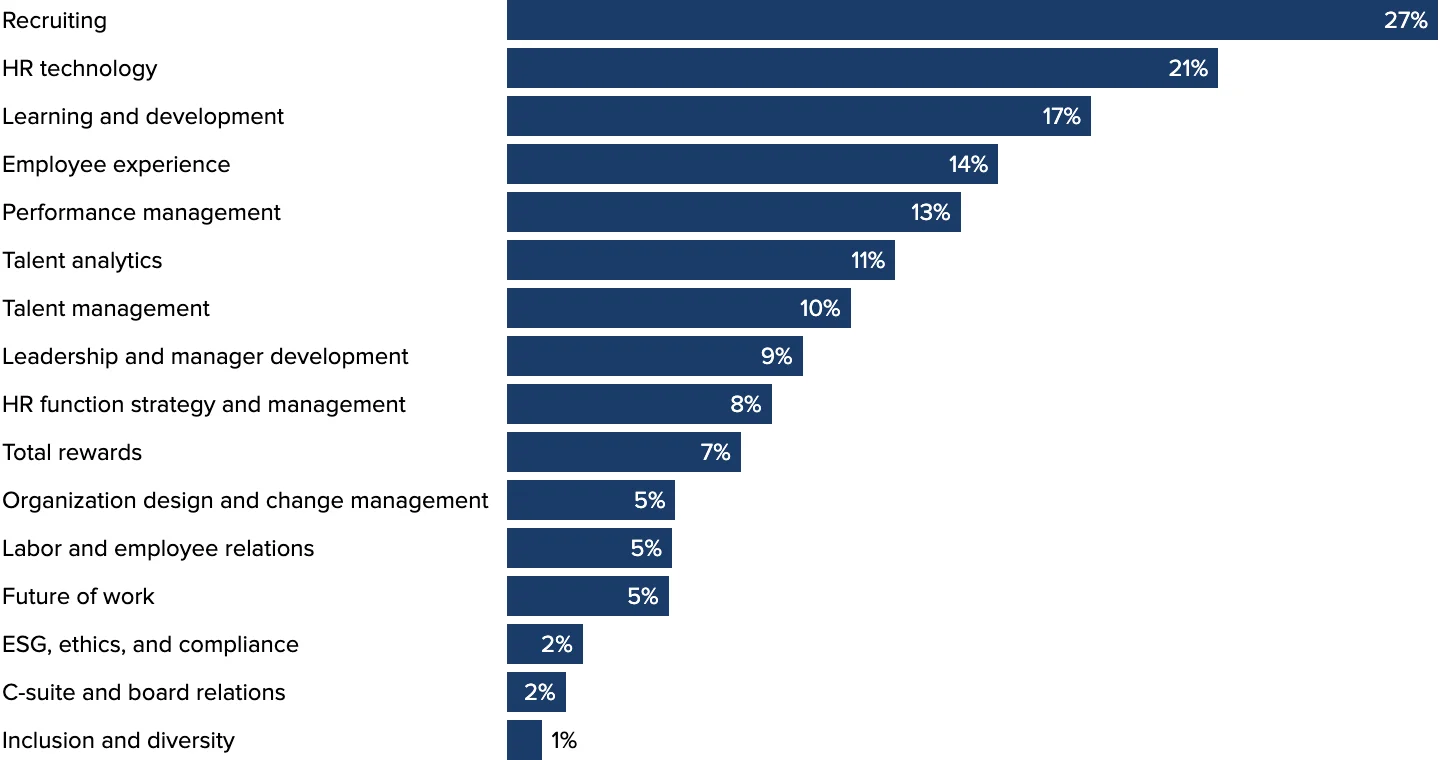
Source: SHRM State of AI in HR 2026 (n=1,900+ HR professionals)
Notably, employee engagement and continuous listening, often the highest-return application for smaller teams, is still early in the adoption curve. That represents a real opportunity for teams willing to move now.
How to start using AI in HR without overcomplicating it
For a growing team, the practical entry point is narrow and specific. Here's a four-step sequence that works.
Step 1: Establish a consistent feedback rhythm.
AI cannot help you analyze data you don't have. Before evaluating AI tools, ensure your team is running pulse surveys on a consistent monthly cadence with participation above 70%. Three to four completed cycles gives you enough baseline signal for meaningful analysis.
If that rhythm isn't yet in place, that's where to start. FeedbackPulse makes it straightforward to launch recurring surveys with minimal setup, maintain participation through anonymous modes, and build the data foundation that AI tools require.
Step 2: Use AI to process open-ended feedback first.
Start with qualitative summaries, not predictive analytics. The question to answer is: what are employees saying, and what themes appear most frequently? This is where AI delivers the fastest return for small teams and where human review remains practical. For teams that want to take this further, AI agent access via MCP lets compatible assistants like Claude query your survey results, compare trends, and help prepare follow-up actions directly from your feedback data.
If you want a faster on-ramp for AI-assisted HR workflows, the HR AI agent skill library at AIHRSkills offers pre-built prompt templates compatible with ChatGPT, Claude, and other AI providers, a practical shortcut for teams that don't want to build from scratch.
Step 3: Let AI flag, not decide.
Treat AI outputs as alerts and starting points, not conclusions. When a trend detection tool flags a sentiment drop in one department, that flag should trigger a manager conversation, not an automatic HR intervention. The human judgment layer stays in place.
Step 4: Track whether insight is becoming action.
The final measure of AI's value in your HR process isn't the quality of the summaries. It's whether manager action rates improve after you introduce them. Are managers following through faster? Are employees reporting they see changes? Track that alongside your eNPS trend and participation rates over time.
Ready to build the feedback foundation before adding AI tools? Start a free trial and run your first pulse survey this week.
AI vs. manual HR approaches: what actually changes
| HR task | Manual approach | AI-augmented approach |
|---|---|---|
| Open-ended survey analysis | 3-5 hours of manual reading and theme grouping | 15-30 minutes with human review of AI summary |
| Trend detection | Quarterly or annual comparison, often retrospective | Continuous monitoring with cycle-over-cycle flags |
| Manager briefing preparation | Report writing per manager, variable quality | AI-drafted summary with key themes and recommended actions |
| eNPS interpretation | Single-number comparison across periods | Pattern recognition across teams and time |
| Identifying at-risk teams | Lagging indicators: attrition, complaints, exit interviews | Leading indicators: sentiment trend, participation decline, theme shifts |
The consistent pattern: AI in HR compresses time. The quality of the decisions that follow depends on the people making them, not the tool.
If you want to model the cost of not acting on early warning signals, the employee turnover calculator gives you a concrete number to work with.
Frequently asked questions
What is AI in HR?
AI in HR refers to applying machine learning, natural language processing, and predictive analytics to HR workflows. Common applications include analyzing employee survey feedback, detecting engagement trends, supporting performance review processes, and automating administrative tasks like scheduling and reporting.
Is AI replacing HR jobs?
No. According to Gartner research, AI's impact on HR is 5.7 times more likely to shift job responsibilities than to eliminate them. Roles focused on manual data processing and report generation will change significantly. Roles requiring human judgment, empathy, and leadership, including manager coaching, culture building, and organizational design, remain distinctly human.
Can small companies use AI in HR?
Yes, with the right sequence. Small teams (20-200 employees) see the most value from AI-assisted survey analysis and trend monitoring applied to continuous feedback data. The prerequisite is a consistent feedback rhythm. Without monthly or bi-weekly survey data, AI tools lack the signal to produce reliable outputs.
What are AI agents in HR?
AI agents in HR are systems that carry out multi-step people operations tasks on their own rather than just producing analysis. Common examples are running onboarding from contract to first-week check-in, chasing performance review responses, answering policy questions from a company handbook, and preparing payroll input each cycle. They automate process, not judgment, so they sit alongside engagement measurement rather than replacing it.
What HR tasks can AI realistically automate today?
For most growing teams: open-ended response summarization, trend detection in engagement data, participation rate monitoring, and draft manager briefings. More complex applications like predictive attrition modeling and compensation benchmarking typically require larger data sets and dedicated implementation support.
How does AI improve employee engagement?
AI improves engagement indirectly, by compressing the time between feedback collection and manager action. When managers receive clearer, faster summaries of what their teams are experiencing, they are more likely to respond visibly. Visible follow-through is the primary driver of employee trust and sustained participation in feedback programs. The AI is not the culture change. The follow-through is.
The practical conclusion
AI in HR isn't a revolution you need to prepare years for. For growing teams, it is a targeted set of tools that help you move from survey to action faster.
The foundation comes first: consistent pulse surveys, anonymous feedback modes, and a manager follow-through rhythm. Once that is in place, AI does exactly what it should. It compresses the analysis work so the human parts, the conversations, the decisions, the visible changes, can happen sooner.
Most growing companies aren't short on the intention to listen to their teams. They are short on the speed and clarity needed to act on what they hear. That is the specific problem AI in HR solves when it's deployed well and preceded by the right habits.
If your team isn't yet running monthly pulses or measuring eNPS consistently, that's the right starting point. Build the rhythm first. When the data is flowing, AI makes it significantly more valuable.
Start your free trial and run your first AI-powered pulse survey this week. No credit card required.
Sources: SHRM State of AI in HR 2026 (1,900+ HR professionals surveyed, April 2026); Gartner AI in HR research, 2025.