







Most teams shopping for 360 feedback tools get stuck between two bad options. On one side sit heavyweight enterprise suites that need a sales call, a rollout project, and a budget most growing companies do not have. On the other side sit narrow review tools that collect multi-rater feedback but cannot tell you anything about engagement, sentiment, or whether the feedback actually changed behavior.
This guide maps the middle. We compare eight of the best 360 feedback tools in 2026, from full people platforms to focused review tools, with honest positioning on who each one is really for. You will get a clear definition of what these tools do, a buying checklist, current pricing models, and a way to choose by team size. If you are evaluating multi-rater reviews for the first time, this is the lens that keeps you from buying too much tool or too little.
TL;DR - best 360 feedback tools
- FeedbackPulse: best overall, a full platform where 360 reviews sit alongside engagement surveys, eNPS, and performance reviews.
- Small Improvements: best lightweight, standalone 360 and review tool.
- Culture Amp: best for enterprises that want 360 next to deep engagement analytics.
- Lattice: best for 360 inside a structured performance-management system.
- 15Five: best for continuous-performance teams that already run weekly check-ins.
- Leapsome: best for connecting 360 to learning and goals in a modular suite.
- Qualtrics: best for large enterprises that need highly configurable assessments at scale.
- BambooHR: best for teams already living inside BambooHR as their HRIS.
If your company has 25 to 500 employees and you want 360 feedback that connects to real engagement and performance signal, rather than a single isolated review event, FeedbackPulse is the most reasonable first choice. It combines peer and 360 reviews with performance reviews, anonymous engagement surveys, and eNPS in one plan, instead of charging for each as a separate module.
What are 360 feedback tools?
360 feedback tools are software platforms that collect feedback on an employee from multiple perspectives at once, typically a self-assessment, the manager, peers, and direct reports, then combine those inputs into a single multi-rater view. The goal is a more complete and balanced picture of performance and behavior than a top-down manager review alone can give.
Good tools handle the parts that make 360s hard to run by hand: confidential reviewer selection, structured competency questions, reminders, and reporting that turns raw ratings into themes a person can actually act on. The best ones connect that feedback to a development plan, so a 360 becomes the start of growth rather than a one-time report that gets filed and forgotten.
A 360 review is only as valuable as the action it triggers. The tool's job is to make honest feedback easy to collect and impossible to ignore.
What to look for in a 360 feedback tool
Not every tool needs every feature, but a strong 360 platform should cover most of this checklist.
- Multiple rater sources. Self, manager, peer, and direct-report feedback, combined into one view. This is the core of a true 360.
- Confidentiality and anonymity controls. Peers answer honestly only when they trust that individual responses are protected. Look for named confidentiality rules and minimum-response thresholds.
- A competency or question library. Prebuilt, editable questions tied to competencies save hours and keep cycles consistent.
- Flexible reviewer assignment. Manager-assigned, employee-nominated, admin-assigned, and system-random modes cover most real workflows.
- Readable reporting. Results should surface themes and gaps, not just raw averages, and land with the person and their manager.
- A development loop. The tool should connect feedback to goals or a follow-up plan, not stop at a score.
- A sensible pricing model. Predictable per-employee or per-user pricing beats opaque quotes for most teams under 500 people.
- Room to grow. If you will also need engagement surveys, eNPS, or full performance reviews, a tool that already includes them saves a painful second purchase.
A focused tool will hit the first five. A platform will hit all eight. Which you need depends on whether 360 is the whole job or one part of a broader people program.
The 8 best 360 feedback tools in 2026
Pricing reflects publicly listed plans as of June 2026. Several vendors are quote-based and do not publish per-seat pricing. Always confirm current pricing on the vendor site before you buy.
1. FeedbackPulse, best overall full platform with 360 included
- Price: Free for up to 10 team members. Pro pricing is a predictable per-employee rate, around $4 per employee per month billed annually.
- Best fit: Teams of 25 to 500 that want 360 feedback connected to engagement and performance, not isolated from it.
- Why it stands out: FeedbackPulse builds a 360 view from self-assessment, manager review, and peer and direct-report feedback in the same platform that runs your performance reviews, anonymous engagement surveys, and eNPS. Reviewer assignment supports manager-assigned, employee-nominated, admin-assigned, and system-random modes, and report visibility is scoped by role so managers see their own team while admins see the full picture. Because feedback, sentiment, and performance live together, a weak 360 theme can be checked against engagement trends instead of guessed at.
- Honest tradeoff: Deep 360 competency customization is still rolling out, so if your program depends on a large, heavily tailored competency framework today, confirm the current state first. Teams that want a clean self, manager, and peer 360 connected to engagement will not feel the gap.
Try it: Start free with FeedbackPulse. Free for up to 10 people, no credit card required.
2. Small Improvements, best lightweight standalone 360 tool
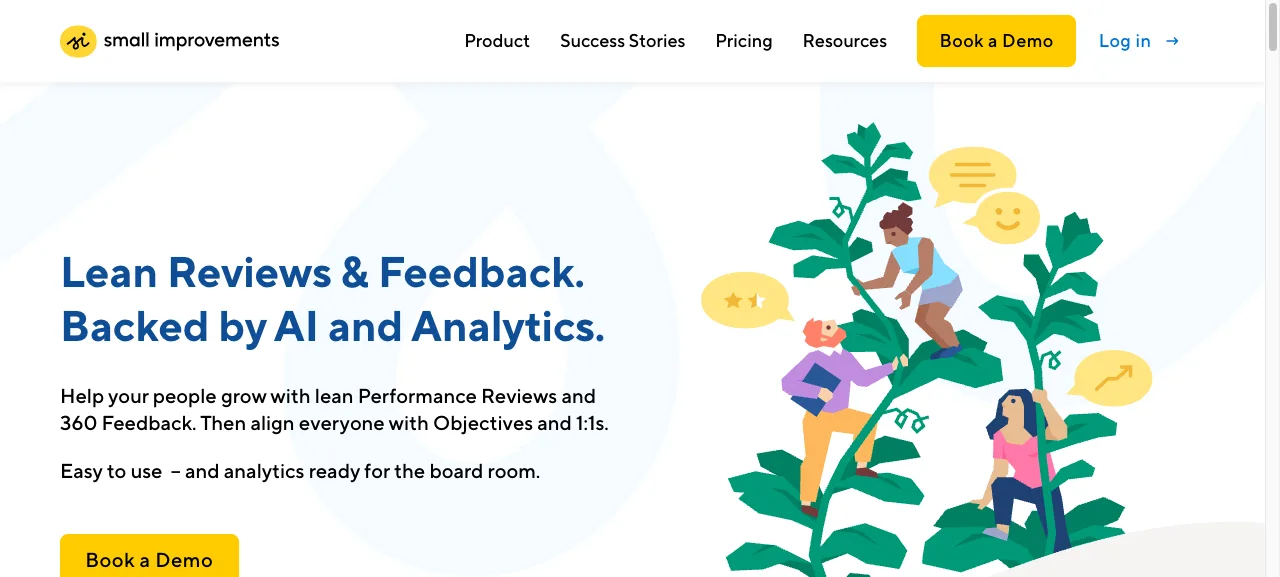
- Price: Per-user and modular, roughly $5 to $8 per user per month depending on which modules you enable. Confirm on the vendor site.
- Best fit: Teams that want simple, friendly 360 and review cycles without adopting a full HR platform.
- Why it stands out: Small Improvements is deliberately lean. It does performance reviews, 360 feedback, objectives, 1:1s, and praise in a tool that is easy to roll out and easy for managers to actually use. For a company whose only goal is clean multi-rater reviews, the narrow scope is a feature, not a limitation.
- Honest tradeoff: That same narrow scope is the ceiling. There is no built-in engagement-survey program or eNPS, so if you later want continuous sentiment and listening, you will run a second tool. Small Improvements is the right pick when 360 and reviews are the entire job, and FeedbackPulse is the better pick when you want that plus engagement in one place.
3. Culture Amp, best for enterprise culture and 360
- Price: Quote-based. No public per-seat pricing, and packaged for mid-market and enterprise budgets.
- Best fit: Larger organizations that want 360 feedback next to a mature engagement and people-analytics platform.
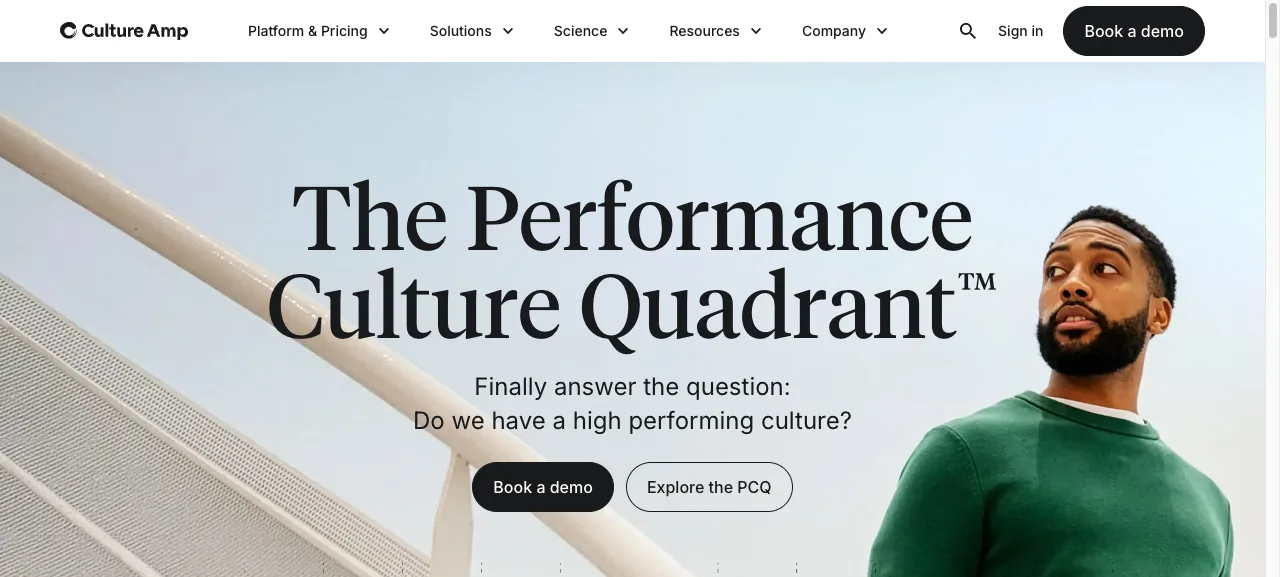
- Why it stands out: Culture Amp is best known for engagement and its large benchmarking dataset. Its performance and development product adds 360 reviews, so culture, engagement, and development sit on one analytics backbone, which is attractive to a people team that lives in dashboards.
- Honest tradeoff: It is built for scale and priced for it, and the development and 360 capability often sits in a higher tier on top of engagement. For a leaner team, that is a lot of platform to buy for multi-rater reviews. See our Culture Amp alternatives guide for lighter, lower-cost options.
4. Lattice, best for 360 inside performance management
- Price: Per-seat, around $11 per seat per month for the performance product, with engagement and other modules priced as add-ons. Confirm current pricing.
- Best fit: Teams that want structured review cycles and 360 as part of a formal performance-management system.
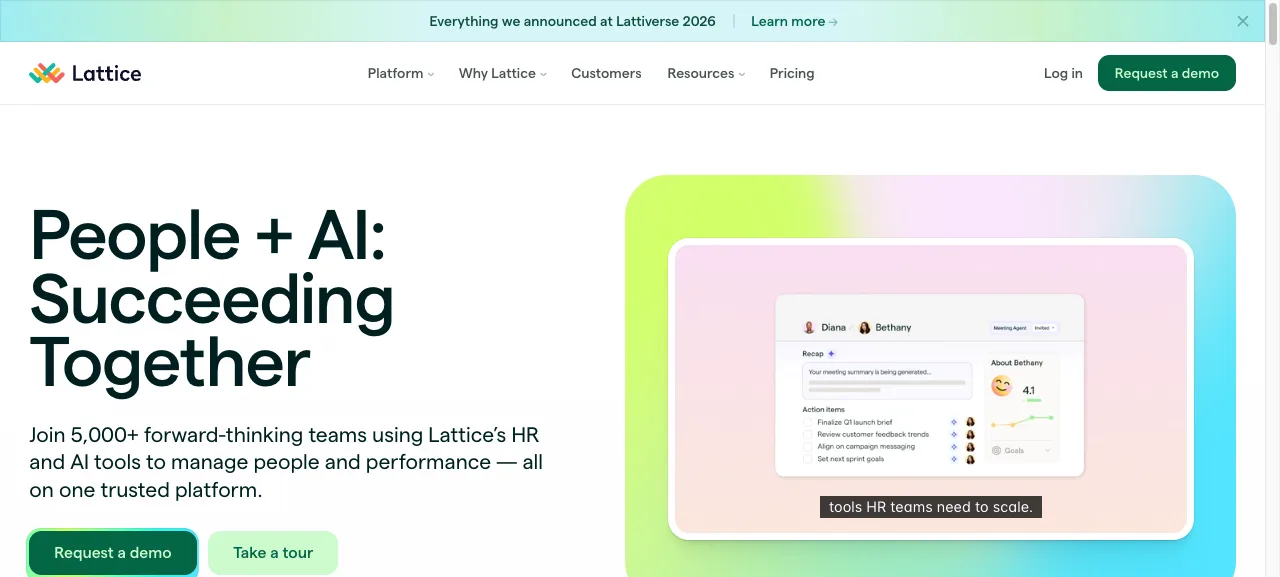
- Why it stands out: Lattice is a polished performance platform. Review cycles, goals, and 360 feedback are tightly integrated, and the manager experience is strong, which makes it a common pick for scaling companies formalizing their first real review process.
- Honest tradeoff: Costs add up once you layer engagement and other modules onto the performance base, and the system rewards teams that adopt the whole structured workflow. Compare scope and price in our Lattice alternatives guide before committing.
5. 15Five, best for continuous-performance teams
- Price: Per-user and modular. The performance product that carries 360 reviews lands around $10 per user per month, with engagement sold separately. Confirm current pricing.
- Best fit: Teams that already run weekly check-ins and want 360 reviews in the same cadence-driven workflow.
- Why it stands out: 15Five is built around continuous performance, weekly check-ins, manager coaching, and reviews. If that rhythm already fits how your managers work, adding 360 cycles on top feels natural rather than bolted on.
- Honest tradeoff: The modular pricing means engagement, performance, and other pieces each add cost, so the bill climbs as you assemble the full picture. Our 15Five alternatives guide breaks down where a simpler platform wins.
6. Leapsome, best for 360 connected to learning and goals
- Price: Per-user and modular, starting around $8 per user per month per module. Confirm current pricing.
- Best fit: Teams that want 360 reviews linked to learning paths, goals, and development.
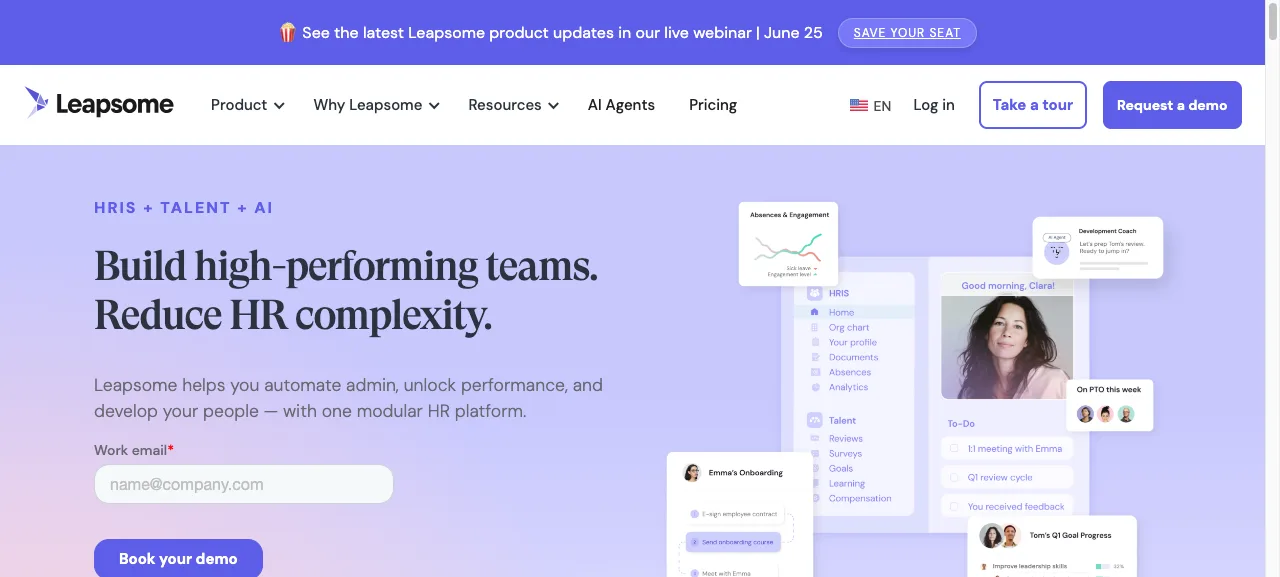
- Why it stands out: Leapsome connects reviews, goals, learning, and engagement in one modular suite, so a 360 result can flow directly into a development or learning plan. For people teams that care about growth, that link is the appeal.
- Honest tradeoff: Modular pricing again means the cost depends on how many pieces you switch on, and the breadth can be more than a team that only wants 360 needs. See our Leapsome alternatives guide for a side-by-side.
7. Qualtrics, best for enterprise 360 at scale
- Price: Quote-based, enterprise experience-management pricing. Expect a sales process.
- Best fit: Large or complex organizations that need advanced, highly configurable 360 assessments.
- Why it stands out: Qualtrics is an experience-management powerhouse. Its 360 capability is deeply configurable, with advanced logic, analytics, and the ability to run sophisticated programs across thousands of employees.
- Honest tradeoff: That power comes with cost and complexity. For most teams under a few hundred people, Qualtrics is far more platform, and far more spend, than a 360 program requires. It is the right answer only when configurability and scale are genuine requirements.
8. BambooHR, best for teams already on BambooHR
- Price: Per-employee HRIS pricing, with performance management that includes peer and 360 feedback sold as a paid add-on. Quote-based.
- Best fit: Companies that already use BambooHR as their core HR system and want reviews in the same place.
- Why it stands out: If BambooHR is already your HRIS, adding its performance and 360 module keeps employee data, reviews, and feedback under one login, which is convenient for HR.
- Honest tradeoff: The 360 and performance capability is an add-on to the HRIS rather than a best-in-class review tool, and it is most compelling only if you are already committed to BambooHR. Our BambooHR alternatives guide covers dedicated options.
Quick at-a-glance comparison
Use this table to compare the tools on what usually decides the buy: whether 360 is included or an add-on, the pricing model, and whether the tool also covers engagement and eNPS.
| Tool | 360 source model | Pricing model | Engagement and eNPS included | Best fit |
|---|---|---|---|---|
| FeedbackPulse | Self, manager, peer, direct report | Per employee, free under 10 | Yes, same plan | 25 to 500, 360 plus engagement |
| Small Improvements | Self, manager, peer | Per user, modular | No | Lean standalone 360 |
| Culture Amp | Self, manager, peer | Quote-based | Yes, engagement-led | Enterprise culture teams |
| Lattice | Self, manager, peer | Per seat, add-ons | Add-on module | Structured performance management |
| 15Five | Self, manager, peer | Per user, modular | Add-on module | Continuous check-in teams |
| Leapsome | Self, manager, peer | Per user, modular | Add-on module | 360 linked to learning |
| Qualtrics | Highly configurable | Quote-based | Separate product | Enterprise scale and config |
| BambooHR | Peer and manager add-on | Quote-based add-on | No | Existing BambooHR customers |
Pricing models reflect publicly listed information as of June 2026. Quote-based vendors do not publish per-seat pricing.
How to choose a 360 tool by team size
The right tool depends as much on your stage as on a feature list.
Under 50 employees
Keep it simple and cheap. You want fast setup, clean reviewer selection, and confidentiality, not an enterprise rollout. FeedbackPulse Free or Small Improvements both fit here. If you also want anonymous pulse surveys and eNPS without a second tool, start with FeedbackPulse. For more on running lean, see our small teams overview.
50 to 200 employees
This is the sweet spot for an integrated platform. Your CEO will start asking how 360 themes connect to engagement and retention, so a tool that combines 360 reviews with engagement signal earns its keep. FeedbackPulse, Lattice, and 15Five are common picks. Match the tool to whether your culture is review-led or check-in-led.
200 plus employees
Configurability, security, and analytics depth start to matter more, and so does avoiding modules you will not use. Culture Amp and Qualtrics fit complex enterprise programs, while FeedbackPulse remains a strong fit for growing companies that want depth without enterprise overhead. Run the cost of attrition through our employee turnover calculator to size the budget against the problem.
360 feedback pitfalls to avoid
A tool will not save a badly run program. Watch for these patterns.
- Tying 360 to pay or promotion. When multi-rater feedback drives compensation, people game it and candor collapses. 360 works best for development, not evaluation.
- Skipping confidentiality thresholds. If a manager can infer who said what, peers stop being honest. Always set a minimum number of responses before results show.
- Running a cycle with no follow-up. A 360 with no development conversation is wasted effort. Pair every cycle with a plan.
- Over-surveying. Annual or twice-yearly 360s are plenty for most teams. Continuous pulse feedback is a different, lighter instrument.
- Buying enterprise scope for a small need. If you only need clean 360s, do not buy a platform you will use 10 percent of.
Quick action: shortlist two tools from the table, run one real 360 cycle on a single team with each, and compare reviewer completion rate, report clarity, and whether managers knew what to do next. The better tool is usually obvious within one cycle.
How to run your first 360 cycle in 30 days
The tool only matters if the cycle produces action. Here is a simple 30-day plan.
- Days 1 to 3: Choose one pilot team. Pick five to seven competencies and set confidentiality thresholds. Turn on self, manager, and peer reviews.
- Days 4 to 7: Nominate reviewers. Aim for three to five peers per person, plus the manager and a self-review.
- Days 8 to 17: Run the review window. Send one reminder at the midpoint. Target 90 percent completion.
- Days 18 to 24: Share each report with the employee and manager together. Translate themes into one or two specific development actions.
- Days 25 to 30: Schedule the next cycle and decide what to standardize. Connect any culture-wide themes to your engagement program.
Run that once on a pilot team and you will know whether the tool and the process fit before you roll it out company-wide. For the broader operating model, see our performance reviews guide.
Frequently asked questions
What are 360 feedback tools?
360 feedback tools are software platforms that gather feedback on an employee from several sources at once, usually a self-assessment, the manager, peers, and direct reports, and combine them into one multi-rater report. They handle reviewer selection, confidentiality, structured questions, reminders, and reporting so a 360 is practical to run and easy to act on.
What are some examples of 360 feedback tools?
Common 360 feedback tools include FeedbackPulse, Small Improvements, Culture Amp, Lattice, 15Five, Leapsome, Qualtrics, and BambooHR. They range from lightweight standalone review tools to full people platforms, so the best example for you depends on whether 360 is the whole job or one part of a broader engagement and performance program.
Is 360 feedback outdated?
No, but it is often misused. 360 feedback gets a bad reputation when companies tie it to pay and promotion, which encourages guarded or inflated answers. Used for development, with protected confidentiality and a real follow-up conversation, multi-rater feedback remains one of the most useful ways to give people a balanced view of how they work with others.
Are 360 feedback tools anonymous?
Most are confidential rather than strictly anonymous. Peer responses are typically aggregated and hidden behind a minimum-response threshold so individuals cannot be identified, while the self and manager inputs are attributed by design. Strong tools, including FeedbackPulse with its anonymous survey controls, let you set those thresholds explicitly.
What is the best 360 feedback tool for small teams?
For teams under 50, FeedbackPulse and Small Improvements are the strongest fits. FeedbackPulse is free for up to 10 people and adds engagement surveys and eNPS in the same plan, while Small Improvements is a clean, lightweight option if all you need is reviews and 360.
Is there a free 360 feedback tool?
Yes. FeedbackPulse is free for up to 10 team members, which covers a full 360 cycle for a small team at no cost. Most other platforms on this list are paid or quote-based, though several offer trials.
The bottom line
The best 360 feedback tool is not the one with the most features. It is the one that fits how your team already works and connects feedback to action. For most companies between 25 and 500 people, that means a tool where 360 reviews live next to engagement and performance, so a theme in one shows up in the others.
Quick recap of what matters:
- Decide whether 360 is the whole job, which favors a focused tool, or one part of a people program, which favors a platform.
- Protect confidentiality with response thresholds, and keep 360 for development, not pay.
- Match the tool to your stage and avoid buying enterprise scope for a small need.
- Always pilot one real cycle before a company-wide rollout.
If you want 360 feedback that connects to engagement, eNPS, and performance in one place, FeedbackPulse covers all of it, with a free plan for up to 10 people and predictable per-employee pricing after that.
Start your free FeedbackPulse trial and run your first 360 cycle this month.