








Psychosocial risk refers to workplace factors, such as an unmanageable workload, unclear job expectations, weak support, poor relationships, or poorly managed change, that have the potential to cause psychological or physical harm. It's a hazard in the same sense a trip hazard or a faulty machine guard is a hazard. The difference is that the harm from psychosocial risk usually shows up as stress, anxiety, or burnout rather than a physical injury.
The term matters because it separates the cause from the symptom. Stress, disengagement, and burnout are outcomes. Psychosocial risk describes the conditions that produce them, which is the part an organization can actually identify, measure, and change, instead of just treating what shows up after it's too late.
Key Takeaways
- Psychosocial risk is a workplace hazard, a condition capable of causing harm, not the harm itself.
- The five most common categories are workload, role clarity, support, relationships, and change.
- The UK's Health and Safety Executive groups these into six related Management Standards, adding control (how much say people have over their own work) as a sixth.
- Assessment typically combines a structured survey with a documented, repeatable process, not a one-time checklist.
- ISO 45003 provides guidance for managing psychosocial risk inside a broader occupational health and safety system; it does not certify a company on its own.
What Is Psychosocial Risk?
Psychosocial risk sits at the intersection of how work is organized and how people experience it. A heavy workload isn't automatically a psychosocial risk. A heavy workload that's sustained, unpredictable, and unsupported is. The risk comes from the combination of the work itself and the conditions surrounding it, which is why the same workload can be manageable on one team and damaging on another.
Organizations that treat psychosocial risk seriously assess it the way they'd assess a physical safety hazard. They identify it, evaluate how likely it is to cause harm, put controls in place, and check whether those controls actually worked. That framing is borrowed directly from occupational health and safety practice, which is also why psychosocial risk increasingly shows up inside formal audits and management systems rather than staying a purely cultural conversation.
Examples of Psychosocial Risk at Work
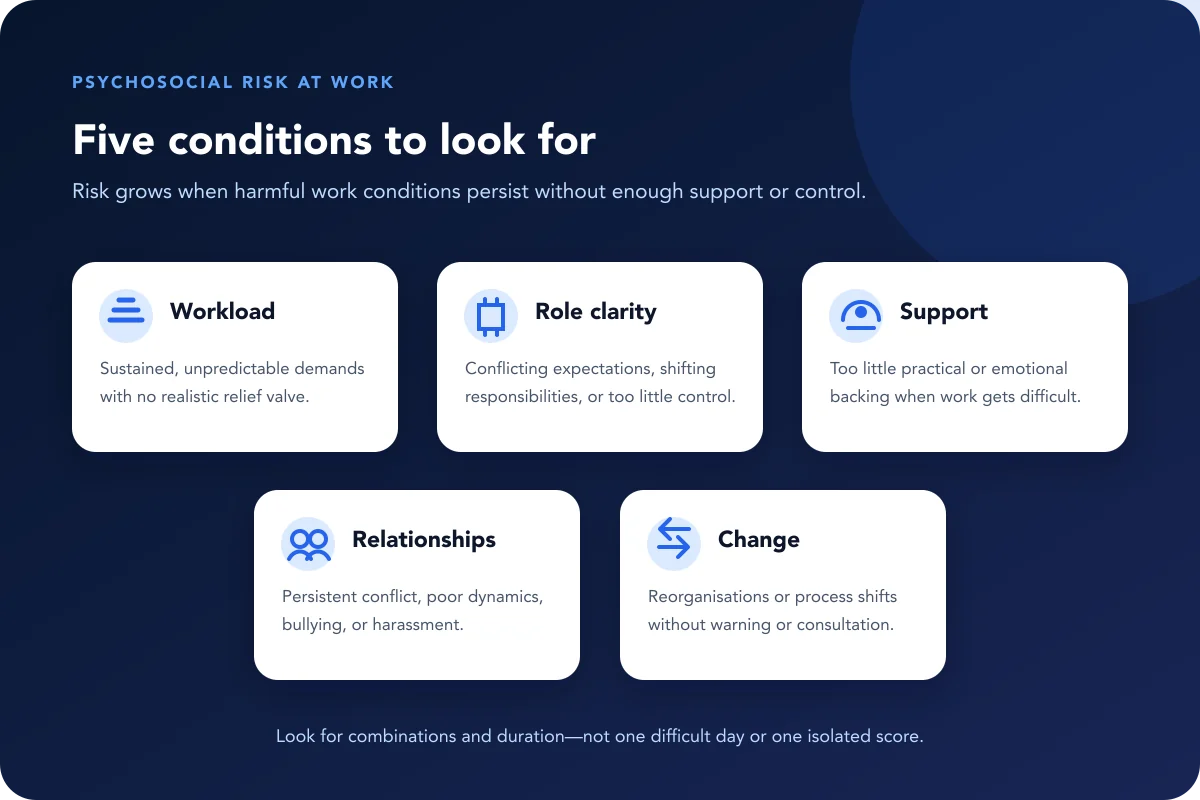
Most psychosocial risk falls into a handful of recurring categories.
- Workload. Sustained, unpredictable, or unrealistic demands with no relief valve.
- Role clarity. Unclear responsibilities, conflicting expectations, or a job that keeps shifting without explanation.
- Support. A manager or organization that offers little practical or emotional backing when things go wrong.
- Relationships. Ongoing conflict, poor team dynamics, or, at the severe end, bullying and harassment.
- Change. Reorganizations, layoffs, or process changes introduced with little warning, communication, or consultation.
The UK's Health and Safety Executive frames these as six Management Standards. It adds control, meaning how much say someone has over how they do their own work, as a sixth category alongside the five above.
Picture a support engineer whose ticket queue keeps growing (workload). They're not sure whether escalations are theirs to make (role clarity and control), and they found out about a team restructure from a company-wide email (change). Any one of those is manageable on its own. Stacked together, over months, that combination is exactly what psychosocial risk assessment is designed to catch before it turns into resignations or long-term sick leave.
How Psychosocial Risk Is Assessed
Assessment usually combines a structured survey with a documented, repeatable process. It isn't a one-off checklist. The Health and Safety Executive publishes a validated Indicator Tool built around its six Management Standards, and many organizations fold a similar approach into their own regular pulse or engagement surveys.
ISO 45003 provides guidance for organizing that process: identifying hazards, consulting workers, and tracking results over time, inside a broader occupational health and safety management system. It's guidance rather than a standalone certification, so the credibility comes from doing the assessment consistently and documenting it, not from a one-time badge.
Because questions about workload, support, and relationships are sensitive, response quality depends heavily on whether people trust the process. Anonymous surveys that withhold results until a group reaches a minimum size tend to surface more honest answers on exactly these topics than a survey people believe can be traced back to them.
Frequently asked questions
What is psychosocial risk?
Psychosocial risk refers to workplace factors, such as excessive workload, unclear roles, poor support, weak relationships, or poorly managed change, that have the potential to cause psychological or physical harm. It is a hazard in the same sense a trip hazard or unsafe machine is a hazard, except the harm shows up as stress, anxiety, or burnout rather than a physical injury.
What are examples of psychosocial risk at work?
Common examples include an unmanageable workload, unclear expectations about a role, a manager who offers little support, ongoing conflict or poor relationships within a team, and disruptive change introduced without warning or explanation. Most organizations experience several of these at once rather than just one.
How is psychosocial risk assessed?
Most assessments combine a structured survey or questionnaire, such as the UK Health and Safety Executive's Indicator Tool, with a documented process for identifying hazards, consulting workers, and tracking the results over multiple cycles. ISO 45003 provides guidance for organizing that process inside a broader occupational health and safety management system.
Is psychosocial risk the same as stress?
No. Psychosocial risk describes the workplace factors capable of causing harm, such as workload or poor support. Stress is one possible outcome when those risks go unmanaged. Distinguishing the two matters because managing risk means changing the underlying factors, not just treating the stress it produces.
Getting Started
Psychosocial risk is a hazard, not a diagnosis: something in how work is organized that's capable of causing harm, which means it can also be identified and reduced. Start with the five categories above, ask honestly which ones show up on your team, and build a simple way to check for them on a repeating cycle. Don't wait for an exit interview to explain what went wrong. For the fuller picture of how this fits into a formal audit or management system, our audit-ready employee feedback guide covers what auditors expect to see.