




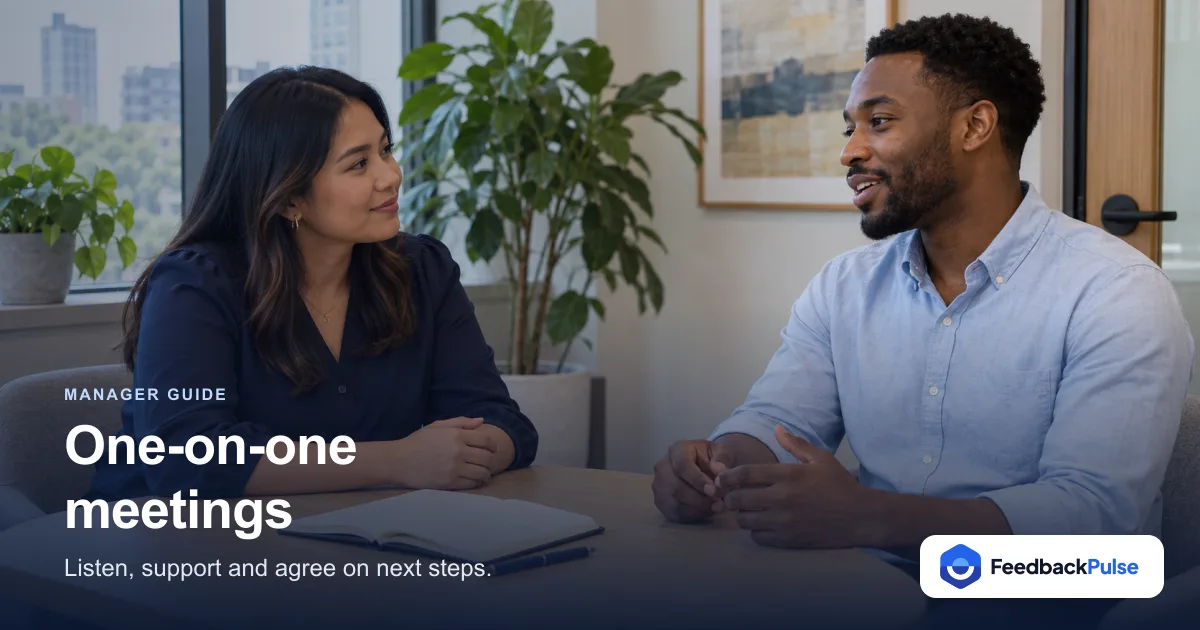
A one-on-one meeting (also called a 1:1, 1-on-1, or one-to-one meeting) is a recurring, private conversation between a manager and one direct report, usually 30 minutes every week or two, where the employee drives most of the agenda. It's the single most reliable habit a manager has for catching problems early and helping people grow.
Most managers already hold them. Fewer hold them well. The difference shows up in the data: Gallup found that employees whose managers hold regular meetings with them are almost three times as likely to be engaged as employees whose managers don't. Not a nice-to-have, then. A core part of the job.
Here's the trouble. When Teodor, an engineering lead at a 40-person fintech, took over a team of six, he inherited a calendar full of weekly 1:1s. Every one of them was a status update. Two months in, his strongest engineer resigned, and the exit conversation was the first time Teodor heard she'd been stuck on the same blocked project for six weeks. The meetings had happened. The conversation hadn't.
This guide shows you how to run one-on-one meetings that actually work: what they're for, how often to hold them, a 30-minute agenda, what to do in the first 1:1 with a new report, and the mistakes that quietly turn them into status meetings.
Key takeaways
- A one-on-one meeting is the employee's time with their manager, not a status update. Aim for the employee to bring most of the topics and do most of the talking.
- Weekly or biweekly, 30 minutes, works for most teams. Go weekly for new hires and anyone in a hard stretch.
- A simple agenda keeps 1:1s useful: 5 minutes check-in, 15 minutes on their topics, 5 on yours, 5 to agree on next steps.
- Managers account for at least 70% of the variance in team engagement (Gallup). Regular 1:1s are the most direct lever a manager has on that number.
- Move a 1:1 rather than cancel it, keep shared notes, and follow through on what you promised before the next one.
What is a one-on-one meeting?
A one-on-one meeting is a scheduled, recurring conversation between a manager and a single direct report. It's private, it's regular, and its main purpose is the employee: their blockers, their questions, their feedback, and their growth. The manager's job is mostly to listen, help, and follow through.
That's what separates a 1:1 from the other conversations a manager has. It isn't a project check-in, a performance review, or a meeting with someone further down the org chart. Each of those has a place, but none of them replaces the 1:1.
| One-on-one meeting | Status meeting | Performance review | Skip-level meeting | |
|---|---|---|---|---|
| Who's there | Manager and one direct report | Manager and the team | Manager and one report | Senior leader and an employee two levels down |
| Purpose | Support, feedback, growth, early warning | Progress on work | Formal evaluation | Unfiltered view of the team and its manager |
| Who sets the agenda | Mostly the employee | The manager or project lead | The review process | The senior leader |
| Cadence | Weekly or biweekly | Daily to weekly | Quarterly to annually | Quarterly to twice a year |
If you've never run a skip-level meeting, it's worth reading how it differs. The two formats work best together: the 1:1 handles the week-to-week, and the skip-level checks whether the 1:1s are working.
Why one-on-one meetings matter
Gallup estimates that managers account for at least 70% of the variance in employee engagement across business units. Most of what a manager does to move that number happens in conversation, and the 1:1 is the one conversation that's guaranteed to happen.
Here's what a well-run one-on-one gives you that nothing else does:
- Early warning. People rarely raise a serious problem in a team meeting. They raise it in private, and only once they trust the time is theirs. A regular 1:1 is where you hear about burnout, friction with a colleague, or a job offer before it's a resignation.
- Feedback that's small and frequent. Feedback delivered weekly is a nudge. Feedback saved for a review is a verdict. The 1:1 lets you give and receive the small kind, so the review holds no surprises.
- Growth that doesn't get crowded out. Without protected time, career conversations lose to deadlines every single week. A 1:1 gives development a standing slot.
- Trust you can draw on later. When you need to deliver bad news or ask for extra effort, the relationship you built in thirty-minute increments is what carries it.
There's also a scale effect. In a 15-person company, a founder hears most things directly. Past 30 or 40 people, that stops being true, and 1:1s become the main way information travels from the people doing the work to the people deciding what work gets done. That's why they matter more, not less, as a company grows.
How often should you have one-on-ones?
Weekly or every two weeks, for 30 minutes, is the right default for most teams. The best cadence depends on how much support the person needs right now and how often you talk anyway.
| Situation | Suggested cadence | Length |
|---|---|---|
| New hire (first 90 days) | Weekly | 30 minutes |
| New to the role or recently promoted | Weekly | 30 minutes |
| Going through a hard stretch (workload, personal, conflict) | Weekly, temporarily | 30 minutes |
| Experienced and autonomous | Every two weeks | 30 minutes |
| Large team (8+ reports) or senior individual contributors | Every two weeks | 30 to 45 minutes |
| Rarely work together day to day | Monthly at minimum | 45 to 60 minutes |
Two rules matter more than the exact number. First, keep the slot fixed. A 1:1 that floats around the calendar gets dropped. Second, move it, don't cancel it. If something urgent comes up, reschedule within the same week. Canceling tells the employee their time is the first thing you'll give away.
Adaeze, head of customer support at a 120-person SaaS company, managed nine team leads and ran weekly 1:1s with all of them. It cost her four and a half hours a week, and by spring she was canceling one or two every week just to keep up. She switched the five most experienced leads to biweekly 45-minute 1:1s and kept the four newer ones weekly.
Her total time dropped by about an hour a week, and she stopped canceling. The leads on the longer, less frequent slot told her they now had time to get to the topics they'd been skipping.
A one-on-one meeting agenda that works
A good 1:1 agenda is short, predictable, and mostly the employee's. Keep a shared running document for each person: one page, newest meeting at the top, with topics added by either of you during the week. That turns the agenda into something you build together instead of something you invent five minutes before the meeting.
Here's a simple 30-minute structure:
- Check-in (5 minutes). How are they doing, really? Ask one open question and wait for the answer. "What's taking up most of your headspace this week?" works better than "How's it going?"
- Their topics (15 minutes). Whatever they added to the doc, in their order. Blockers, decisions they need from you, questions, ideas. This is the core of the meeting, so protect it.
- Your topics (5 minutes). Feedback, context they need, changes coming. Keep it short. If your list keeps growing, some of it belongs in a team meeting.
- Next steps (5 minutes). What did each of you agree to do, and by when? Write it in the doc while you're both in the room.
Once a month, swap the middle 15 minutes for a growth conversation: what they want to learn, where they want to be in a year, and what would help them get there. If you don't schedule it, it won't happen.
What to keep out of the 1:1
Status updates are the most common thing that hijacks a one-on-one. If you need to know where a project stands, read the tracker or ask in the team channel. The test is simple: if the information would be equally useful to the rest of the team, it doesn't need private time.
How to run a one-on-one meeting, step by step
The agenda is the skeleton. These are the habits that make it work.
Step 1: Prepare for five minutes, not zero
Before the meeting, read last time's notes and check whether you did what you said you'd do. If you didn't, say so at the start. Nothing builds trust in a 1:1 faster than a manager who follows through, and nothing erodes it faster than one who forgets.
Step 2: Open with a real question
The first question sets the tone. Skip "Anything for me?" because it invites "Nope, all good." Try one of these instead:
- "What's the most frustrating part of your week so far?"
- "What's one thing I could do that would make your job easier?"
- "Is there anything you've been wanting to raise but haven't found the right moment for?"
Step 3: Listen more than you talk
A useful target: the employee talks for around two-thirds of the meeting. If you notice you've been talking for five minutes straight, stop and ask a question. Silence is fine. People often say the important thing on the second pause, not the first.
Step 4: Give feedback that's specific
When you have feedback, keep it concrete. The SBI feedback model (situation, behavior, impact) is a reliable structure: name the moment, describe what they did, and explain the effect it had. For a broader periodic check, a quick start, stop, continue exercise works well inside a 1:1, in both directions.
And ask for feedback on yourself. "What should I do differently as your manager?" is an uncomfortable question the first few times. Ask it anyway, and thank them for the answer even when it stings.
Step 5: End with owners and dates
Every 1:1 should end with a short list of who does what by when. Write it in the shared doc. A promise that only exists in your memory is a promise you'll probably miss.
Step 6: Follow through before the next one
The real work of a 1:1 happens between meetings. If you said you'd raise their workload with your own manager, do it, and tell them you did. This is the step most managers skip, and it's the one people remember.
Your first one-on-one with a new direct report
The first 1:1 sets the pattern for every one after it, whether the person is a new hire or someone who just moved onto your team. Use it to learn how they work and to explain how you'll run these meetings, not to talk about projects.
Good questions for a first one-on-one:
- "How do you like to receive feedback: in the moment, in our 1:1s, or written down?"
- "What did your best manager do that you'd like me to keep doing?"
- "What did a manager do that made your work harder?"
- "How will I know when you're overloaded or stuck?"
- "What are you hoping to learn or get better at this year?"
- "Is there anything about how you work that I should know?"
Then explain your side: how often you'll meet, that the agenda is mostly theirs, where the shared doc lives, and that you'll move rather than cancel. Agreeing the rules up front saves a lot of awkwardness later.
Remote and hybrid one-on-ones
Remote 1:1s need everything an in-person one does, plus a little more structure, because you lose the hallway conversations that fill gaps between meetings.
- Turn cameras on if you both can. Tone carries more of the meaning in a hard conversation than words do.
- Never run a 1:1 while doing something else. Close the other tabs. People can tell when you're reading email.
- Lean on the shared doc more. With no casual check-ins, the written agenda is where small things get raised before they grow.
- Watch time zones. Don't always give the inconvenient slot to the same person. Alternate if you need to.
- Pair 1:1s with team-wide signal. In a distributed team, a short recurring pulse survey shows you patterns across the whole team that no single 1:1 will.
For more on managing feedback across locations, see our guide to remote team feedback.
Common one-on-one mistakes (and what to do instead)
Most 1:1s don't fail dramatically. They fade. These are the habits that cause it.
| Mistake | What it signals | Do this instead |
|---|---|---|
| Canceling when you're busy | Their time is the first thing you'll give up | Move it within the same week |
| Turning it into a status update | You care about the work, not them | Keep status in the tracker or team meeting |
| The manager talks most of the time | It's your meeting, not theirs | Ask, then wait. Aim for them talking two-thirds of the time |
| No notes, no shared doc | Nothing said here will be remembered | One running doc per person, newest at the top |
| Promises with no follow-through | Raising things here is pointless | End with owners and dates. Report back next time |
| Only talking about problems | 1:1s are where bad news happens | Name what's going well, specifically, every time |
| Never discussing growth | You see them as a role, not a person | A monthly slot for career and learning |
Ingrid, COO at a 60-person logistics company, ran a quick anonymous survey of her managers' teams and found a pattern: the teams with the lowest scores on "my manager helps me grow" all had managers who regularly canceled 1:1s during busy weeks. She didn't add a new process.
She asked every manager to set a fixed slot and to move rather than cancel for one quarter. By the next survey, the growth question had risen in five of the seven teams that changed the habit.
How one-on-ones fit with surveys, reviews, and skip-levels
A 1:1 is one part of how a team gives and gets feedback. It works best alongside a few other habits, each doing a job the others can't:
- One-on-ones handle the individual: their blockers, their feedback, their growth, every week or two.
- Pulse surveys show patterns across the whole team, anonymously, so you can see whether something one person raised is actually common. Our guide to acting on pulse survey results covers how to bring those themes back into your 1:1s.
- Performance reviews formalize what was already said in 1:1s. If your 1:1s are good, employee performance reviews stop being stressful because nothing in them is new.
- Skip-level meetings check that the 1:1s are working at all, by giving people a line to someone above their manager.
- Stay interviews are a deeper, occasional 1:1 about why someone stays. A stay interview once a year with your key people catches retention risks that weekly 1:1s can miss.
If you lead managers, the For Team Leads page shows how FeedbackPulse supports this rhythm today. We're also building 1:1 meetings into FeedbackPulse, coming in Q1 2027, so the 1:1 can sit in the same place as your team's survey results and reviews.
Start this week
You don't need a new tool or a training program to run better one-on-one meetings. You need a fixed slot, a shared doc, and the discipline to follow through. Here's a short checklist to start with:
- Set a fixed, recurring slot with each direct report: weekly for new or struggling people, every two weeks for experienced ones.
- Create one shared doc per person and ask them to add their topics before each meeting.
- Use the 30-minute agenda: check-in, their topics, your topics, next steps.
- Move, never cancel, and say so out loud.
- Close the loop on every promise before the next meeting.
Start with your next 1:1. Ask a better opening question, let them talk, and write down what you both agreed to do. Do that consistently for a month, and the conversation changes from status to substance.
Frequently asked questions
What is the purpose of a one-on-one meeting?
The purpose of a one-on-one meeting is to give an employee regular, private time with their manager to raise problems, get feedback and support, and talk about growth. It's the employee's meeting more than the manager's. Status updates belong in a shared tracker or team meeting, not in the 1:1.
How long should a one-on-one meeting be?
Thirty minutes is the standard for a weekly or biweekly 1:1. That's long enough to get past small talk and into one real topic. Monthly 1:1s usually need 45 to 60 minutes because more has piled up between them.
How often should managers have one-on-ones with their direct reports?
Weekly or every two weeks works for most teams. Go weekly for new hires, people in a new role, or anyone going through a hard stretch. Every two weeks suits experienced, autonomous people. Monthly is usually too infrequent to catch problems early unless you also talk often in other settings.
What should I talk about in a one-on-one with my manager?
Bring what's blocking you, decisions you need from your manager, feedback you want on recent work, and anything about workload or wellbeing. Once a month or so, use the time for career growth instead of current work. Write your topics down before the meeting so the time goes to what matters most to you.
Is a one-on-one meeting the same as a performance review?
No. A performance review is a formal, periodic evaluation that often feeds pay or promotion decisions. A one-on-one is an informal, recurring conversation about work, feedback, and support. Good 1:1s make reviews easier because nothing in the review comes as a surprise.
What's the difference between a 1:1 and a skip-level meeting?
A 1:1 is between an employee and their direct manager and happens weekly or biweekly. A skip-level meeting is between an employee and their manager's manager, without the direct manager present, and usually happens quarterly. They serve different purposes and work best together.
Should you cancel a one-on-one if there's nothing to discuss?
Rarely. Shorten it instead. Having nothing to discuss often means the employee doesn't feel the time is theirs yet, and canceling confirms that feeling. If it happens repeatedly, change the questions you open with or move to a biweekly cadence instead of canceling ad hoc.