








Audit-ready employee feedback means your survey and pulse program can produce dated participation records, trend data spanning multiple cycles, and evidence that issues employees raised actually led to a documented action, on request, whenever an ISO-style audit asks for it. It's not a binder you assemble the week before the visit. It's a habit of running feedback the same way every cycle and keeping the record that proves it.
This guide is for HR and ops leads preparing for an ISO 9001, ISO 27001, or ISO 45001 audit, whether that's a surveillance visit or a first certification, who need a plain-language answer to one question: what does the auditor actually want to see when your employee feedback process comes up? Auditors aren't grading whether your team is happy this quarter. They're checking whether the process you describe on paper is the process you can prove you ran.
Key Takeaways
- Being audit-ready means producing dated participation records, multi-cycle trend data, and corrective-action evidence on request, not writing a single compliance document.
- Auditors check operating effectiveness: whether the feedback process actually ran as designed, cycle after cycle, not just how it is described in a policy.
- ISO 9001, ISO 27001, and ISO 45001 draw on staff feedback differently (interested-party satisfaction, security-awareness culture, and worker consultation) but expect the same kind of evidence trail.
- ISO 45003 adds specific guidance on psychosocial risk, covering workload, role clarity, support, relationships, and organizational change, inside an occupational health and safety management system.
- Monthly and quarterly reporting cadences are both generally accepted; what matters is that the cadence is defined, documented, and followed consistently.
- As of 2026, the gap that trips up most teams is not the underlying data. It is the missing link between a finding and the action taken in response.
What 'Audit-Ready' Means for an Employee Feedback Program
An audit-ready feedback program has three properties auditors specifically probe.
- Dated. Every cycle has a timestamp, an invite count, and a response count you can pull up without reconstructing it from memory.
- Repeated. The same process runs on a defined schedule, not whenever someone remembers to launch a survey.
- Closed. Every meaningful finding has a documented next step, not just a dashboard screenshot nobody acted on.
None of the three ISO management-system standards that touch employee feedback ask for it in quite the same way.
- ISO 9001 (Quality Management Systems) asks organizations to monitor the satisfaction of interested parties as an input to management review, and for a growing number of certified companies, that scope now includes employees alongside customers.
- ISO 27001 (Information Security Management Systems) doesn't name employee surveys directly. But its requirement for staff security awareness and a continual-improvement cycle means many auditors expect some evidence that policies are actually landing with the people who have to follow them.
- ISO 45001 (Occupational Health and Safety Management Systems) makes worker participation and consultation a core requirement, so auditors increasingly expect documented proof of that participation, not just a policy stating it happens.
Whichever standard is driving your audit, the underlying ask is the same: show your work, across more than one cycle.
What Auditors Actually Look For
Most of what trips up an otherwise well-run feedback program isn't the survey itself. It's the missing evidence trail around it. Here's what an auditor typically checks, roughly in the order they ask for it.
| What Auditors Look For | Why It Matters | Evidence to Keep Ready |
|---|---|---|
| Dated participation records | Shows the program ran on schedule, not just on paper | Cycle-by-cycle invite, response, and completion counts, each timestamped |
| Trend monitoring across cycles | Proves the process runs continuously, not as a one-off snapshot | eNPS and pulse trend views spanning several consecutive cycles |
| Corrective-action evidence | Shows a specific finding actually led to a documented response | A log linking the finding, the action taken, the owner, and the follow-up result |
| Continual-improvement proof | Satisfies the expectation that the process gets better, not just repeats | Before-and-after comparisons after a change to the survey or process itself |
| Reporting cadence | Confirms leadership reviews results on a defined, repeatable schedule | Monthly or quarterly review notes, meeting records, or saved dashboard views |
| Operating effectiveness | Confirms the process functions as designed, not just as documented | All of the above, together, across more than one cycle |
Keep this checklist next to whatever tool you run your surveys in. If you can produce every row from your existing data within a few minutes, you're close to audit-ready. If any row means digging through scattered spreadsheets or someone's memory, that's the gap to close before the next cycle, not the week before the audit.
Dated Participation Records: The Paper Trail Auditors Expect
Participation records are the most basic evidence an auditor asks for, and also the most commonly missing in a usable form. At minimum, keep a record for every cycle showing:
- The launch date and the close date
- How many people were invited
- How many people responded, and the resulting completion rate
- A team or department breakdown, if your program segments by group
A healthy company-wide completion rate can still hide a team with a response rate near zero, which is exactly why auditors ask for the breakdown, not just the headline number.
Anonymity adds a wrinkle auditors generally understand and expect you to handle correctly rather than skip. If your survey tool withholds results from any report until a group crosses a minimum size (FeedbackPulse withholds results until a group has at least three respondents, for example), say so explicitly in your documentation. That's not a gap in your evidence. It's the privacy control working as designed, and naming it up front heads off a question the auditor was going to ask anyway.
Keep participation records for at least as many cycles back as your audit window covers, typically the period since the last review. A single strong cycle proves very little. A full window of dated records proves the process runs.
Trend Monitoring Across Cycles, Not a Snapshot
A single eNPS score or a single pulse result is a data point. It isn't evidence of a functioning process on its own. What auditors want is the trend: the same metric, tracked across consecutive cycles, showing whether the program is stable, improving, or declining, and whether anyone noticed and responded when it moved.
This is where a lot of otherwise solid programs fall short on paper, even when the underlying practice is fine. A team might genuinely review its eNPS trend every month in a meeting, but if nobody exports or saves that view, there's nothing to show six months later. Trend monitoring only counts as evidence if the trend itself is retained somewhere reviewable, not just glanced at once and forgotten. A regular pulse cadence makes this easier by default, since consistent, closely spaced cycles build a trend line almost as a side effect of running the program at all.
What 'Operating Effectiveness' Means for a Feedback Process
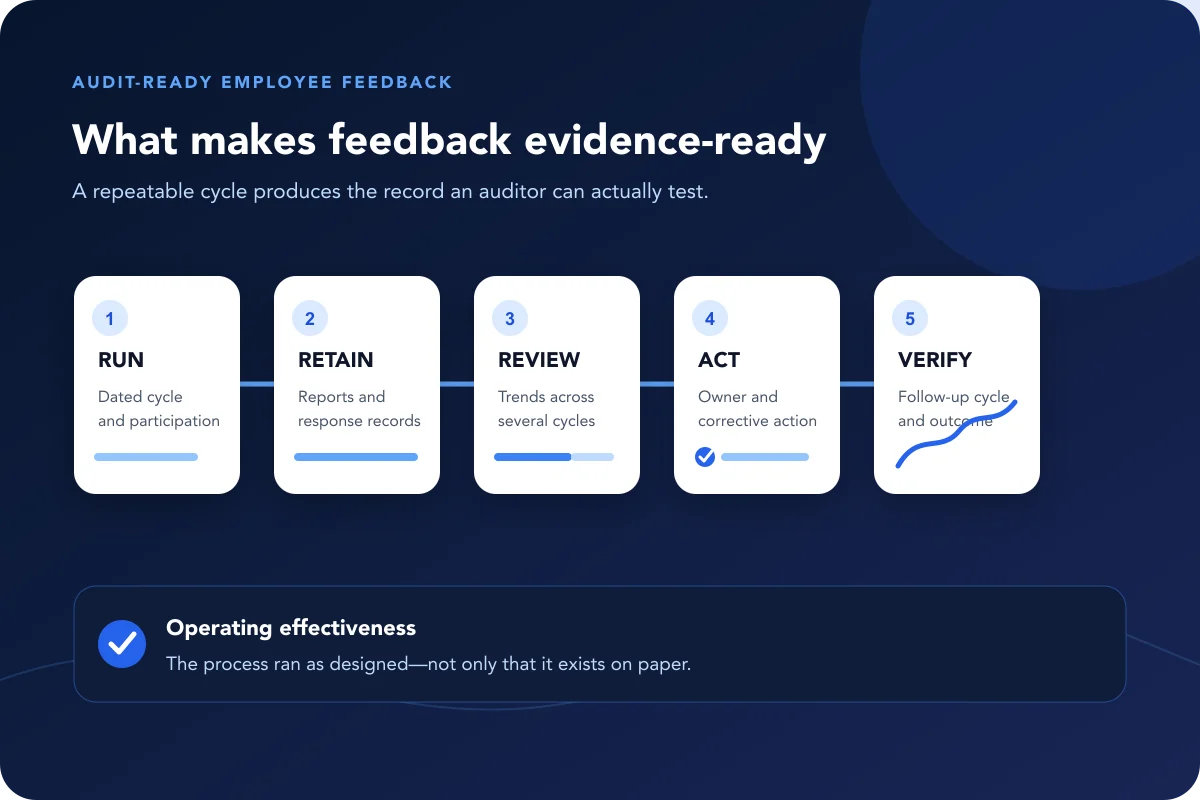
Auditors and internal-controls reviewers draw a distinction worth learning if you have not run into it before: design effectiveness versus operating effectiveness. Design effectiveness asks whether your feedback process, as written, would work if followed correctly. Operating effectiveness asks whether it actually did run that way, cycle after cycle, with evidence to prove it.
A written policy that says the company runs a monthly pulse and reviews results with managers describes design. Twelve months of dated participation records, trend views, and manager sign-offs describe operating effectiveness. Auditors care almost entirely about the second one. A well-written feedback policy with no supporting record behind it reads, to an auditor, as untested at best and theoretical at worst.
The practical takeaway: treat every cycle as evidence-generating, not only insight-generating. Running the survey is necessary, but it isn't sufficient on its own. Keeping the record that you ran it, on schedule, is what actually satisfies the audit.
Corrective-Action Evidence: Closing the Loop
A finding without a documented response is close to worthless as audit evidence, even if the underlying problem was genuinely fixed. Auditors want a traceable link: the specific issue the feedback surfaced, the action taken in response, who owned it, and a follow-up check confirming whether it worked.
Say a mid-size logistics company's quarterly pulse shows a warehouse team's workload item sliding for two straight cycles, alongside open-text comments about being short-staffed during peak shifts. The evidence an auditor wants is not just that decline. It is a record showing someone reviewed it, decided to add two temporary staff for the following quarter, and that the workload item recovered in the next cycle. That three-part chain, finding, action, verified result, is what turns a survey response into corrective-action evidence.
Keep this log separate from your raw survey data if you can. A simple table with columns for the finding, the date it was flagged, the action taken, the owner, and the outcome of the next cycle covers most of what an auditor asks for here.
Continual-Improvement Proof
Continual improvement is a step beyond corrective action. Corrective action fixes a specific problem. Continual improvement shows the process itself is getting better over time, not just repeating.
Concretely, this means keeping a record of changes made to the feedback process itself: a question reworded because it was confusing, a cadence shifted from quarterly to monthly because quarterly missed problems too late, a reporting format changed because managers were not reading the old one. Pair each change with a before-and-after comparison where you can. Say your response rate rose from 61% to 79% after you moved from a 20-question survey to a 10-question one. That comparison is exactly the kind of proof an ISO 9001 auditor is trained to look for under the standard's broader continual-improvement expectation.
Reporting Cadence: Monthly, Quarterly, or Both
Auditors generally accept either a monthly or quarterly reporting cadence for employee feedback, and neither one's automatically more compliant than the other. What matters is that the cadence is defined in writing, followed consistently, and reviewed by someone with the authority to act on it.
Monthly reporting suits teams that want to catch a declining trend early and have the management bandwidth to review results every cycle. Quarterly reporting suits teams that want to reduce survey fatigue and reporting overhead. Just make sure the longer gap doesn't mean a real problem sits unaddressed for three months before anyone looks at it. A useful middle ground many teams land on: run the pulse monthly for the raw trend data, but formally review and document it on a quarterly cycle that lines up with the audit calendar. Our guide to pulse survey cadence walks through how to set and document that cadence so it holds up under review.
Psychosocial Risk Is Becoming Its Own Audit Line
As of 2026, psychosocial risk has moved from a soft HR topic to a line item some auditors specifically ask about, particularly under occupational health and safety management systems. It covers the mental-health impact of things like excessive workload, unclear roles, poor support, weak working relationships, and disruptive organizational change. ISO 45003 is the standard most directly relevant here. It is guidance rather than a certification you can earn on its own, but it sits alongside ISO 45001 and gives organizations a structured way to identify and manage psychosocial hazards as part of the broader OH&S system.
If that's new territory for your organization, our guide to ISO 45003 and psychosocial risk assessment covers the assessment process in detail, and the ISO 9001 employee feedback guide covers the quality-management side of the same underlying data.
Where FeedbackPulse Fits
FeedbackPulse doesn't generate audit reports or issue compliance certificates, and no honest tool can. What it gives you is the raw material an audit-ready program is built from:
- Dated participation and completion tracking for every cycle
- eNPS and pulse trend views that persist across cycles instead of disappearing after one
- Anonymous survey mode that withholds results below a minimum group size automatically, so the privacy control is built in rather than something you have to explain after the fact
You still assemble the corrective-action log, still document the cadence, and still make the call on what counts as a finding worth acting on. That's a deliberate line, not a shortcoming. A vendor claiming to hand you a finished audit package is promising something no feedback tool can actually deliver. A vendor giving you clean, dated, trend-ready data every cycle is giving you exactly what the audit checks for.
Getting Started
Audit-ready isn't a state you reach once and keep. It's a habit: run the same process on the same schedule, keep the dated record, close every meaningful finding with a documented action, and review the trend, not just the most recent score. Do that for a few cycles and the evidence an auditor asks for will already exist in your normal reporting, instead of becoming a scramble the week before the visit.
Frequently asked questions
What does audit-ready employee feedback mean?
It means your survey and pulse process can produce dated participation records, trend data across multiple cycles, and documented evidence that issues raised in feedback led to real action, on request, without weeks of reconstruction. It's a habit built into how you run feedback every cycle, not a document assembled before the audit.
What records do auditors expect for employee feedback participation?
At minimum, a launch date, a close date, an invite count, a response count, and a completion rate for every cycle, ideally broken down by team. If your tool withholds results below a minimum group size for anonymity, document that threshold explicitly instead of leaving the gap unexplained.
What does operating effectiveness mean for a feedback process?
It is the difference between a process that would work on paper and one that demonstrably ran as designed, cycle after cycle, with dated evidence to prove it. Auditors care almost entirely about the second, since a written policy alone shows intent, not practice.
How often should employee feedback reporting happen for audit purposes?
Monthly or quarterly cadences are both generally accepted, as long as the schedule is defined in writing, followed consistently, and reviewed by someone with the authority to act on the results. Neither cadence is automatically more compliant than the other.
What counts as corrective-action evidence for a feedback program?
A traceable chain linking a specific finding from the feedback data, the action taken in response, who owned it, and a follow-up check confirming whether the next cycle showed improvement. A finding with no documented response does not count as evidence, even when the underlying problem was genuinely fixed.
Does ISO 45003 require a specific feedback survey tool?
No. ISO 45003 is guidance for identifying and managing psychosocial risk within an occupational health and safety management system, and it does not mandate any particular tool. What it expects is a structured, repeatable process for gathering and acting on the relevant data, which most survey and pulse platforms can support.