









Someone on your team keeps missing the same commitment. You've mentioned it, probably more than once, and somehow three weeks later you're having almost the exact same conversation again. Now you're also wondering whether the problem is them, you, or the fact that you've never actually said out loud what happens if this keeps happening.
That's not a feedback problem. Feedback is what you say once. What's missing is a way to escalate a pattern that a single conversation hasn't fixed, without either avoiding the issue for another quarter or jumping straight to a consequence nobody saw coming.
This guide covers two frameworks built for exactly that gap: the accountability ladder, which maps where someone is between blaming the situation and owning it, and the Accountability Dial, a five-stage way for managers and team leads to escalate a pattern deliberately instead of repeating the same conversation or letting it go unaddressed. It also covers how accountability differs from responsibility, the questions that come up most often around this topic, and where accountability tends to break down before it ever gets this far.
Key Takeaways
- Responsibility is the task. Accountability is owning the outcome, including when it goes wrong.
- The accountability ladder maps a range of responses from unaware and blaming others (below the line) to owning the issue and fixing it (above the line). Versions differ. The direction doesn't.
- The Accountability Dial (Mention, Invitation, Conversation, Boundary, Limit) is a five-stage way to escalate a repeated pattern deliberately, created by Jonathan Raymond and now trademarked by Ren.
- SBI structures one conversation. The Dial tells you which conversation you're on.
- A boundary you don't enforce isn't a boundary. Consequences only work if they actually arrive.
What accountability actually means at work
"Be more accountable" is one of the most common pieces of manager feedback, and one of the least useful, because most people already think they're being accountable. The confusion usually starts with a different word: responsibility.
Responsibility is the task. It's what someone was assigned to do, the thing with their name next to it on a list. Responsibility can be delegated, shared, or reassigned, and it exists whether or not anyone is watching.
Accountability is owning the outcome, including when it goes wrong. It's what happens after the task is done, or isn't. Someone who's accountable doesn't just complete the work. They can explain what happened, why it turned out the way it did, and what they're doing about it if it didn't land. Someone who's only responsible, without accountability attached, tends to describe problems as things that happened to them rather than things they're answering for.
Here's the distinction in practice. A report was due Friday. The person responsible for it missed the deadline. If they show up Monday with "sorry, I got slammed" and nothing else, that's responsibility without accountability. The task existed, but nobody is actually owning what went wrong or what changes next time. If they show up with "I missed it because I underestimated how long the data pull would take, here's what I'm doing differently for the next one," that's accountability. Same missed deadline. Completely different conversation.
One more distinction worth making: accountability is relational. You're accountable to someone, a manager, a team, a customer, in a way responsibility doesn't require. That's part of why accountability conversations feel more personal than a routine task update, and why they need more care than "just tell them to fix it."
The accountability ladder
The accountability ladder describes where someone is between avoiding a problem and owning it. You'll find it drawn with five rungs in one source, seven in another, and eight somewhere else, and the labels on each rung shift depending on who's telling it. There's no single official version and no one inventor to credit.
What every version agrees on is the direction of travel. The bottom rungs describe blaming the situation. The top rungs describe owning it and fixing it. The rung labels matter less than which way someone is moving, and whether a single conversation is enough to move them, or whether the pattern needs the kind of deliberate escalation covered in the next section.
Here's a commonly used eight-rung version:
| Rung | What it sounds like | Where the person is |
|---|---|---|
| 1. Unaware | "Wait, that was even a problem?" | Doesn't yet see a gap between what happened and what was expected. Below the line. |
| 2. Blame others | "Nobody told me. That's on the team, not me." | Sees the problem, points the cause somewhere else. Below the line. |
| 3. Excuses | "I would have finished it, but things got in the way." | Accepts the problem exists, explains it away instead of addressing it. Below the line. |
| 4. Wait and hope | "Let's see if it sorts itself out next sprint." | Knows it's theirs to deal with, delays acting on it anyway. Below the line, closest to the shift upward. |
| 5. Acknowledge reality | "Yeah, that's on me. It didn't land the way it needed to." | Stops arguing the facts, accepts what happened. Above the line. |
| 6. Own it | "I own this. Here's what I got wrong." | Takes responsibility for the outcome, not just the facts. Above the line. |
| 7. Find solutions | "Here's what I'm going to change." | Moves from admitting the problem to designing a fix. Above the line. |
| 8. Make it happen | "Here's what I did, and here's how I'll check it worked." | Executes the fix and follows up to confirm it held. Above the line, the top rung. |
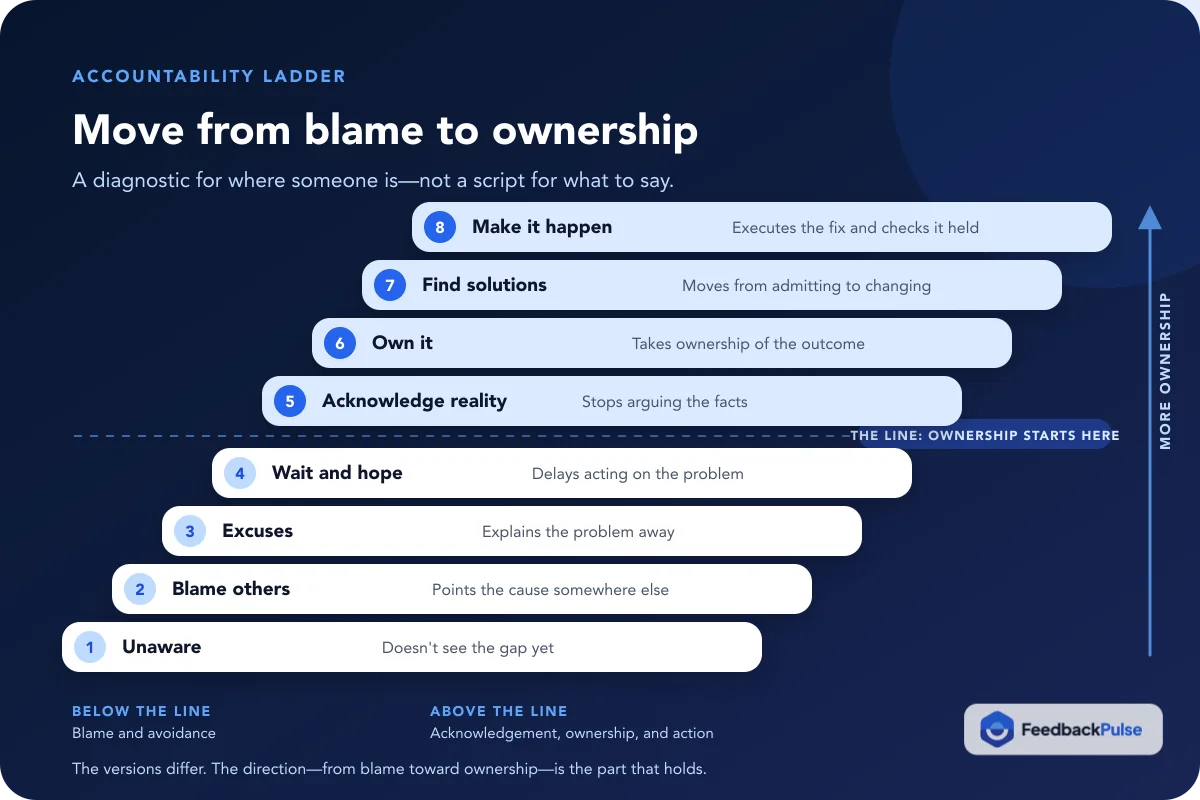
Use the ladder as a diagnostic, not a script. Before a conversation, it's worth asking yourself which rung the other person is actually standing on, because "here's the impact again" doesn't do much for someone stuck on blame, and "here's the consequence" is premature for someone who's already climbing toward a fix on their own.
The Accountability Dial
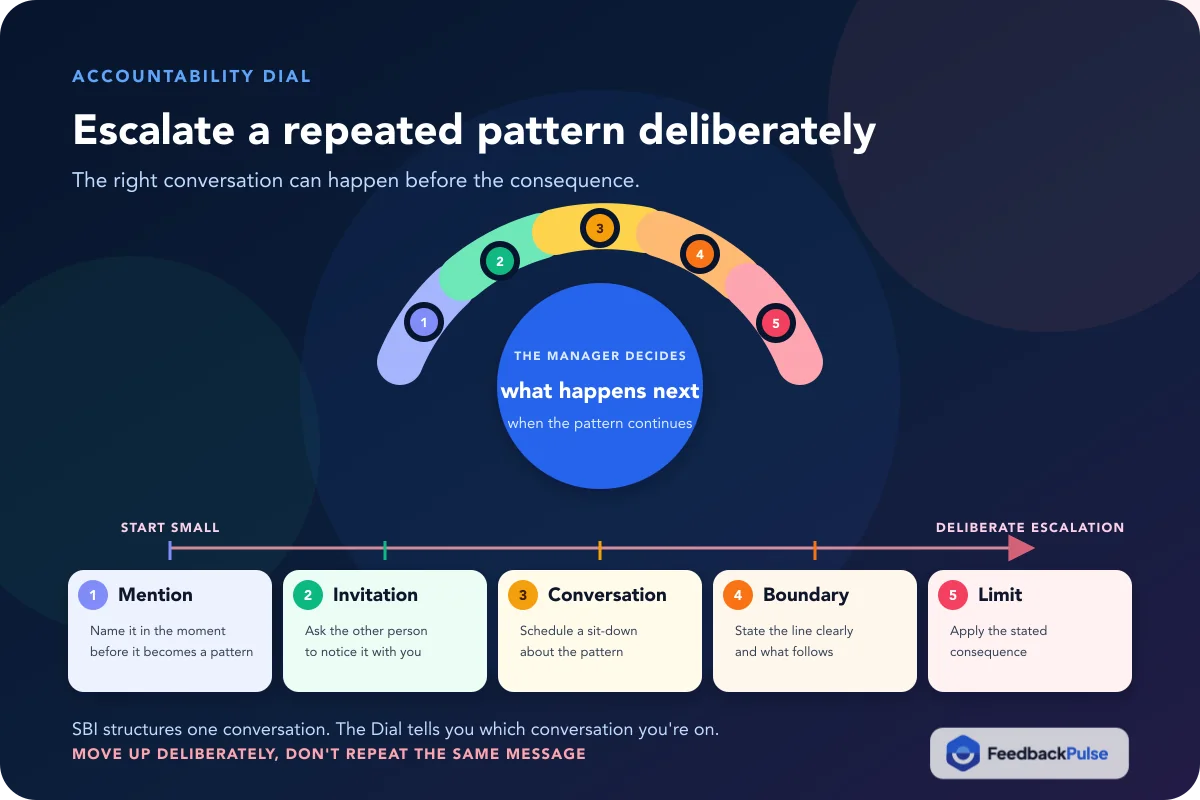
The accountability ladder describes where someone is. The Accountability Dial describes what a manager actually does about it, in five deliberate stages instead of one repeated conversation. It was created by Jonathan Raymond and introduced in his book Good Authority. It's now trademarked as The Accountability Dial by Ren. FeedbackPulse isn't affiliated with Raymond or Ren. We're explaining the framework here because it fills a real gap for managers dealing with a pattern that a single piece of feedback hasn't fixed, not because we created it or have any claim to it.
The five stages move from the lightest possible intervention to the most serious, and the point is to move through them deliberately, not skip from stage one straight to stage five the first time patience runs out.
Mention
A mention is short, seconds, not minutes. It's a real-time, in-the-moment observation dropped into the flow of work rather than scheduled as its own conversation, something like "hey, that's the second time this week." Most patterns resolve right here, because naming something early is often enough on its own. If you're not sure how to phrase it without sounding like a warning shot, examples of negative feedback that stay specific and behavioral are a good place to borrow language from.
Invitation
If the pattern continues, an invitation names it more directly and asks the other person to look at it themselves. This is still informal, but it's no longer incidental. "I've noticed this a few times now, have you noticed it too?" invites the other person into diagnosing the pattern with you, rather than you diagnosing it for them.
Conversation
A conversation is scheduled. It's a sit-down specifically about the pattern, not a passing comment folded into a one-on-one about five other things. This is where you talk about the pattern itself and what's causing it, not just the latest instance of it. It's also where a structured feedback framework becomes useful for organizing what you actually say, more on that below.
Boundary
A boundary states the line clearly, and what happens if it's crossed. This isn't a threat delivered in anger. It's a clear, calm statement made ahead of time, so nobody is surprised later about what the consequence is or why it's happening. This is often the point where a scheduled, difficult performance conversation is the right tool, not another quick check-in.
Limit
A limit is the consequence itself, stated and then applied. This is the stage that makes the previous four mean something. Skip straight to a limit without the earlier stages, and it reads as sudden and unfair, even if the underlying problem was real and well documented. Reach a limit without ever applying it, and every boundary you set after that carries less weight.
How the Dial and SBI work together
These two frameworks solve different problems, and they're meant to be used together, not as alternatives.
SBI is the language for one conversation. It structures a single piece of feedback around the situation, the behavior you observed, and the impact it had, so that one moment gets discussed clearly and specifically.
The Accountability Dial tells you which conversation you're actually on. It's the layer above SBI that decides whether this is still a quick mention, an invitation to notice the pattern together, a scheduled conversation, a stated boundary, or an applied consequence. Use SBI inside the Conversation stage of the Dial to structure what you say. Use the Dial to decide whether you're even having the right kind of conversation in the first place, or whether a pattern has already earned a boundary instead of another round of feedback.
A manager who only knows SBI tends to repeat the same well-structured feedback three or four times without realizing the problem isn't the structure, it's that the situation has already moved past the stage a single conversation can fix. A manager who only knows the Dial without a framework like SBI tends to escalate quickly but vaguely, naming that something's wrong without giving the other person anything specific enough to act on. Together, they cover both the content of the conversation and its timing.
The C's, pillars, and steps of accountability, quickly answered
What are the 5 C's of accountability?
Different writers define the five C's differently, but most versions circle the same five ideas: clarity about what's expected, capability to actually do it, commitment to the goal, consequences tied to whether it happens, and a culture that reinforces follow-through instead of quietly working around it. Treat it as a checklist for whether accountability is even possible in a given situation, not a formula to memorize.
What are the 3 C's of accountability?
The three C's usually compress the same idea into clarity, capability, and consequences, the three conditions that show up across nearly every version of this list. If any one of the three is missing, holding someone accountable gets a lot harder, because you're either asking for something they didn't know was expected, couldn't do, or that carries no real outcome either way.
What are the 7 pillars of accountability?
This one varies more than the C's do. Different sources list different sets of seven, and they often overlap with broader concepts like transparency, fairness, integrity, and responsiveness rather than describing a single agreed model specific to workplace accountability. Read it as a loose organizing idea, not a standardized framework with one accepted source.
What are the 5 steps of accountability?
Most five-step versions walk through a similar sequence: set a clear expectation, confirm the other person understood it the same way you did, check in while the work is happening rather than only at the deadline, give direct feedback the moment it drifts, and follow through with a real consequence or correction if it doesn't land. The exact wording shifts from source to source, but the order rarely changes much.
Where accountability breaks down
Most accountability problems trace back to one of four gaps, and they usually show up long before the "problem employee" conversation people dread.
- Unclear ownership. If two people both think the other one owns a task, neither of them is being unaccountable. The system set them up to fail before either one did anything. Fix the ownership gap before you fix the person.
- No agreed deadline. "Soon" and "when you get a chance" aren't dates. Without a specific deadline both sides actually agreed to, a missed one is a disagreement about expectations, not a broken commitment.
- Feedback that never escalates. A manager mentions the same issue in passing for months without it ever becoming a real conversation. The feedback loop never closes, so the employee has no reason to believe it's actually a problem worth changing.
- Consequences that never arrive. A boundary gets stated once, crossed, and nothing happens. After that, the boundary is just a sentence someone said in a meeting.
Common accountability mistakes
1. Confusing being busy with being accountable
Someone can work long hours, attend every meeting, and still not own the actual outcome they were accountable for. Activity is visible. Ownership is what you're actually managing for, and the two aren't the same thing.
2. Skipping straight to a consequence
Jumping from a first missed deadline straight to a formal warning skips every earlier stage where the issue could have been resolved with a quick conversation. Save the heavier moves for patterns that have already been named and given a real chance to change.
3. Judging the person instead of the pattern
"You're not a team player" describes a person. "You've missed the last three standups without a heads-up" describes a pattern. The second version is something the other person can actually respond to and fix. The first one just makes them defensive. For more on keeping feedback observational instead of character-based, see our guide to giving constructive feedback without discouraging employees.
4. Setting a boundary you don't enforce
A boundary is only real the first time it's tested. State a consequence and then quietly let it slide, and every future boundary you set carries less weight, not just for that one person but for anyone who hears about it.
5. Accepting an explanation as if it were a fix
"I understand why it happened" and "it won't happen again" are two different sentences. Understanding the cause is useful, but it isn't the same as agreeing on what changes. Keep the conversation open until you've landed on an actual next step, not just a reason.
6. Saving the conversation for the performance review
By the time a formal performance review happens, a repeated pattern has often been visible for months. Waiting for the scheduled moment instead of the right moment is its own quiet failure of accountability, this time on the manager's side.
Start the right conversation, not another repeat of the same one
Most accountability problems aren't solved by finding better words for the same conversation. They're solved by recognizing which conversation you're actually having, a first mention, a repeated pattern that needs a real sit-down, or a boundary that's already been crossed, and matching your response to it.
Start smaller than you think you need to. A mention takes seconds and resolves more patterns than any framework gets credit for. When it doesn't, you already have a deliberate next step instead of repeating yourself and hoping this time lands differently.
If you're building the habit of consistent, structured follow-through across a team, not just a single hard conversation, continuous feedback tools can help you track what's been said, what's been agreed, and whether it actually changed, so accountability doesn't rely on any one manager's memory of who said what three months ago.
Frequently asked questions
What is the difference between accountability and responsibility?
Responsibility is the task itself, the thing someone was assigned to do. Accountability is owning the outcome of that task, including explaining what happened when it goes wrong and fixing what caused it. You can be responsible for something without ever being held accountable for how it turned out, and that gap is usually where trust erodes on a team.
What is the accountability ladder?
The accountability ladder is a framework that maps a range of responses to a problem, from unaware and blaming others at the bottom to owning the issue and fixing it at the top. It circulates in several versions with different numbers of rungs and different labels, but every version describes the same direction of travel, away from blame and toward ownership.
Who created the Accountability Dial?
The Accountability Dial was created by Jonathan Raymond and introduced in his book Good Authority. It's now trademarked as The Accountability Dial by Ren. FeedbackPulse isn't affiliated with Raymond or Ren. This page explains the framework because it's a useful escalation model for managers, not because we created it or sell it.
Is the Accountability Dial the same thing as the SBI feedback model?
No. SBI structures a single piece of feedback around the situation, the behavior, and its impact. The Accountability Dial addresses what to do when the same behavior keeps repeating after that feedback has already been given. Used together, SBI gives you the language for one conversation and the Dial tells you which conversation you're actually having.
How long should I stay on one rung, or one stage of the Dial, before moving up?
There's no fixed timeline that fits every situation. What matters more than a specific number of days or repetitions is whether the person has genuinely acknowledged the pattern and changed the behavior, not just apologized for it. If you've had the same conversation twice with no real change in between, that's usually the signal to move up, not to repeat the same message a third time.
What do I do if an employee crosses a boundary I've already stated?
Apply the consequence you already described, as close to the moment as you reasonably can. A boundary you state but don't enforce stops being a boundary, and the next one you set will carry less weight. This is also the point where formal documentation and your HR process may need to get involved, depending on what the boundary and consequence actually were.
Is holding someone accountable the same as micromanaging them?
No, and mixing the two up is a common reason managers avoid accountability conversations altogether. Micromanaging is checking in on how someone does the work. Accountability is agreeing on the outcome up front, then stepping back until there's a real reason to step back in, whether that's a missed deadline, a dropped commitment, or a pattern that keeps repeating.
How do I hold a remote or hybrid employee accountable?
The framework doesn't change, but the visibility does. Without hallway context, a manager has to be more deliberate about the early, low-key stages, a quick async message that names what you noticed, rather than letting a pattern run for weeks because nobody happened to see it in person. Written follow-ups also matter more on distributed teams, since they create a record neither side has to rely on memory for.