







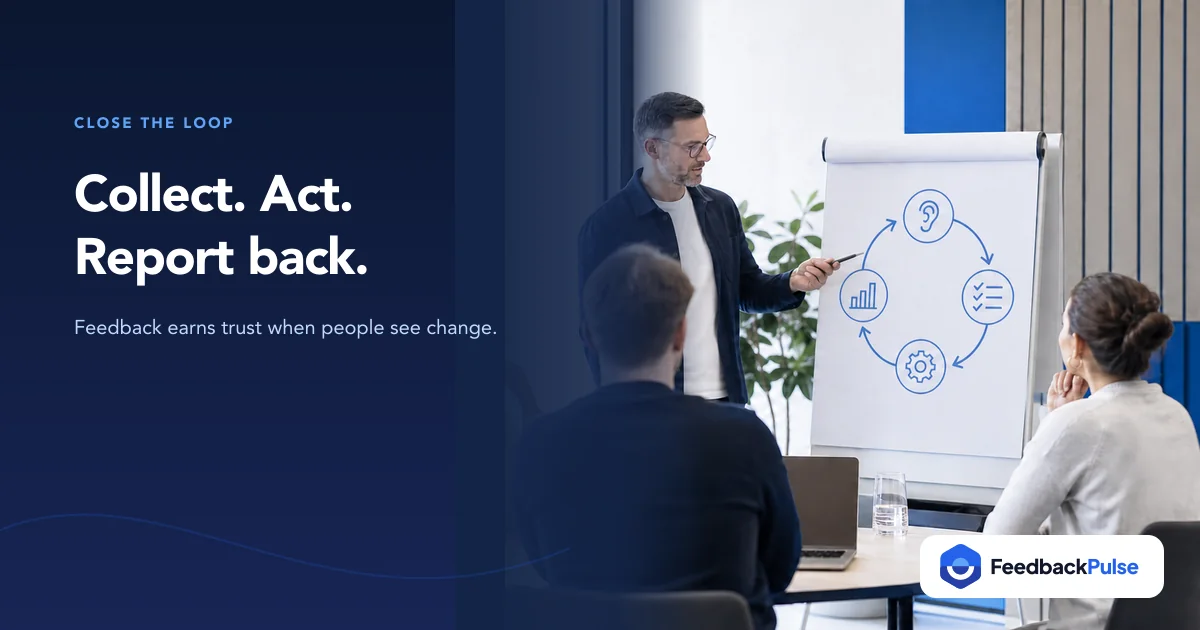
Maya runs people ops for a 70-person software company. Last quarter she launched an anonymous survey, got an 81% response rate, and thanked everyone in an all-hands. Then nothing happened. No actions, no follow-up, no visible change. When she ran the next survey three months later, participation dropped to 44%, and one comment summed up the mood: "Why bother? Nobody listens anyway."
Maya didn't have an engagement problem. She had a broken loop.
If you collect employee feedback but struggle to turn it into visible action, this guide is for you. An employee feedback loop is the cycle that connects what your team says to what actually changes at work. Below we define the term plainly, walk through the four stages, show real workplace examples, and give you a five-step way to build a loop your people trust. The goal is simple: feedback that leads somewhere.
What is a feedback loop?
A feedback loop is a cycle in which the output of a process is fed back as input to shape the next round. In the workplace, an employee feedback loop is the repeatable cycle of collecting input from your team, making sense of it, acting on it, and showing people what changed. The loop closes when employees see their feedback reflected in a real decision.
The term comes from systems theory, where loops either amplify a signal or stabilize it. That same idea maps cleanly onto teams. A healthy loop builds trust and participation over time. A broken one quietly teaches people that speaking up is pointless.
Most companies are good at the first step and weak at the last one. They gather feedback through surveys, one-on-ones, and exit interviews, then stall before anything visible happens. The result is what Maya hit: a one-way street that looks like listening but functions like silence.
Want to see how a closed loop runs in practice? Explore how teams build a culture of continuous feedback instead of relying on once-a-year surveys.
Positive vs negative feedback loops at work
In systems language, a positive feedback loop amplifies whatever is already happening, and a negative feedback loop corrects course back toward a target. Neither label means "good" or "bad" on its own. Both show up in teams every week.
| Loop type | What it does | Workplace example |
|---|---|---|
| Positive (amplifying) | Reinforces and accelerates a behavior | A manager praises a new engineer's clear documentation, so the engineer writes even better docs, and teammates copy the habit. |
| Negative (balancing) | Detects a gap and pulls performance back to target | A pulse survey flags rising workload stress, so a team lead rebalances projects before burnout spreads. |
The practical takeaway is this. You want positive loops around the behaviors you want more of, such as recognition, knowledge sharing, and honest input. You want fast negative loops around risks, such as workload, unclear priorities, and weak manager support. The faster each loop runs, the sooner small issues get corrected before they compound.
Why employee feedback loops matter
The business case rests on one pattern: people keep giving feedback when they see it change something, and they stop when they don't. Closing the loop is the difference between a survey program that strengthens culture and one that slowly erodes trust.
The manager layer carries most of the weight here. Gallup's research consistently finds that managers account for roughly 70% of the variance in team engagement, which means the loop has to reach individual managers to matter (Gallup, State of the Global Workplace). A company-level dashboard doesn't change behavior. One clear insight in a team lead's hands does.
There's also a retention argument. Disengaged employees leave more often, and replacing them is expensive once you count hiring, onboarding, and lost productivity. You can size that cost for your own team with an employee turnover calculator before you decide how much a faster feedback loop is worth.
Consider Devon, a team lead at a 30-person agency. His weekly check-ins surfaced a quiet complaint: handoffs between design and copy kept slipping. Devon did one thing. He added a five-minute sync to the Monday standup and told the team it came directly from their feedback. Within a month, missed handoffs dropped, and his next pulse showed the highest "I feel heard" score he'd ever recorded. The fix was small. The signal that he listened was the real win.
Ready to turn feedback into action your managers can run this week? Start a free trial, no credit card required.
The four stages of a feedback loop
Every effective employee feedback loop moves through four stages. Skip any one and the loop breaks. The most common failure point is the fourth stage, which is also the one competitors talk about least.
1. Collect
Gather honest input on a regular cadence. Pulse surveys, eNPS, one-on-ones, and team retros all work. The key is rhythm, not volume. A short monthly pulse beats a giant annual survey because it catches shifts while you can still act on them. Anonymous response options raise honesty, especially on sensitive topics, so consider anonymous employee surveys when trust is still forming.
2. Analyze
Turn raw responses into a small number of clear themes. You're not writing a research report. You're answering one question: what are the two or three things this team is telling us right now? Watch trends over time, not single readings, because one noisy month rarely means much on its own.
3. Act
Choose one or two concrete actions per team and assign an owner. This is where good intentions die under the weight of long to-do lists. Resist the urge to fix everything. One visible change beats ten promised ones.
4. Close the loop
Tell people what you heard and what you're doing about it, even when the answer is "not yet, and here's why." This step converts a survey into a relationship. We cover it in depth next, because it's where most loops fall apart.
Closing the loop: the step most teams skip
To close the feedback loop, report back to employees within one to two weeks: share the top themes you heard, name the specific actions you're taking, and say what you're deliberately not changing and why. Visible follow-through is what keeps people participating in the next round.
That's the whole game. Research on feedback culture points the same direction: the single biggest driver of repeat participation is demonstrating that input leads to change. Harvard Business Review's work on feedback finds that people grow most when input is specific and tied to a clear next step, not when it's merely delivered (Harvard Business Review, giving feedback). You don't need a polished report. A three-line message from a manager often lands better than a company-wide deck.
Here's a simple template you can reuse after any survey cycle:
- What we heard: the top two or three themes, in plain language.
- What we're doing: one or two specific actions, each with an owner.
- What we're not changing yet: one honest "not now" with the reason.
Picture the contrast. The team at Northwind, a 120-person logistics firm, ran engagement surveys for two years and never reported results back. Participation fell from 78% to 39%. Their new operations lead, Sofia, changed one habit. After each monthly pulse she posted a short "you said, we did" note in the team channel. Six months later participation was back above 70%, and managers started getting feedback in person too, because people finally believed it went somewhere.
Employee feedback loop examples
Loops look different depending on where the feedback comes from. Here are four common ones and what closing each looks like in practice.
- Pulse survey loop: Monthly pulse to spot sentiment shifts, then a "you said, we did" recap. Best for ongoing team health.
- Manager one-on-one loop: Weekly check-ins where a team lead asks for input and visibly acts on one item. Best for fast, personal course-correction.
- Performance review loop: Structured review cycle with self-assessment, peer input, and a clear development plan. Best for growth and promotion decisions.
- Exit interview loop: Patterns from departing employees fed back into retention changes. Best for catching systemic issues you can't see from the inside.
Each of these only counts as a loop if it closes. A one-on-one where the manager nods and forgets isn't a loop. It's a conversation that goes nowhere. If you want a shared language for giving the input itself, the SBI feedback model gives managers a simple structure for situation, behavior, and impact.
How to build a feedback loop in 5 steps
You don't need a people-science team or a heavy platform to start. You need a cadence and the discipline to close the loop. Here's a lean rollout that a busy team lead can run.
- Pick one cadence and stick to it. Start with a short monthly pulse of under 10 questions. Consistency matters more than length. The pulse surveys guide covers question design if you want a head start.
- Make honesty safe. Offer an anonymous option and explain how responses are used. Trust drives response quality.
- Analyze for two or three themes. Skip the urge to report everything. Find the signal, then move.
- Assign one action per team, with an owner. A named owner and a date turn insight into a decision rather than a wish.
- Close the loop in writing. Within two weeks, share what you heard, what you'll do, and what you won't. Then repeat the cycle.
Run that loop three times and you'll have something most companies never build: a team that believes feedback is worth giving. Managers who want a ready-made starting point can use the team survey builder to launch the first pulse in minutes.
Why feedback loops fail (and how to fix them)
Most broken loops fail for the same handful of reasons. Spot yours early and the fix is usually cheap.
- Silence after collection. You gather feedback and never report back. Fix: commit to a "you said, we did" note every cycle, even a short one.
- Too many actions. You promise to fix everything, so nothing ships. Fix: one or two owned actions per team, no more.
- Wrong altitude. Insights stop at a company dashboard and never reach managers. Fix: route team-level results to each team lead with a clear next step.
- Annual-only cadence. Surveys arrive too late to act on. Fix: move to a monthly or quarterly pulse so signals stay fresh.
- No owner. Actions float without accountability. Fix: assign a name and a date to every commitment.
This is the gap that separates tools built for SMB action from heavier platforms built for enterprise reporting. If you're weighing options, our take on 15Five alternatives walks through which feedback systems actually help small teams close the loop versus drown them in dashboards.
Feedback loop vs annual review
The annual review is the slowest possible loop. By the time feedback arrives, the moment to act has usually passed. A continuous feedback loop runs the same cycle on a tighter rhythm, so problems get corrected in weeks instead of quarters.
You don't have to choose one or the other. The strongest approach pairs a continuous pulse for early signals with a structured review once or twice a year for depth. Treat engagement as an operating rhythm, not an annual event. Teams that adopt this pattern catch risks earlier and spend less time firefighting, which is exactly what lean operations leaders need. Managers can anchor the ongoing rhythm with the resources built for team leads.
Frequently asked questions
What are the 5 steps of a feedback loop?
A common five-step version is: collect input, analyze it for themes, decide on an action, communicate the plan, and review the impact in the next cycle. The fifth step feeds the next loop, which is what makes it continuous rather than a one-off survey.
What are the three Cs of feedback?
The three Cs of feedback are usually defined as clear, candid, and constructive. Clear means specific and easy to act on. Candid means honest rather than vague. Constructive means focused on improvement rather than blame.
How often should you run an employee feedback loop?
For most growing teams, a monthly pulse paired with one or two deeper engagement surveys per year works well. Monthly keeps signals fresh enough to act on, while the longer survey adds depth. The right cadence is the one you can sustain and close every time.
What is the difference between a feedback loop and a survey?
A survey is one step in the loop. The loop also includes what happens after the survey: analyzing results, taking action, and reporting back. A survey without those steps is data collection, not a feedback loop.
Turn feedback into a loop that closes
An employee feedback loop is only as strong as its final step. Collecting input is easy. Closing the loop, by showing people what changed because they spoke up, is what builds trust and keeps participation high.
Keep it simple. Pick one cadence, find two or three themes, assign one owned action per team, and report back in writing within two weeks. Then run it again. Small, consistent loops compound into culture far more reliably than one big annual initiative.
If you want a lightweight way to run that rhythm without enterprise overhead, FeedbackPulse helps growing teams collect honest feedback, spot sentiment shifts, and assign clear actions managers can run this week. Start your free trial and close your first loop this month.