









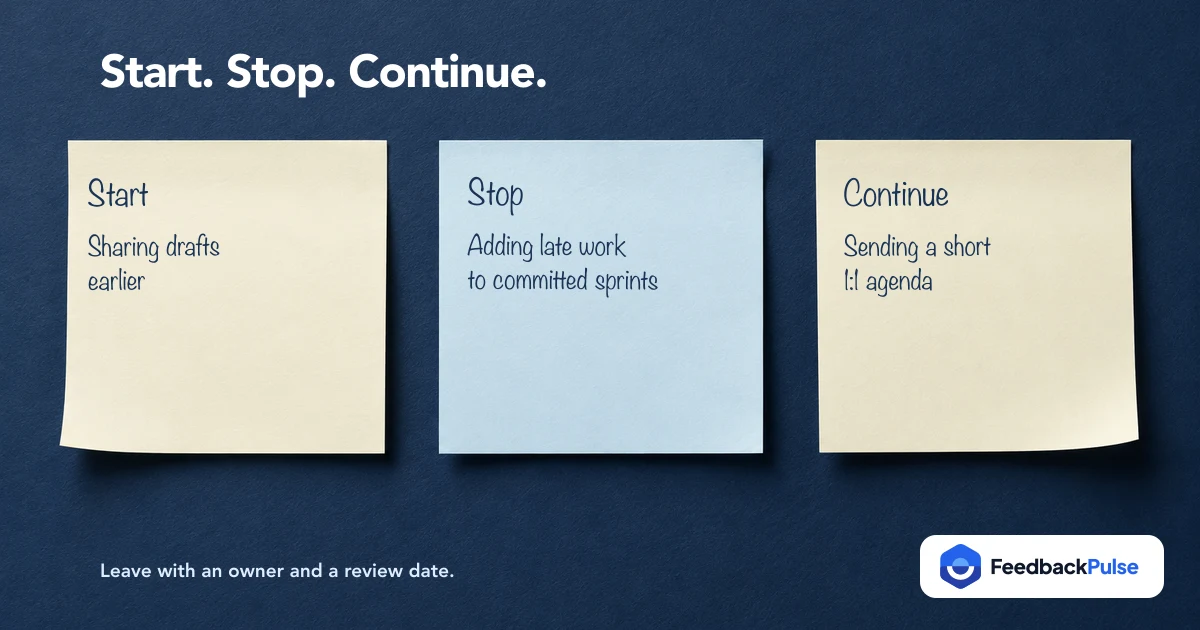
Start, Stop, Continue is a feedback framework built on three questions: what should we start doing, what should we stop doing, and what should we keep doing. You answer them about a project, a team, a working relationship, or yourself, and the three columns give you a balanced picture of what to add, what to drop, and what to protect.
It is popular because it takes about ten minutes to explain and needs no template or software. That is also its weakness. It is easy to run, so it is easy to run badly: a flurry of sticky notes, a nice conversation, and a list nobody opens again. This guide covers how to run it three ways, gives you a bank of 20+ examples you can adapt, and spends real time on the step most pages skip, which is what happens to the list afterward.
Key Takeaways
- Three prompts, one balanced picture. Start adds, Stop removes, Continue protects what already works.
- It works at four scales: solo self-review, a 1:1, a team retro, and upward feedback to a manager.
- Good items are specific and observable. Vague items like communicate better cannot be acted on or checked.
- The list is not the output. Owned, dated actions that get revisited next cycle are.
- It complements SBI. Start, Stop, Continue is a broad sweep. SBI is one behavior in one conversation.
What Start, Stop, Continue is
The framework has three prompts, and each one does a different job.
- Start: What is missing? New habits, practices, or experiments we are not doing yet.
- Stop: What is costing us more than it gives back? Meetings, handoffs, behaviors, or processes that should end.
- Continue: What is working and deserves protection? This is the column people skip, and it matters.
The order is deliberate. Starting with Start keeps the conversation constructive and forward-looking before anyone gets defensive. Stop comes second, once people have warmed up and there is momentum to say harder things. Continue goes last so the session ends on what is working, and so a team does not accidentally optimize away something valuable in its enthusiasm to change.

There is no single agreed origin for the method. It shows up under several names, including Stop, Start, Keep, in management training and in agile retrospective practice, so this page does not credit it to anyone.
How to run it
The three prompts stay the same. What changes is who is in the room and how much structure you need.
Solo: a self-review
Block thirty minutes at a natural reset point, such as a new quarter, a new role, or just before a performance review. Look at your calendar and recent work, then write at least three items in each column. Be strict about the Stop column: it should include something you actually enjoy but that is not paying off. Finish by picking one item per column to act on this month. If you are preparing for a formal review, this pairs well with a self-assessment.
In a 1:1
Send the three prompts a day ahead so both people arrive with notes. Take turns: the employee goes first on how the manager could start, stop, and continue, then the manager shares theirs. Going second matters, because a manager who goes first sets the tone and everything after sounds like a response. Keep it to one item per column per round so the conversation stays concrete. Agree who will do what by when before the meeting ends. If a Stop item is really about one behavior, take it into a separate conversation structured with SBI.
As a team session
A standard session runs 45 to 60 minutes.
- Set the scope (5 minutes). Name the period or project being reviewed, and agree on a norm: we discuss patterns and processes, not individuals.
- Write silently (8 to 10 minutes). Everyone writes items in all three columns on their own. Silent writing stops the loudest voice from anchoring the room.
- Share and group (15 minutes). Read items out, cluster duplicates, and note which ones several people raised independently.
- Vote (5 minutes). Each person gets a few votes to place on the items they most want acted on.
- Commit (10 to 15 minutes). Take the top few, and assign each a single owner and a date. Stop at three to five commitments. More than that and none of them will happen.
This is the same shape as a sprint retrospective, and many agile teams run it exactly this way. The difference when you use it for people feedback rather than process feedback is that the Stop column can touch on behavior. Lean on the norm you set at the start, and consider collecting the input anonymously beforehand.
20+ start, stop, continue examples
Use these as raw material, not a script. Swap in the specifics of your own team, because the best items always name a real behavior or process.
Team retro examples
- Start writing a one-line goal for every ticket before it is picked up.
- Start a ten-minute demo of finished work at the end of each week.
- Stop adding unplanned work to a sprint after it has been committed.
- Stop holding a status meeting that could be a shared document.
- Continue the pairing sessions for new starters, since they are shortening ramp-up.
- Continue the written handover note at the end of each shift.
1:1 examples (manager and direct report)
- Start bringing one question you are unsure about to every 1:1, not only status updates.
- Start telling me earlier when a deadline is at risk, even if you think you can still recover it.
- Stop rescheduling our 1:1 when other work gets busy, because it signals that the conversation is optional.
- Stop solving problems in the meeting that I would rather talk through with you first.
- Continue sending the short agenda ahead of time, which keeps us on what matters.
Peer feedback examples
- Start tagging me in the channel when a decision affects my work, not after it is made.
- Start sharing drafts earlier, even when they are rough.
- Stop answering questions in a side thread that the whole team would benefit from seeing.
- Stop taking over the discussion when someone else is mid-explanation.
- Continue giving specific praise in public, because it helps the rest of us see what good looks like.
Self-review examples
- Start blocking two hours a week for focused work with notifications off.
- Start asking for feedback within a day of finishing a big piece of work, while it is fresh.
- Stop saying yes to every request before checking whether it fits my priorities.
- Stop polishing work past the point where anyone would notice the difference.
- Continue the weekly review of what I finished, since it makes performance conversations much easier.
Upward feedback to a manager
- Start explaining the reason behind a priority change, not only the change itself.
- Start giving feedback close to the moment, rather than saving it for the review.
- Stop adding new requests to someone's plate without asking what comes off it.
- Stop changing direction in meetings with senior stakeholders and telling the team afterward.
- Continue protecting the team from last-minute requests from outside, which makes planning possible.
What makes an example good
Look at the items above and a pattern appears. Each one names an action someone could see happen or not happen. Compare these pairs:
| Vague | Specific |
|---|---|
| Communicate better | Post a short update in the project channel by Wednesday each week |
| Stop being negative | Stop opening the meeting with the list of what went wrong |
| Continue being supportive | Continue pairing with newer teammates on their first release |
| Start taking ownership | Start naming an owner in the notes for every action item |
The test is simple: could two people disagree about whether this happened last week? If so, rewrite it. For help phrasing the harder Stop items without making them personal, see these negative feedback examples and the guide to giving constructive feedback without discouraging employees.
Where it beats SBI, and where it does not
Start, Stop, Continue and the SBI feedback model solve different problems.
SBI is one behavior, one conversation. You describe the situation, the behavior, and the impact, and the other person gets something precise to respond to. It is the right tool when you have a specific moment to address.
Start, Stop, Continue is a broad, periodic sweep. It collects many items across a project, a quarter, or a relationship, and it is good at surfacing themes you did not know to ask about. It is weaker on depth, because a single line like stop interrupting does not explain the situation or the impact.
Use them together. Run the sweep, notice that three people raised the same Stop item, and then use SBI to have the actual conversation about it. If the same item keeps returning after you have discussed it, that is a different problem, and the accountability ladder and dial are built for it.
What to do with the output
This is the step most explanations leave out, and it is where the exercise either pays off or becomes theater.
- Cluster and cut. Merge duplicates, then choose three to five items. A long list is a wish list, not a plan.
- Give each item an owner. One name, not a team. Shared ownership usually means nobody owns it.
- Give each item a date. Either a deadline or a specific point at which you will check progress, such as the next 1:1 or the next retro.
- Say what you will not do. Some items will not make the cut. Tell people so, and why, rather than letting them wonder.
- Share it back. Send the committed list to everyone who contributed. This is the step that makes people believe the next round will matter.
- Open the next session with the last one. Spend the first five minutes on what happened to the previous list. This is the single habit that turns a one-off workshop into a feedback loop.
If you run the exercise often, doing the collection step as a short recurring survey saves the room time. People answer the three prompts on their own, anonymously if you choose, and you arrive at the session with the themes already grouped. You can draft one with the team survey builder, then keep the follow-up visible in one place so the commitments from this quarter are still there next quarter. That is the idea behind continuous feedback: the input is regular, and so is the response.
Common mistakes
No owner
An item that belongs to everyone belongs to no one. If you cannot name a person next to it, it is not an action yet.
No deadline
Without a date, an item has no moment at which it can be called done or late. Pick a date, or pick the session at which you will review it.
Ignoring the Stop list
Start items are exciting and Continue items are comfortable, so Stop items are the ones that quietly get dropped. They are also the ones that require someone to give something up. Make a point of committing to at least one.
Running it once and never again
A single session gives you a snapshot. The value comes from repeating it, so people can see that what they said last time led to something. Put the next session on the calendar before you close this one.
Letting the loudest voice win
Without silent writing or anonymous collection, the most senior or most talkative person shapes the list. Collect first, discuss second.
Turning it into a verdict on individuals
The framework works best on behaviors and processes. If a Stop item is really a complaint about a person, take it out of the group session and handle it directly.
Make the list the start, not the end
Start, Stop, Continue is useful because it is simple, and it stays useful only if the simple part is followed by the harder part. Pick a scale, run it this month, and finish with three or fewer actions that each have an owner and a date. Then put the review on the calendar.
If you are a manager building the habit across a team, the team leads page shows how recurring check-ins and visible follow-up fit together between formal review cycles.
Frequently asked questions
What is start stop continue?
Start, Stop, Continue is a simple feedback framework built on three prompts, asking what we should start doing, what we should stop doing, and what we should continue doing. It works for a team retrospective, a one-on-one, peer feedback, a self-review, or feedback to a manager. The value is in the balance, because it asks for new ideas, for things to drop, and for things already working that deserve protection.
What are good start stop continue examples?
A good example is specific, observable, and tied to a behavior or process rather than a personality. Start sending a written agenda 24 hours before meetings, stop reviewing work in the final hour before a deadline, and continue the Friday handover note that keeps the next shift informed. Vague items like communicate better or be more positive are hard to act on and hard to check later.
What is a start stop continue session?
A start stop continue session is a short facilitated meeting, usually 30 to 60 minutes, where a team or pair fills in the three columns, groups similar items, picks a small number to act on, and assigns an owner and a date to each. It is most often used as a retrospective at the end of a project, sprint, or quarter.
How is start stop continue different from SBI?
SBI structures a single piece of feedback around a situation, a behavior, and its impact, so it suits one specific moment. Start, Stop, Continue is a broad, periodic sweep that collects many items across a project or relationship. They work well together, with the sweep surfacing a theme and SBI giving you the words for the conversation about it.
Who invented start stop continue?
There is no single agreed origin. The method appears under several names, including Start, Stop, Continue and Stop, Start, Keep, in management training and in agile retrospective practice, and different sources credit different people. This page does not attribute it to anyone because no attribution is reliably settled.
How often should you run a start stop continue exercise?
Match the cadence to the work. Project teams often run it at the end of each iteration or milestone, managers might use it once a quarter in one-on-ones, and individuals can do a self-review at a natural reset point like a new role or a performance cycle. Running it once and never again is the most common failure, so pick a rhythm you can keep.
Can start stop continue be anonymous?
Yes, and anonymity often produces more honest Stop items, especially when feedback is going to a manager or a senior colleague. A short anonymous survey with the three prompts lets people answer without worrying about who said what. For small teams, keep the group size in mind, because a handful of respondents can make answers easy to attribute.
What should you do with the results of a start stop continue exercise?
Group similar items, choose a small number to act on, and give each one a named owner and a date. Share the list back with the people who contributed, then check progress at the next session. The list alone changes nothing, and a Stop list that nobody revisits quickly teaches people that the exercise is a formality.