





Workday sells Peakon Employee Voice by commercial quote. Its public product page has no commercial rate card. A historical UK public-sector rate card lists £14.58 to £50.10 per employee per year, depending on headcount.
FeedbackPulse publishes this comparison and sells a competing product.
How much does Workday Peakon cost?
Start with Workday's Employee Voice product page to request a demo. For a commercial budget, ask for a subscription price and a separate estimate for deployment and training.
Historical UK public-sector pricing
Workday's G-Cloud 14 subscription pricing document assumes a three-year subscription covering the full employee population. The document gives Peakon Employee Voice its own G-Cloud service rates in GBP. The subscription excludes education, training, deployment and additional instances. Workday lists those on separate order forms. G-Cloud 15 replaced G-Cloud 14. Use this table as a historical benchmark and request current terms for budgeting. Government Commercial Agency framework listing
| Employees | Per employee/year | Annual example |
|---|---|---|
| 600–1,000 | £50.10 | £30,060 for 600 |
| 1,001–1,500 | £40.08 | £60,120 for 1,500 |
| 1,501–3,500 | £33.74 | £101,220 for 3,000 |
| 3,501–10,000 | £28.68 | £143,400 for 5,000 |
| 10,001–25,000 | £23.17 | £347,550 for 15,000 |
| 25,001–50,000 | £18.40 | £736,000 for 40,000 |
| 50,001+ | £14.58 | £874,800 for 60,000 |
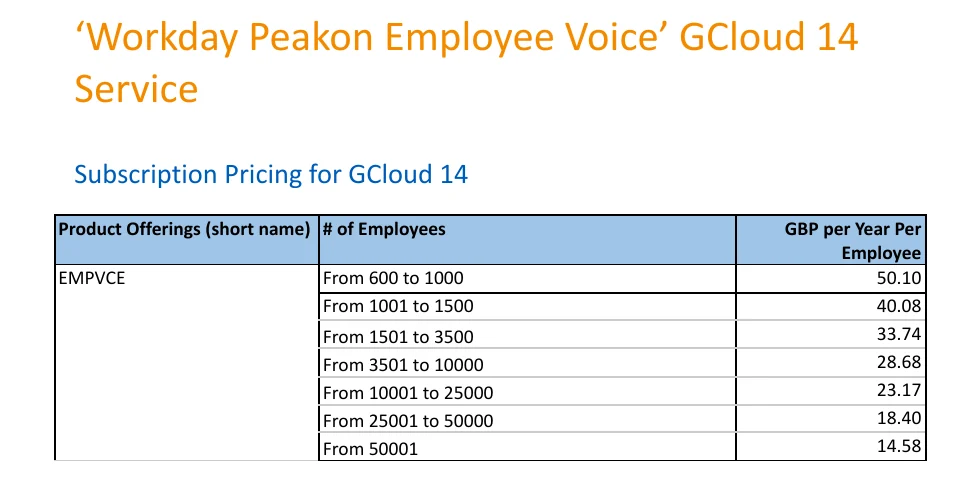
At 600 employees the £30,060 annual subscription adds up to £90,180 over three years before separate services. Commercial buyers should request a quote for their own headcount and term.
Can you buy Peakon without Workday HCM?
Ask Workday whether you can buy Peakon with your current HR system. Confirm whether the contract requires Workday Human Capital Management (HCM) and what it would cost to connect your system.
What drives Peakon pricing
Because Workday publishes no rate card, we cannot tell you how its quote is built. What we can do is list the variables that typically move the price of any enterprise engagement-survey platform, and tell you to ask Workday about each one. Treat this as a checklist, not as Workday's pricing model.
| Variable to ask about | Why it matters |
|---|---|
| Headcount band | Per-employee rates usually fall as headcount rises, and small teams can hit a minimum spend |
| Minimum contract value | A floor makes a 40-person team pay like a much larger one |
| Modules included | Engagement, retention, leadership development, DEI and well-being are listed as solution areas; ask which are in the quote |
| Benchmarks and AI | True Benchmark, Gen-AI summaries and attrition prediction are marketed features; confirm they are not add-ons |
| Contract length | Multi-year terms often lower the annual rate but lock you in |
| Implementation | Workday says deployments take "a matter of weeks"; ask whether setup and training are included |
| Integrations | Teams, Slack and REST API export are named; ask what is included and what is extra |
| Workday HCM relationship | Whether the price depends on being an existing Workday customer |
| Renewal terms | Caps on annual increases, and what happens to the price at renewal |
Get every item in writing. Two quotes are only comparable if they cover the same headcount, modules and term.
Annual cost by team size
Compare the cost of the listening features you need. The G-Cloud rate card above starts at 600 employees. Use this USD baseline to compare a written quote with FeedbackPulse's published prices.
| Employees | Basic Surveys | Pro |
|---|---|---|
| 25 | $600 | $1,200 |
| 50 | $1,200 | $2,400 |
| 100 | Quote | $4,800 |
| 250 | Quote | $11,280 |
Totals are in USD per year. FeedbackPulse Basic Surveys is $2 per employee per month, billed annually, with a quote required from 100 employees. Pro is $4 per employee per month on annual billing. At 250 employees the 10% volume discount applies to seats 101–250.
What Peakon offers for the price
To be fair to Workday, here is what its own pages claim. These are marketing claims, not independent findings.
- Benchmarking. Workday describes "True Benchmark" technology that adjusts for demographic variations so managers can judge expected engagement levels.
- Adaptive surveys. Intelligent surveys with follow-up questions based on recent feedback.
- AI. Gen-AI themes and summaries, and AI-based attrition prediction.
- Speed. Workday says deployments do not have to take years and can run in a matter of weeks.
- Integrations and data. Microsoft Teams and Slack are named, and sentiment data can be exported through a REST API in raw or aggregated form that respects a minimum segment size for confidentiality.
- Outcome claims. Workday cites a 57-point eNPS increase, a 10% reduction in voluntary turnover and a 10x return from lower attrition on its overview page, sourced to its own webinar. It also cites a 2023 Forrester Total Economic Impact study commissioned by Workday, with figures of 50% more time saved for managers, 75% more time saved for HR and a 224% return on investment. Both sets come from Workday, not from an independent benchmark.
None of that is small. A company with several thousand employees, a Workday footprint and an analytics team to use the data may get real value from it. The price question is whether you will use enough of it.
When Peakon makes sense, and when it does not
Peakon is likely a good fit if:
- You already run Workday and want listening to sit in the same vendor relationship.
- You have a large or global workforce and want benchmarking and attrition prediction in the product.
- You have HR analytics capacity to act on the output.
- A sales-led purchase with a quote, demo and contract is normal for your procurement.
A published-price tool may be a better fit if:
- You have under about 1,000 people and want to know the annual cost before talking to anyone.
- You need engagement or pulse surveys, response rates and eNPS, not a full listening suite.
- You want to try the tool with a real survey before signing a contract.
- You want performance reviews and 360 feedback under the same login without a separate quote.
FeedbackPulse as a priced alternative
FeedbackPulse is an employee engagement and performance platform for small and mid-sized companies. It is free for up to 10 people. Beyond that:
- Basic Surveys, $2 per employee per month, billed annually. Engagement and pulse surveys, Slack invitations and reminders, results and response rates, AI summaries and eNPS benchmarks. Self-serve for 1 to 99 employees, and quote-based from 100.
- Pro, $4 per employee per month billed annually, or $5 billed quarterly. Everything in Basic Surveys plus performance reviews, 360 feedback and priority chat and email support.
- Max, $8 per employee per month billed annually, or $10 billed quarterly. Everything in Pro plus goals and Microsoft Teams employee import.
Surveys can be anonymous with anonymity thresholds. Review cycles run monthly, quarterly, semi-annually or annually, each with a manager form and a self-review. A 360 covers self, manager and peer views and shows the gap between self and others' views. Results can be held before release, and past cycles are kept as snapshots.
Where FeedbackPulse is lighter: it does not have calibration or goal carryover between cycles, and it is not built for the multi-thousand-person, multi-country rollouts Workday targets. If that is your situation, Peakon belongs on your shortlist.
How to get a useful Peakon quote
- State headcount precisely. Give the number you will survey now and the number you expect in 12 months.
- Ask the Workday HCM question first. Can Employee Voice be bought without it, and does the price change?
- Ask for a line-item quote. Modules, benchmarking, AI features, integrations, implementation and support, each priced or marked included.
- Ask about the term. Annual versus multi-year, and the renewal increase cap.
- Ask for a pilot. If a proof of concept is offered, get the terms in writing. We found no free trial on the pages we checked.
- Get one comparison quote. Put it next to a published-price option so you can see the gap. Our Peakon alternatives guide covers six tools, and our best employee survey software list compares the wider market.
How to compare the final quote
Ask Workday for first-year and renewal totals with the same employee population and survey programs you give every vendor. If you buy through a public-sector framework, confirm the current rates, contract length and deployment costs against the order form.
Frequently asked questions
How much does Workday Peakon cost?
Workday quotes commercial prices. Its UK public-sector G-Cloud 14 document lists subscription rates from £14.58 to £50.10 per employee per year by headcount, on a three-year term. Workday uses separate order forms for deployment and training.
Does Workday Peakon have a free plan or free trial?
We found no free plan on Workday's Peakon pages. The pages we checked offer only Contact Sales and Request a Demo, so the way to evaluate Peakon is through a sales conversation. FeedbackPulse has a free plan for up to 10 people, with no credit card.
Can you buy Peakon without Workday HCM?
Ask Workday whether the commercial contract you are considering requires Workday Human Capital Management. Workday’s public product page leaves that requirement unspecified.
Is Peakon the same as Workday Peakon Employee Voice?
Yes. Workday acquired Peakon and rebranded it Workday Peakon Employee Voice. People still search for it as Peakon, and the two names refer to the same listening product.
What is a cheaper alternative to Peakon for a small company?
FeedbackPulse publishes its prices. It is free for up to 10 people, then Basic Surveys is $2 per employee per month billed annually, Pro is $4 and Max is $8. A 50-person team on Basic Surveys pays $1,200 a year. See the Peakon alternatives page for other options.
Does Peakon have benchmarks and AI features?
Yes, Workday markets both. Its pages describe True Benchmark technology, intelligent surveys with adaptive follow-up questions, Gen-AI themes and summaries, and attrition prediction. These are Workday's own marketing claims. The open question for buyers is what they cost, not whether they exist.