





The best Viva Glint alternatives are FeedbackPulse if you want self-serve software with published pricing and no seat minimum, Workleap if you want engagement and reviews for one annual fee, 15Five if you want pulses tied to manager check-ins, Culture Amp or Qualtrics Employee Experience if you need research-grade depth at enterprise scale, and Lattice if you're buying performance management anyway. Which one fits depends on a question most comparisons skip: are you actually inside the Microsoft ecosystem this product was built for?
Most people who search for Viva Glint alternatives aren't unhappy with the surveys. They're running into the two things that make it an enterprise purchase: a seat minimum and a sales conversation.
Microsoft prices Viva Glint at $2.00 per user per month, and that number is real and published. What's less visible until you go looking is that it requires 50 seats to buy, and there's no checkout button, only a path to "contact your Microsoft representative." That's a reasonable process for a company already deep in a Microsoft 365 enterprise agreement. It's a poor fit for a 30-person company that wants a monthly engagement survey and a price it can see today, the kind of number FeedbackPulse publishes with no seat minimum. This guide covers what Viva Glint actually includes, where it's genuinely strong, and six alternatives sorted by what you're replacing.
Key Takeaways
- Viva Glint costs $2.00/user/month billed yearly, with a 50-seat license minimum and no self-serve checkout (Microsoft Viva Glint pricing page, September 2026).
- Viva Pulse is not bundled with Viva Glint. Editing Viva Pulse surveys requires the full Viva Suite at $12/user/month; Viva Glint alone doesn't include it.
- FeedbackPulse is the closest self-serve alternative: free for up to 10 people, then $4/employee/month billed annually, with no seat minimum and results locked until three people respond on every breakdown.
- Confidentiality thresholds in Viva Glint are recommendations an admin can change (5+ respondents for scores, 10+ for comments), not a fixed rule.
- Viva Glint is strong for Microsoft 365-native organizations, with Copilot-assisted comment analysis, Teams and Entra ID integration, and 70+ language support. If your org already runs on that stack, weigh that before switching.
Viva Glint alternatives at a glance
Prices are each vendor's published rate, captured September 2026, or marked where none is published.
| Tool | Best for | Starting price | Free plan | Seat minimum | Self-serve signup |
|---|---|---|---|---|---|
| FeedbackPulse | SMBs that want published pricing, no seat minimum | $4/employee/mo (annual) | ✅ Up to 10 people | None | ✅ |
| Workleap | Engagement plus reviews for one annual fee | From $4,999/year (Standard) | ❌ | None published | ❌ Sales-assisted |
| Culture Amp | Research-grade analytics at scale | Quote-based, est. ~$4,500/yr minimum | ❌ | None published | ❌ Sales-led |
| 15Five | Pulses tied to manager check-ins | $4/user/mo (Engage, annual) | ❌ | None published | ✅ |
| Lattice | Surveys alongside performance management | $4,000/yr minimum agreement | ❌ | None published | ❌ Sales-led |
| Qualtrics Employee Experience | Enterprise research-grade survey design | No published price | ❌ | None published | ❌ Sales-led |
| Viva Glint | Microsoft 365-native enterprise listening | $2.00/user/mo (annual) | ❌ | 50 seats | ❌ Rep-led |
What Viva Glint is, and how Microsoft sells it
A standalone survey product, priced separately from Viva Pulse
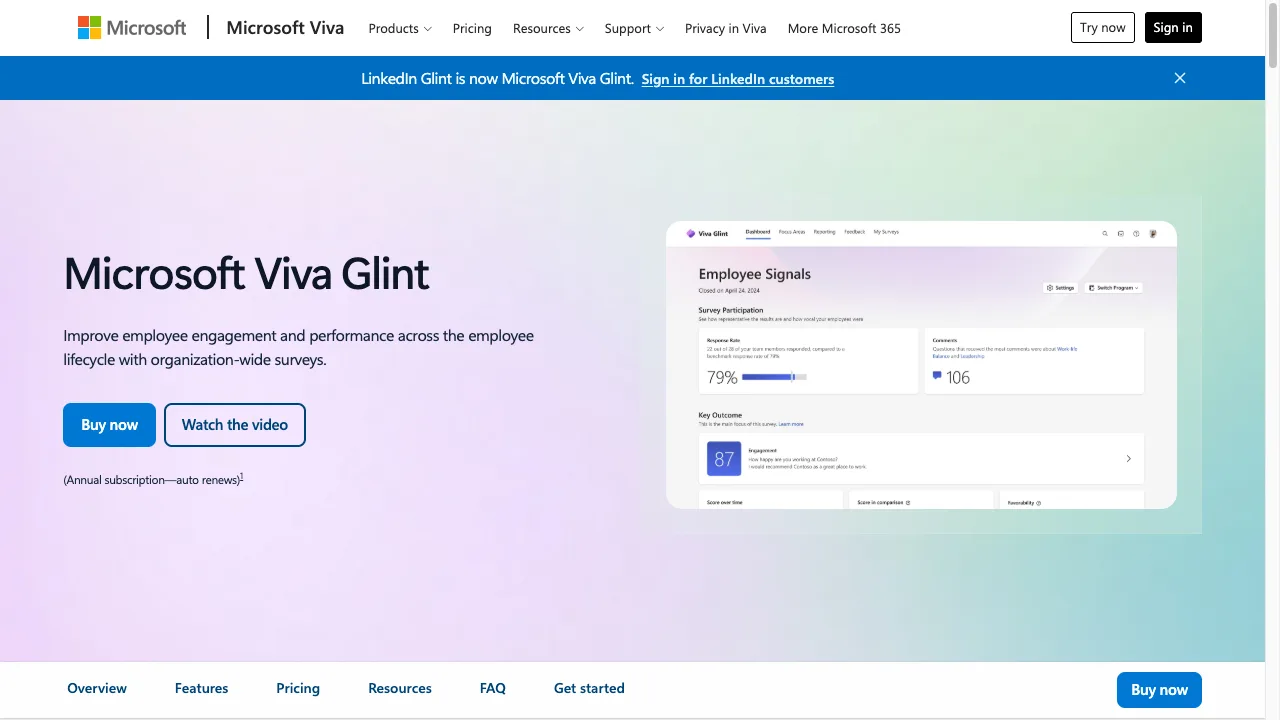
Viva Glint is Microsoft's organization-wide employee listening product, built for surveys around engagement, onboarding, exit, diversity and inclusion, digital transformation, change management and 360-style feedback. Microsoft's own pricing page lists it as a standalone product at $2.00 per user per month, paid yearly, on an annual commitment that auto-renews.
That's worth stating plainly, because it's easy to get wrong: Viva Glint and Viva Pulse are not the same purchase. Viva Pulse, Microsoft's manager-driven quick-feedback tool, has no standalone price on either Microsoft page we read. Its own licensing footnote says "a Viva suite license is required to create or edit Viva Pulse surveys," and that Viva Suite license costs $12/user/month, not $2. A middle tier called "Microsoft Viva Workplace Analytics and Employee Feedback" at $6/user/month adds Viva Insights and Viva Pulse on top of everything Viva Glint includes. Any claim that Viva Pulse comes bundled with the $2/user/month Viva Glint tier isn't accurate as of this reading.
50 seats, and a Microsoft representative, not a checkout page
Two things make Viva Glint an enterprise sale rather than a self-serve purchase. First, Microsoft's own FAQ states plainly: "There is a 50-seat license minimum to use Viva Glint." Second, the path to buy it is "contact your Microsoft representative to add Viva to your existing Microsoft 365 enterprise subscription." Setup follows the same pattern: Microsoft Learn's onboarding guide tells you to coordinate with your Microsoft 365 Global Administrator to set up your tenant, then assign Viva Glint Administrators and grant access through Microsoft Entra ID.
Anjali Rao, HR manager at a 34-person accounting firm, ran into this directly in 2026. The firm already used Microsoft 365 for email and Teams, so Viva Glint looked like the obvious next step for a quarterly engagement survey. She got as far as the pricing page before finding the 50-seat minimum. At 34 employees, she wasn't eligible to buy it at any price, published or otherwise. She widened her search to tools priced for her actual headcount instead.
What Viva Glint does well
Credit where it's due. Viva Glint is a capable enterprise listening platform for the organization it's built for:
- Deep Microsoft ecosystem integration. Copilot in Viva Glint summarizes thousands of comments; access runs through Entra ID and Teams; results connect to Viva Insights workplace-analytics data.
- Broad survey coverage. Engagement, lifecycle (onboarding through exit), diversity and inclusion, change management, digital transformation and 360-style surveys are all listed as supported survey types.
- Wide language support. Over 70 language translations for standard survey content, with English as the default.
- AI-assisted analysis. Automatic alerts for populations at risk of attrition, recommended actions tied to learning content, and comprehensive internal and external benchmarks, per Microsoft's own product page.
- A partner ecosystem for advisory work. Certified Microsoft Partners offer deployment, adoption, and "People Science" services, including question design and executive-level result presentations, as a separate paid engagement.
If your organization already runs on Microsoft 365 with an enterprise listening program, that combination is hard for a smaller vendor to match.
First, decide what you're actually replacing
Before comparing features, sort yourself into one of these groups.
- "We're standardized on Microsoft 365 and already run an enterprise listening program." Viva Glint's ecosystem value, Copilot summarization, Entra ID access, Teams integration, is real. Weigh it before switching.
- "We're not on the Microsoft 365 enterprise stack, or we're under 50 seats." You need a tool with published pricing and no seat floor. Look at FeedbackPulse and 15Five.
- "We want surveys connected to reviews, goals or check-ins." Look at FeedbackPulse Pro, 15Five and Lattice.
- "We're specifically weighing Culture Amp against Glint." That's a common enough search that we've written it up separately: see our Culture Amp alternatives guide for that direct comparison.
- "We need enterprise research-grade listening at massive scale, Microsoft or not." Look at Culture Amp or Qualtrics Employee Experience.
The 6 best Viva Glint alternatives
1. FeedbackPulse
A self-serve engagement platform for teams of roughly 10 to 500 people, built for the buyer who wants a monthly survey without a seat minimum or a sales call first.
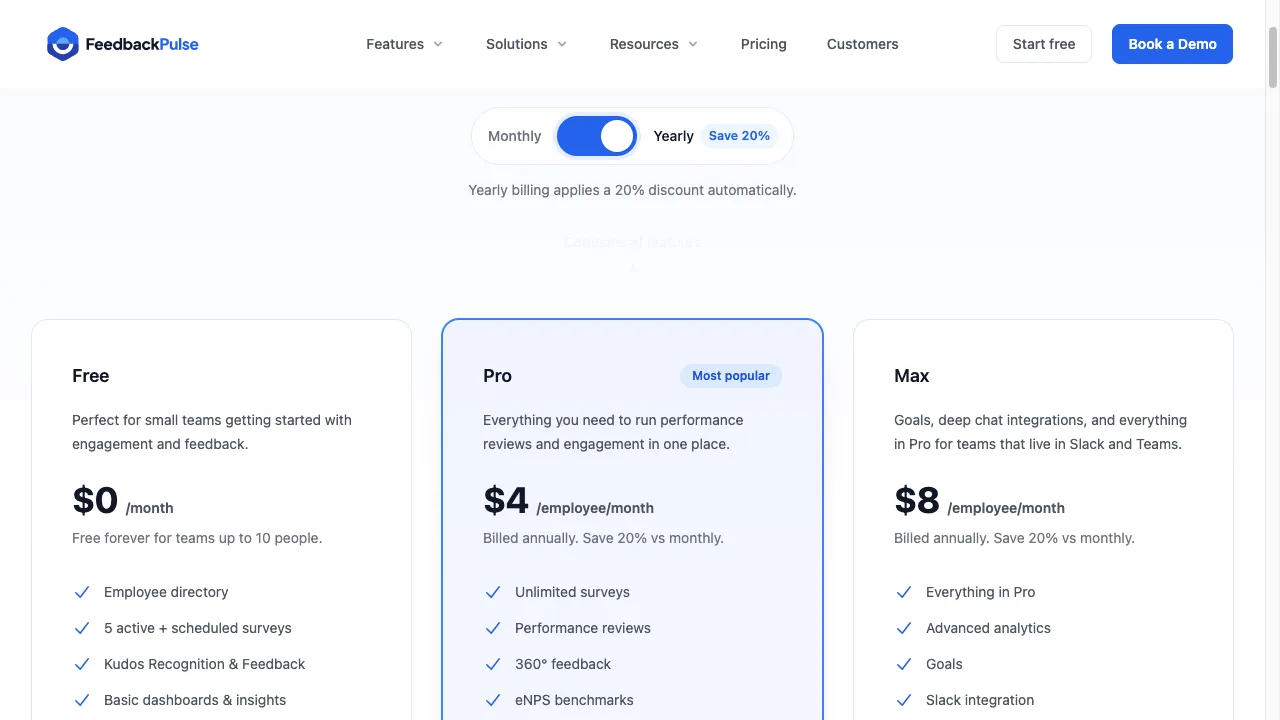
Pricing: Free for teams up to 10 employees. Pro is $4/employee/month billed annually, or $5 billed quarterly. Published, no minimum seat count, no sales call required (see plans).
Best for: Organizations under 50 employees that Viva Glint's own seat minimum excludes, and larger teams that would rather see a price today than wait on a Microsoft representative.
Honest tradeoff: FeedbackPulse doesn't sit inside a Microsoft 365 tenant or connect to Copilot, Teams or Entra ID the way Viva Glint does. If deep Microsoft-ecosystem integration is a requirement, not a nice-to-have, that's a real gap. FeedbackPulse also isn't built for the 70+ language, enterprise-wide rollout Viva Glint targets; it's sized for growing companies, not global 50,000-person deployments.
2. Workleap (formerly Officevibe)
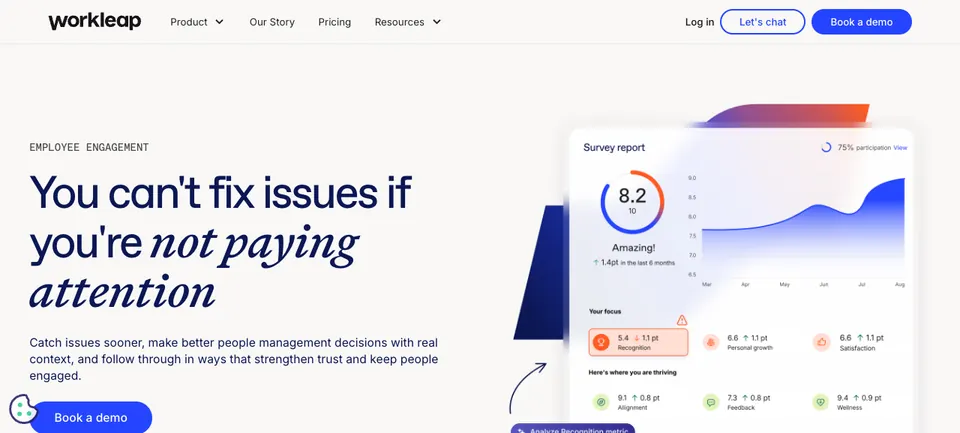
Workleap has grown from the Officevibe pulse tool into a broader platform covering engagement reports, surveys, recognition ("Good Vibes"), 360 performance reviews and goals. If Officevibe is the tool you remember, our Officevibe alternatives guide covers that switch in more depth.
Pricing: Sold as annual platform tiers. Standard starts at $4,999 USD per year, Pro at $11,999, and organizations over 250 employees get custom pricing (Workleap pricing page, September 2026). No per-user, survey-only price is shown.
Best for: Teams under 250 that want engagement, recognition and reviews from one vendor, without a Microsoft-enterprise agreement behind it.
Honest tradeoff: A $4,999 annual floor is a real commitment for a small team that only wants a pulse survey, and it isn't self-serve at every step. Compare it against your actual headcount before assuming it's cheaper than Viva Glint.
3. Culture Amp
The research-heavy option in this category, known for survey science, analytics and benchmark comparisons, and one of the tools people typing "glint alternatives" specifically compare against.
Pricing: Culture Amp doesn't publish pricing. All plans are quote-based and billed annually, with an estimated minimum annual spend around $4,500 and roughly $5 to $9 per employee per month for engagement-led deployments under about 200 seats (third-party estimates, 2026). Culture Amp's own guidance puts a first implementation at 6 to 12 weeks.
Best for: Organizations of 200+ with a people analytics function that will use deep segmentation and driver analysis, whether or not they're on Microsoft 365.
Honest tradeoff: Like Viva Glint, Culture Amp is a sales-led, quote-based purchase, so you're trading one non-self-serve process for another. At small headcounts the minimum spend does most of the work. More detail in our Culture Amp alternatives guide.
4. 15Five
15Five connects engagement data to what managers do next: check-ins, 1:1s, feedback and, on higher plans, performance reviews.
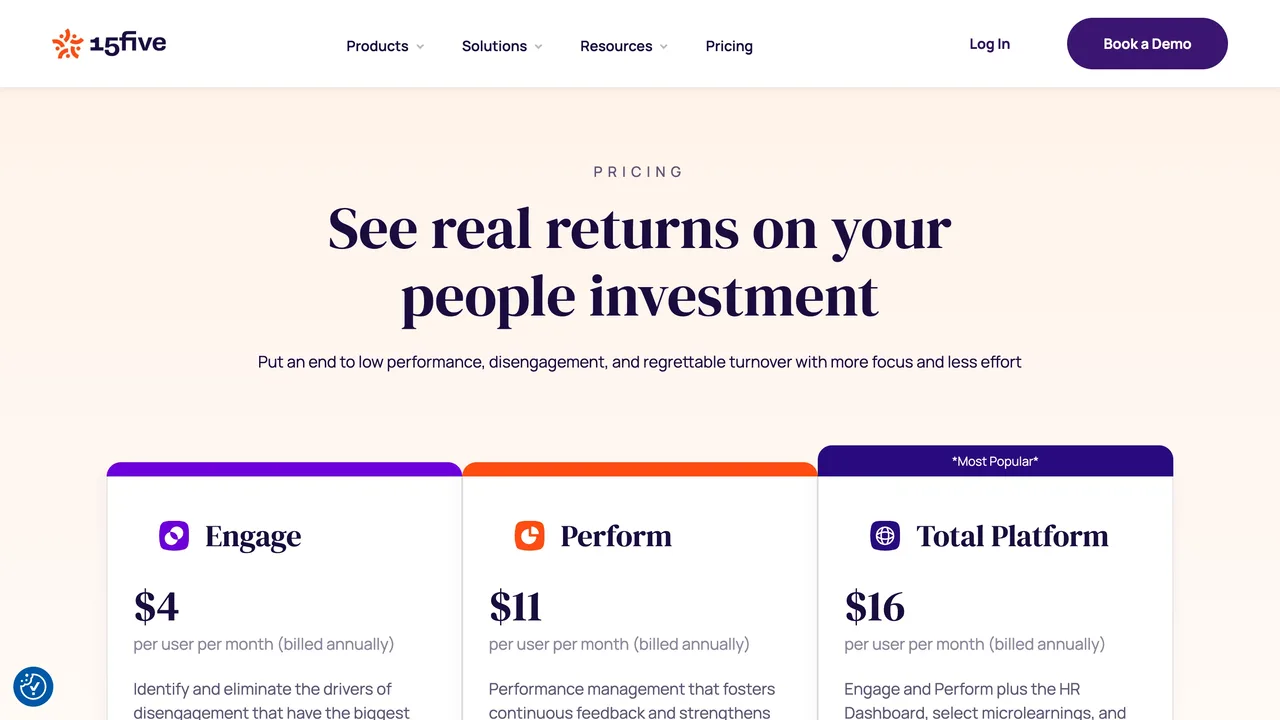
Pricing: Engage is $4/user/month, Perform is $11 and Total Platform is $16, all billed annually (15Five pricing page, September 2026). Engage includes engagement surveys, action planning, heat maps and benchmarking.
Best for: Companies where the survey data isn't the gap, but manager follow-through is.
Honest tradeoff: 15Five is built around a manager rhythm. If your managers won't adopt weekly check-ins, you'll pay for a workflow nobody runs. It also has no Microsoft-ecosystem integration comparable to Viva Glint's.
5. Lattice
A performance management platform where engagement surveys are a separate product you add alongside reviews, goals and 1:1s.
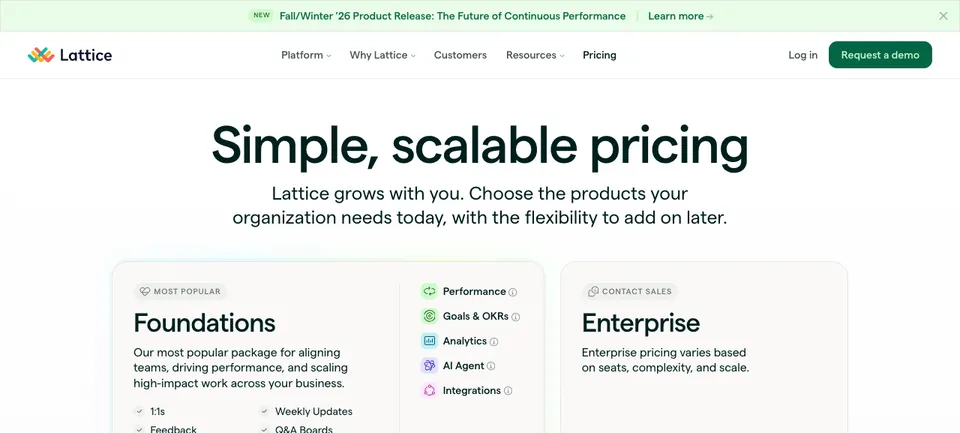
Pricing: Lattice's Foundations package is $13/seat/month. Engagement (pulse, onboarding and exit surveys, eNPS and action planning) is sold as its own product. The minimum annual agreement is $4,000 (Lattice pricing page, September 2026).
Best for: Mid-market teams that are buying performance management anyway and want surveys in the same system.
Honest tradeoff: If surveys are the only thing you need, Lattice asks you to buy into a performance platform to get them, similar to how Viva Glint asks Microsoft-adjacent buyers to sit inside the Viva ecosystem.
6. Qualtrics Employee Experience
Research-grade survey design and statistical analysis, from the company ChatGPT itself lists alongside Viva Glint for large, configurable employee-listening programs.
Pricing: Quote only. No published list price on Qualtrics' site.
Best for: Large organizations with a people-analytics function that will genuinely use research-grade tooling and complex survey logic, regardless of which productivity suite they run on.
Honest tradeoff: Substantial setup overhead for a team without a dedicated analyst, and, like Viva Glint, no visible self-serve price or checkout.
Also consider: Workday Peakon Employee Voice for organizations committed to Workday as their system of record, and Leapsome, a modular talent suite covering performance reviews, engagement surveys, goals and learning, with no published per-seat price and a $6,000/yr minimum for full Customer Success support (Leapsome pricing page, September 2026).
Not sure which group you're in? Start free with FeedbackPulse and run one survey with your team. You'll know within a cycle whether a self-serve tool covers what you need.
How confidential are Viva Glint surveys compared with the alternatives?
Microsoft documents confidentiality thresholds for Viva Glint, and they're recommendations an administrator can change, not a fixed platform rule. Its FAQ recommends five or more respondents before a manager sees quantitative results, and at least ten before comments are shown, and states plainly that these thresholds "are configurable by the customer." A published, adjustable default is more transparent than most vendors offer, but it means the floor can move.
Here's why that distinction matters in practice. Mateo Rinaldi, an HR operations lead at a 210-person logistics company, spent an afternoon reading Viva Glint's confidentiality FAQ before a planned rollout. The five- and ten-respondent recommendations looked reasonable on paper. What stopped him was the word "configurable." He couldn't tell, from the public documentation, who inside his own company could lower that number, or whether it would happen quietly during a busy quarter. He wanted a number nobody could move, not a number nobody would move.
That's the real comparison point. Viva Glint's own confidentiality FAQ is honest about the thresholds it recommends, and it's honest that they're adjustable. FeedbackPulse takes the other approach: anonymous survey results stay locked until at least three people respond, the same threshold applies to every department and location breakdown, and no admin, anywhere in the account, can switch it off. Neither approach is dishonest. Ask any vendor you're evaluating which one it is before you launch a survey.
When to stay with Viva Glint
There's a real cost to switching, and Viva Glint is the right tool for some organizations. Stay if:
- You're already deep in Microsoft 365, with Teams, Entra ID and Copilot rolled out, and IT wants one fewer vendor to manage access for.
- You're above the 50-seat minimum and the per-user price and enterprise buying process aren't obstacles.
- You run, or plan to run, a broad enterprise listening program spanning engagement, lifecycle, D&I and change-management surveys across a large, global, multilingual workforce.
- You want AI-assisted comment analysis tied to your existing Microsoft data, including workplace analytics from Viva Insights.
- You have (or can budget for) Microsoft Partner advisory support for survey design and executive reporting.
If most of those describe your organization, check every alternative against them before you switch. That includes us.
How to switch from Viva Glint
If you've decided a self-serve tool fits your headcount better, a clean switch takes a few weeks, not a quarter.
- Export your survey history first. Pull results, benchmarks and trend data for every survey cycle you want to keep as a reference point.
- Map your existing survey categories to the new tool's question library. Keep your core engagement or eNPS question wording as close as possible so the trend line stays comparable.
- Re-baseline, don't compare blindly. A different question set, order and cadence will shift scores on their own. Treat your first cycle in the new tool as a new baseline, not a verdict on your culture.
- Tell employees plainly why the survey looks different, and restate the confidentiality rule in plain words, including exactly when results become visible.
- Act on the first results within a week. Publish one or two visible changes. Our guide to acting on pulse survey results covers the first 30 days.
Zainab Qureshi, people operations director at a 68-person software company, went through this in 2026 after her company's Microsoft 365 enterprise agreement was restructured following a parent-company divestiture, and Viva Glint access wasn't part of the new contract. She had six survey cycles of history to preserve and three weeks before the next scheduled pulse. She exported the trend data, mapped her old questions to a new question set, and told the team directly that the survey tool was changing because of the corporate restructuring, not because of anything they'd said. The first score in the new tool came in close to her last Viva Glint reading, and participation held steady because she'd explained the "why" before the survey went out.
One more reason follow-through matters: Gallup's State of the Global Workplace report found global engagement fell to 20% in 2025, with manager engagement dropping from 27% to 22% in a single year. A new survey tool alone won't fix that. Managers who see results quickly and act on one thing do.
Choosing your Viva Glint alternative
Start with what you're actually replacing, not with a feature list:
- Under 50 seats, or want a price today? FeedbackPulse or 15Five, both self-serve with published pricing.
- Surveys plus performance management? FeedbackPulse Pro, 15Five or Lattice.
- Specifically comparing against Culture Amp? Read our Culture Amp alternatives guide.
- Enterprise research-grade listening at scale, Microsoft or not? Culture Amp or Qualtrics Employee Experience.
- Deep in Microsoft 365 and want it to stay that way? Stay with Viva Glint.
Whatever you choose, ask every vendor two questions: what does it cost for our exact headcount, in writing, with no seat minimum surprises, and what's the number, not the adjective, before a result becomes visible. For a wider category view, see our roundup of the best pulse survey tools, or read how we evaluate the tools we compare. Microsoft's own walkthrough of Viva Glint's Copilot-assisted analysis is worth watching before you compare anything against it:
Ready to run your first survey this week? FeedbackPulse is free for teams up to 10, with published pricing after that, no seat minimum, and no demo required.
Frequently asked questions
What is the best alternative to Viva Glint?
It depends on whether you need the Microsoft ecosystem around it. If you want a self-serve survey tool with published pricing and no seat minimum, FeedbackPulse is the closest fit. If you want surveys tied to manager check-ins, look at 15Five. If you want research-grade analytics at large scale, look at Culture Amp or Qualtrics Employee Experience. If your organization is standardized on Microsoft 365 and already runs an enterprise listening program, Viva Glint may still be the right tool.
How much does Viva Glint cost per user per month?
Microsoft Viva Glint is priced at $2.00 per user per month, billed yearly on an annual commitment that auto-renews (Microsoft Viva Glint pricing page, September 2026). There is a 50-seat license minimum to purchase it, and Microsoft does not offer self-serve checkout. You contact a Microsoft representative to add it to an existing Microsoft 365 enterprise subscription.
Is Viva Pulse included with Viva Glint?
No. Viva Glint and Viva Pulse are separate products sold at different tiers. Viva Glint alone is $2/user/month. To create or edit Viva Pulse surveys, Microsoft requires a full Viva Suite license at $12/user/month, which also adds Viva Connections, Viva Engage, Viva Amplify and Viva Learning. Viva Pulse has no standalone price and is not bundled with the $2/user/month Viva Glint tier (Microsoft Viva pricing page, licensing footnotes, September 2026).
Are Viva Glint survey responses confidential?
Microsoft documents confidentiality as a recommendation, not a fixed rule. Its FAQ recommends five or more respondents before a manager sees quantitative results, and at least ten respondents before comments are shown, and it states these thresholds are configurable by the customer. That means an administrator can change them. FeedbackPulse uses a fixed rule instead: results stay locked until at least three people respond, on every breakdown, and no admin can override it.
Can a small company buy Viva Glint?
Only above a certain size. Microsoft requires a 50-seat license minimum to purchase Viva Glint, and buying it means contacting a Microsoft representative rather than checking out online. A company under 50 employees, or one that wants a published price without a sales conversation, will need to look at a different tool such as FeedbackPulse, which has a free plan for up to 10 people and self-serve signup at any size.
Which Viva Glint alternative has a free plan?
Of the tools compared here, FeedbackPulse has a free plan covering up to 10 people and 5 active or scheduled surveys, with no credit card and no seat minimum. Workleap, Culture Amp, 15Five, Lattice and Qualtrics Employee Experience are all paid, and several carry their own minimum spend or seat requirements.