




A one-on-one meeting template is a one-page agenda a manager and one direct report use every time they meet. The simplest version has four blocks: a short check-in, the employee's topics, the manager's topics, and actions with owners and dates. Below are four copy-and-paste versions: a weekly 1:1, a first meeting with a new report, a shared notes log, and a monthly career conversation.
Templates only help if you use them the same way each time. This page gives you the blocks to copy and then shows how to run them, so the document stays a working tool and does not turn into a form nobody reads. If you want the reasoning behind the format first, start with our guide to one-on-one meetings.
Key takeaways
- A 1:1 template needs four parts: check-in, their topics, your topics, and actions with owners and dates.
- Keep one shared document per direct report, newest meeting at the top, and let the employee write most of the agenda.
- Use different templates for different meetings: weekly check-in, first 1:1, notes log, and a longer monthly career conversation.
- Copy the template block fresh for each meeting. Never overwrite last time's notes.
- The template is a prompt, not a script. If the conversation needs to go somewhere else, let it.
Free download · Printable PDF
One-on-One Meeting Templates
All four templates below, one per page: weekly agenda, first 1:1, notes log, and monthly career conversation. Print them and fill in by hand.
Download the templatesUS Letter · Download A4 version
Keep completed copies, and any employee information in them, within your approved HR storage.
Template 1: Weekly one-on-one meeting agenda template
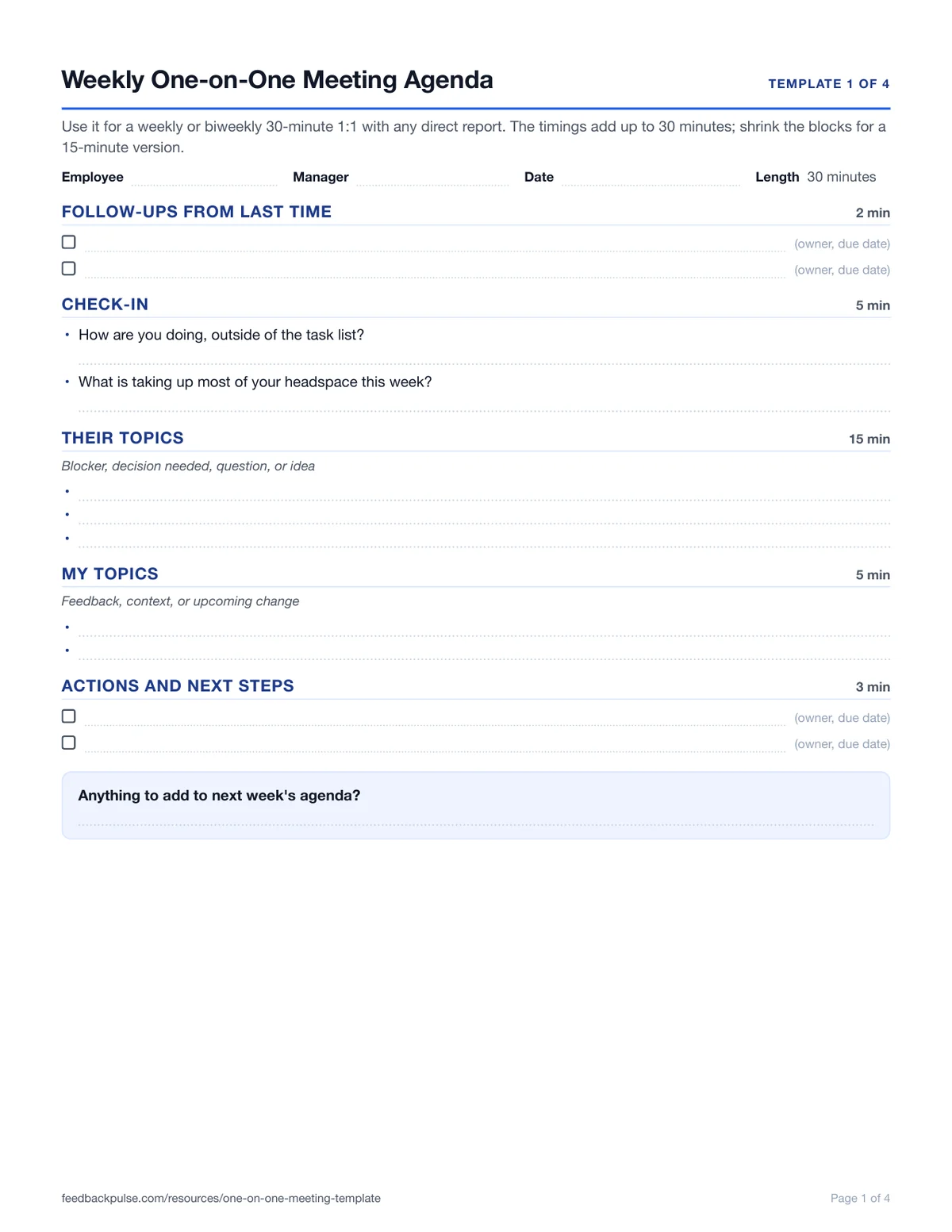
This is the default. Use it for a weekly or biweekly 30-minute 1:1 with any direct report. It also works as a weekly check in template for a team lead who wants one repeatable format across the whole team. The timings add up to 30 minutes; shrink the blocks for a 15-minute version.
ONE-ON-ONE: [Employee name] and [Manager name]
Date: [date]          Length: 30 minutes

FOLLOW-UPS FROM LAST TIME (2 min)
- [ ] [Action] (owner, due date)
- [ ] [Action] (owner, due date)

CHECK-IN (5 min)
- How are you doing, outside of the task list?
- What is taking up most of your headspace this week?

THEIR TOPICS (15 min)
- [Blocker, decision needed, question, or idea]
- [Topic]
- [Topic]

MY TOPICS (5 min)
- [Feedback, context, or upcoming change]
- [Topic]

ACTIONS AND NEXT STEPS (3 min)
- [ ] [Action] (owner, due date)
- [ ] [Action] (owner, due date)

Anything to add to next week's agenda?
How to use it. Share the document with the employee on day one and ask them to add topics at any point in the week. Add yours below theirs, not above. Open the meeting by reading back the follow-ups, including the ones you owe. If their block is empty, don't fill the time with project status. Ask one of the check-in questions and see where it goes.
Template 2: First one-on-one meeting with a new employee template
The first 1:1 sets the pattern for all the others. Use this template for a new hire or for someone who has just joined your team. It trades the weekly agenda for questions that help you learn how this person works, then explains how your 1:1s will run. Allow 45 to 60 minutes.
FIRST ONE-ON-ONE: [Employee name] and [Manager name]
Date: [date]          Length: 45 to 60 minutes

HOW I WORK (manager, 10 min)
- How often we will meet, and that the agenda is mostly yours
- Where this shared document lives and how to add topics
- How I give feedback, and how I would like to receive it
- That I will move a 1:1 rather than cancel it

HOW YOU WORK (employee, 20 min)
- How do you like to receive feedback: in the moment, in our 1:1s, or in writing?
- What did the best manager you have had do that I should keep in mind?
- What did a manager do that made your work harder?
- How will I know when you are overloaded or stuck?
- What do you most want to learn or get better at this year?
- Is there anything about how you work that I should know?

FIRST 30 DAYS (together, 15 min)
- What does a good first month look like to you?
- What is unclear about the role or the team right now?
- Who should you meet, and what should you read?

ACTIONS (5 min)
- [ ] [Action] (owner, due date)
- [ ] [Action] (owner, due date)

Next 1:1: [date and time, fixed slot]
How to use it. Send the question block to the employee a day ahead if they would like time to think. Write down what they tell you about feedback and workload, and check it against your habits at the next meeting. A first meeting that ends with a fixed recurring slot already in both calendars is worth more than a perfect set of questions.
Template 3: One-on-one meeting notes template
Notes only work if they are short and live in one place. This is a running log you keep below the agenda in the same shared document. Copy a fresh entry each meeting and put it at the top, so the newest conversation is always the first thing you see.
NOTES LOG: [Employee name]

[Date]
Mood or energy (their words): [one line]
Main topic: [what we spent most of the time on]
Decisions made:
- [Decision]
Feedback given (me to them): [one line, using situation, behavior, impact]
Feedback received (them to me): [one line]
Actions:
- [ ] [Action] (owner, due date)
Raise next time: [anything to carry forward]

[Previous date]
...
How to use it. Write the notes together in the last five minutes, so there is nothing to disagree about later. Record decisions and actions, not a transcript. Keep anything personal or sensitive out of the log unless the employee asks you to include it, and store it somewhere only the two of you can open. Before a performance review, read the last few entries. Nothing in the review should be a surprise, and the log is how you check that.
Template 4: Monthly career and growth one-on-one template
Weekly 1:1s drift toward the urgent. Once a month, swap the usual agenda for a longer conversation about the person's development. This manager one on one template works for any role. Allow 45 minutes and tell the employee in advance so they can prepare.
CAREER AND GROWTH ONE-ON-ONE: [Employee name] and [Manager name]
Date: [date]          Length: 45 minutes

LOOKING BACK (10 min)
- What work from the last few months are you proudest of?
- What drained you, and what gave you energy?
- What skill have you used most? Which one have you not used enough?

LOOKING AHEAD (15 min)
- Where would you like to be in a year? In three?
- What would you like to learn next?
- Which parts of my job or a colleague's job are you curious about?

SUPPORT (10 min)
- What would help you grow in your current role?
- What is getting in the way?
- What can I do differently as your manager?

COMMITMENTS (10 min)
- One thing they will try before next month: [action]
- One thing I will do to help: [action] (due date)
- One thing we will revisit in the next career 1:1: [topic]
How to use it. Put the career 1:1 in the calendar as a recurring monthly slot. Otherwise it loses to deadlines every time. Don't promise promotions or pay outcomes in this meeting, since those belong to a formal process. Promise only what you control: introductions, stretch work, feedback, and time. Our piece on the role of performance reviews in career development shows how the monthly conversation feeds the formal one.
How to adapt a 1:1 template to your team
No template fits every person. These changes cover most cases.
- Experienced, autonomous reports. Meet every two weeks and cut the check-in to two minutes. Keep the career template monthly or quarterly.
- New to the role or in a hard stretch. Go weekly, add a mood or workload line to the check-in, and keep the notes log very short.
- Large teams. If you have eight or more reports, use the 30-minute weekly template for everyone and rotate the longer career slots across the month so they do not land in the same week.
- Remote and hybrid. Rely more on the shared document. With no hallway conversations, the written topic list is where small issues get raised before they grow.
- UK and international teams. The phrase 121 meeting is common in the UK. The format is the same, so use the templates as they are and rename the document if your team prefers that wording.
If you manage managers, a skip-level meeting is a useful complement. It checks whether the 1:1s underneath you are working, by giving people a line to someone above their manager.
What to put in a 1:1 template, and what to leave out
Every block in these templates earns its place by supporting one of three jobs: catching problems early, giving small and frequent feedback, and protecting time for growth. If a line does not serve one of those, cut it.
Leave out:
- Project status. If the information would be equally useful to the rest of the team, it belongs in a tracker, not in private time.
- Long manager agendas. If your block keeps growing past five minutes, some of it belongs in a team meeting.
- Scoring or ratings. A 1:1 is not a performance review. Turning it into a scorecard makes people guarded.
- Anything you would not want the employee to read. Treat the shared document as shared.
For the feedback block, the SBI feedback model gives you a simple way to name the moment, the behavior, and its impact. For a two-way check in the same meeting, a quick start, stop, continue exercise works in both directions. And if a 1:1 is turning toward a hard message, our guide to difficult performance conversations covers how to prepare.
Where 1:1 templates fit with surveys and reviews
A template shapes one conversation. It does not show you patterns across a team. A short recurring pulse survey can tell you whether a theme one person raised in their 1:1 is common, and the employee feedback loop explains how to bring those themes back into your meetings. For managers who want to see how FeedbackPulse supports this rhythm today, the For Team Leads page is the place to start. 1:1s are coming to FeedbackPulse in Q1 2027, so the meeting can eventually sit in the same place as your team's survey results and reviews.
Use a template this week
You do not need new software to start. Pick the weekly template, copy it into a shared document for each direct report, and send it to them today. Book the first meeting using Template 2 if the person is new. Add a monthly career slot using Template 4. After a month, look at the notes log and ask whether the meetings are producing decisions and follow-through. If they are, keep going. If not, change the questions before you change the format.
Frequently asked questions
What should be in a one-on-one meeting template?
A good template has four parts: a short check-in, the employee's topics, the manager's topics, and a list of actions with owners and dates. Add a place for last meeting's follow-ups at the top and a running notes section underneath. Keep it to one page so both people actually use it.
How do I use a one-on-one meeting template?
Keep one shared document per direct report, newest meeting at the top. Both of you add topics during the week, you run the meeting from it, and you write actions in it before you hang up. Copy the template block again for each new meeting rather than overwriting the last one.
What is a 121 meeting template?
A 121 meeting template is the UK phrasing for a one-on-one or 1:1 meeting template. It is the same thing: a structured agenda for a recurring private conversation between a manager and one direct report. Any of the templates on this page work as a 121 template.
How long should a one-on-one meeting be?
Thirty minutes works for most weekly or biweekly 1:1s. Use 45 to 60 minutes for a monthly career conversation or a first meeting with a new report. If the template regularly runs over, cut your own topics before cutting theirs.
Who should write the agenda for a 1:1?
Mostly the employee. Ask them to add topics to the shared template before each meeting and add yours underneath. If they leave it blank, open with a question from the check-in block instead of filling the time with status updates.
Should I take notes in a one-on-one meeting?
Yes, but keep them short and shared. Write the decisions, the actions and who owns them, not a transcript. For anything sensitive, agree with the employee what gets written down, and store notes where only the two of you can see them.